
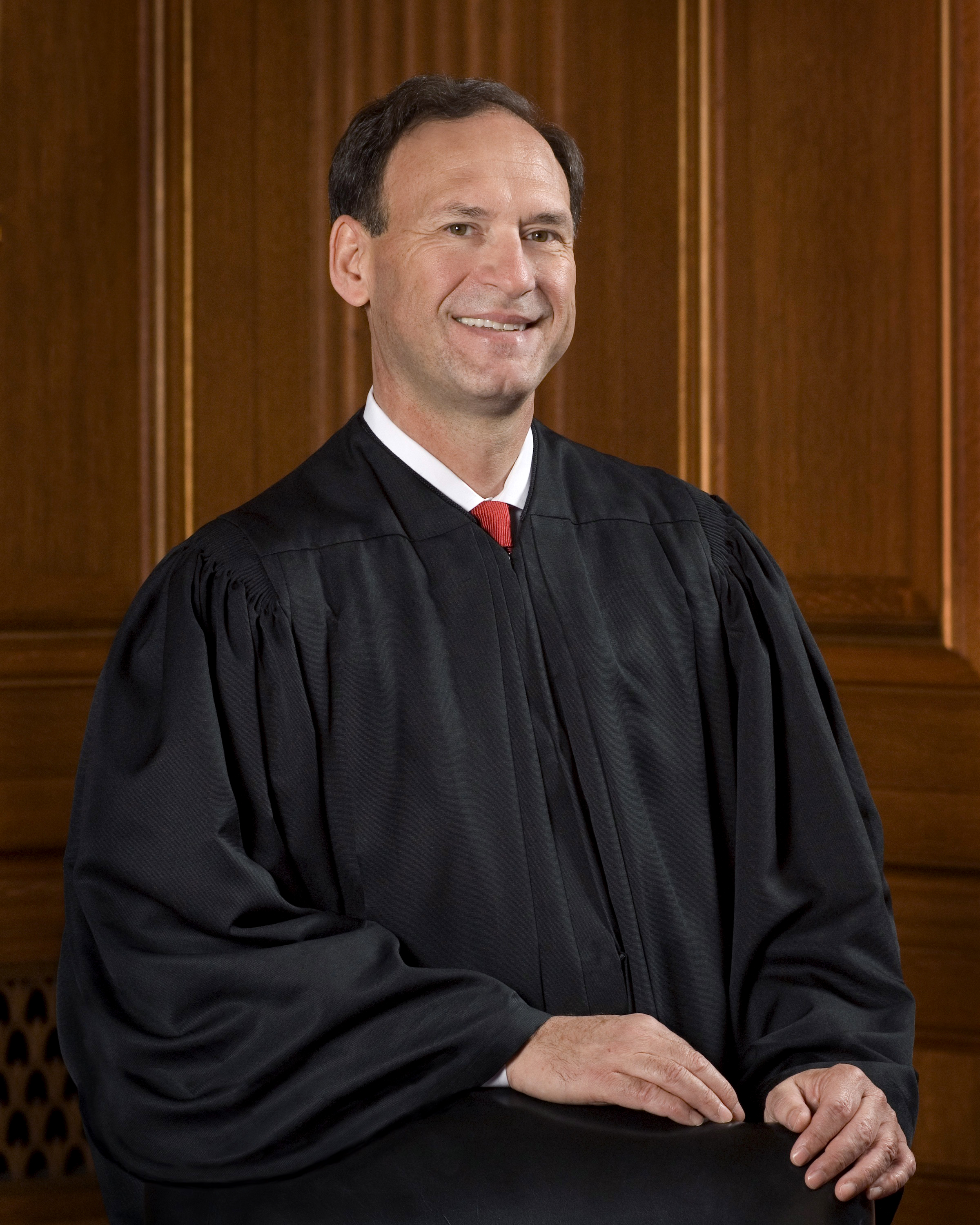
Currently serving · Supreme Court of the United States
Samuel A. Alito Jr.
Currently serving
Associate Justice · Supreme Court of the United States · 2006–present · Appointed by George W Bush
Samuel A. Alito Jr. serves as an Associate Justice of the Supreme Court of the United States (2006–present) was appointed by George W Bush. The page below collects sourced biographical facts, the appointment record, and provenance for Jr..
FJC ID: 1377101
Key facts
- Full name
- Samuel A. Alito Jr.
- Court
- Supreme Court of the United States
- Role
- Associate Justice
- Status
- Currently serving
- Seat
- SCT0911
- Appointed by
- George W Bush
- Appointment
- Senate-confirmed
- Confirmed
- 2006-01-31
- Supreme Court service
- 2006–present
- Took seat
- 2006
- Born
- —
- Died
- —
- Dataset version
- 1.20260711
Appointment & service record
Associate Justice of the Supreme Court of the United States · 2006–present
- Seat
- SCT0911
- Appointing president
- George W Bush
- Appointment
- Senate-confirmed
- Confirmed
- January 31, 2006
Seat, appointing president, appointment type, confirmation date, and service dates are drawn from the Federal Judicial Center Biographical Directory and the Supreme Court's own members roster.[1][2][3]
Sources
- [1]https://www.fjc.gov/node/1377101fjc · retrieved 2026-06-16
- [2]https://www.supremecourt.gov/about/members_text.aspxsupremecourt.gov · retrieved 2026-06-16
- [3]https://www.fjc.gov/history/judges/biographical-directory-article-iii-federal-judges-exportfjc-directory · retrieved 2026-06-16
Biographical narrative
1,035 words · sourced from the Wikipedia REST extract
Samuel Anthony Alito Jr., born April 1, 1950, is an associate justice of the Supreme Court of the United States. Appointed by President George W. Bush in 2005 and sworn in on January 31, 2006, he has served on the nation's highest court since that date. A graduate of Princeton University and Yale Law School, Alito’s career has spanned roles as a federal prosecutor, assistant to the Solicitor General, judge on the United States Court of Appeals for the Third Circuit, and ultimately a Supreme Court justice. He is the second Italian‑American jurist to sit on the Court after Antonin Scalia.
Early life and legal career
Alito was born in Trenton, New Jersey, to parents who emigrated from southern Italy; his father, Samuel A. Alito Sr., had been a Calabrian immigrant whose family settled in Philadelphia before moving to New Jersey, where he earned a master’s degree at Rutgers University and worked as a high‑school teacher and later the first director of the state Office of Legislative Services. His mother, Rose Fradusco, was also an educator. The Alito family lived in Hamilton Township, a suburb of Trenton, where young Samuel attended Steinert High School. In 1968 he graduated as class valedictorian.
He entered Princeton University in 1969 and earned a Bachelor of Arts summa cum laude from the Woodrow Wilson School of Public and International Affairs in 1972. His senior thesis, supervised by political scientist Walter F. Murphy, explored the Italian Constitutional Court. During his undergraduate years he chaired a student conference on privacy boundaries that examined domestic intelligence gathering and advocated for oversight of national security surveillance; the conference also addressed issues such as decriminalization of sodomy and anti‑discrimination in hiring. Alito was active in debate, serving as chair of the American Whig‑Cliosophic Society’s Debate Panel, and he joined Stevenson Hall rather than Princeton’s traditional eating clubs.
In December 1969, while still a sophomore at Princeton, Alito received a low lottery number (32) in the Selective Service drawing and entered the university’s Army ROTC program. He was commissioned as a second lieutenant in the United States Army Reserve upon graduation from law school in 1975. After completing the Signal Officer Basic Course at Fort Gordon, Georgia, he served on active duty from September to December of that year, achieving the rank of first lieutenant and later captain before being honorably discharged from the inactive reserve in 1980.
Alito attended Yale Law School, where he served as an editor of the Yale Law Journal. He earned his Juris Doctor in 1975. Following law school, he clerked for Third Circuit appeals judge Leonard I. Garth in Newark, New Jersey, during 1976–77. In 1977 he became an Assistant United States Attorney for the District of New Jersey, prosecuting cases involving drug trafficking and organized crime until 1981.
From 1981 to 1985 Alito worked as an assistant to U.S. Solicitor General Rex E. Lee, arguing twelve cases before the Supreme Court on behalf of the federal government; only two of those arguments were lost. In 1985 he joined the Office of Legal Counsel as deputy assistant attorney general under Charles J. Cooper, a position he held until 1987.
In 1990 Alito was appointed by President George H. W. Bush to the United States Court of Appeals for the Third Circuit. He served on that court for sixteen years, hearing appeals from federal district courts in Pennsylvania, New Jersey, and Delaware, as well as cases involving maritime law and other specialized matters.
Supreme Court tenure
President George W. Bush nominated Alito to the Supreme Court on October 31, 2005, following the retirement of Justice Sandra Day O'Connor. The nomination was confirmed by the Senate on January 31, 2006, at which time he assumed the seat designated SCT0911. He has been an associate justice from that date onward.
Alito’s tenure on the Court has seen him author majority opinions in several high‑profile cases. In 2010 he wrote the opinion for McDonald v. Chicago, a decision that extended Second Amendment protections to state and local governments through incorporation. In 2014 his opinion in Burwell v. Hobby Lobby established that closely held corporations could refuse coverage of contraceptives on religious grounds under the Religious Freedom Restoration Act. His 2018 majority opinion in Janus v. AFSCME addressed public‑sector union security agreements, holding that mandatory union fees violated First Amendment rights. In 2022 he authored the Court’s opinion in Dobbs v. Jackson Women’s Health Organization, which overturned the constitutional right to abortion established by Roe v. Wade.
Alito has described his interpretive approach as “practical originalism” and is considered a member of the conservative bloc that often aligns on key issues. He continues to serve on the Court, participating in oral arguments, writing opinions, and contributing to the Court’s deliberations on a broad range of legal questions.
Jurisprudence and legacy
Throughout his service, Alito has consistently applied a textualist and originalist framework to constitutional interpretation, emphasizing the historical context of statutes and the Constitution. His opinions often reflect a focus on federalism, individual rights, and the limits of governmental power. In cases involving civil liberties, he has frequently weighed the balance between state interests and personal freedoms, as seen in his rulings on gun ownership, religious liberty, union membership, and reproductive rights.
Alito’s jurisprudence has had a lasting impact on American law. The McDonald decision reinforced the applicability of Second Amendment protections to state actions, reshaping firearm regulation across the country. Burwell v. Hobby Lobby expanded the scope of religious freedom claims in corporate contexts, influencing subsequent litigation involving faith‑based organizations. Janus v. AFSCME altered the landscape of public‑sector labor relations by redefining the legal status of union security agreements. The Dobbs ruling dramatically shifted abortion policy, prompting widespread legislative responses at both state and federal levels.
Beyond his written opinions, Alito’s presence on the Court has contributed to a broader dialogue about constitutional interpretation, judicial restraint, and the role of precedent. His career trajectory—from federal prosecutor to appellate judge to Supreme Court justice—illustrates a path marked by extensive experience in both advocacy and adjudication. As an associate justice, he continues to shape the legal landscape through his participation in the Court’s deliberations and his contributions to its body of jurisprudence.
Sources & provenance
Every quantitative or attributable claim above carries a per-section [N] marker that resolves to the corresponding URL below. Each entry records the upstream provider, the canonical URL, and the timestamp at which the underlying source was retrieved.
Key facts
- https://www.fjc.gov/node/1377101fjc · retrieved 2026-06-16
- https://www.supremecourt.gov/about/members_text.aspxsupremecourt.gov · retrieved 2026-06-16
- https://www.fjc.gov/history/judges/biographical-directory-article-iii-federal-judges-exportfjc-directory · retrieved 2026-06-16
Biographical narrative
- https://en.wikipedia.org/wiki/Samuel_AlitoWikipedia · retrieved 2026-06-16
Explore the federal judiciary
Fewer than 120 people have served on the Supreme Court of the United States in its history. Browse the full roster of current and former justices, or explore how the appointed federal judiciary fits into the federal government.