
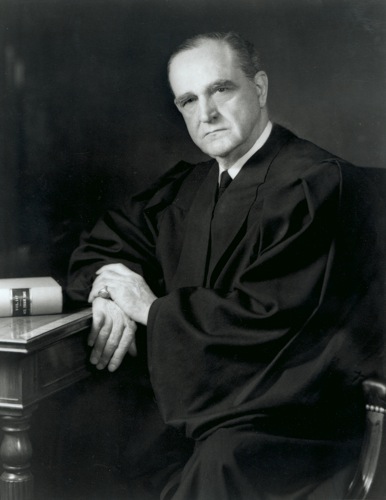
Historical · Supreme Court of the United States
Sherman Minton
Former justice
Former Associate Justice · Supreme Court of the United States · 1949–1956 · Appointed by Harry S Truman
Sherman Minton served as an Associate Justice of the Supreme Court of the United States (1949–1956) was appointed by Harry S Truman. The page below collects sourced biographical facts, the appointment record, and provenance for Minton.
FJC ID: 1385206
Key facts
- Full name
- Sherman Minton
- Court
- Supreme Court of the United States
- Role
- Associate Justice
- Status
- Former justice
- Seat
- SCT0414
- Appointed by
- Harry S Truman
- Appointment
- Senate-confirmed
- Confirmed
- 1949-10-04
- Supreme Court service
- 1949–1956
- Took seat
- 1949
- Born
- 1890
- Died
- 1965
- Dataset version
- 1.20260711
Appointment & service record
Associate Justice of the Supreme Court of the United States · 1949–1956
- Seat
- SCT0414
- Appointing president
- Harry S Truman
- Appointment
- Senate-confirmed
- Confirmed
- October 4, 1949
Seat, appointing president, appointment type, confirmation date, and service dates are drawn from the Federal Judicial Center Biographical Directory and the Supreme Court's own members roster.[1][2][3]
Sources
- [1]https://www.fjc.gov/node/1385206fjc · retrieved 2026-06-17
- [2]https://www.supremecourt.gov/about/members_text.aspxsupremecourt.gov · retrieved 2026-06-17
- [3]https://www.fjc.gov/history/judges/biographical-directory-article-iii-federal-judges-exportfjc-directory · retrieved 2026-06-17
Biographical narrative
855 words · sourced from the Wikipedia REST extract
Sherman Minton was an American jurist who served as the United States Senate’s representative from Indiana and later as an associate justice of the Supreme Court. Born in 1890, he pursued a legal career that led him to the federal bench, where he held office from 1949 until his retirement in 1956. His tenure on the highest court was marked by a philosophy of judicial restraint and deference to the political branches, reflecting his earlier experience as a legislator during the New Deal era.
Early life and legal career
Minton entered the world on October 20, 1890, in Georgetown, Indiana, the third child of John Evan Minton and Emma Livers Minton. His upbringing was shaped by economic hardship; after his father suffered heat stroke while working as a railroad laborer, he took on various jobs—including farming, butchery, and grocery sales—to support the family. The death of his mother in 1900 during an operation for breast cancer left a lasting impression on Minton, prompting him to question organized religion.
He received his early education in a two‑room schoolhouse until eighth grade before attending high school at Edwardsville and later New Albany, where he participated in athletics and helped found the debate club. After completing secondary schooling, Minton pursued higher education and earned a law degree, though specific institutions are not detailed in the available records.
During World War I, Minton served as a captain in the United States Army. Following his military service, he established a legal practice and became active in Indiana politics. In 1930, under Governor Paul V. McNutt’s administration, he was appointed utility commissioner, a role that brought him into public service at the state level.
Minton’s political ambitions culminated in his election to the United States Senate in 1934, representing Indiana. As a senator, he became known for defending New Deal legislation and delivering speeches that emphasized the necessity of federal action during economic hardship. One of his notable addresses, often referred to as the “You Cannot Eat the Constitution” speech, critiqued attempts to limit government intervention. He also supported President Franklin D. Roosevelt’s court‑packing proposal, aligning himself with the New Deal coalition.
After an unsuccessful bid for reelection in 1940, Minton transitioned to the judiciary. President Roosevelt appointed him as a judge on the United States Court of Appeals for the Seventh Circuit. In this capacity he presided over appellate cases until his nomination to the Supreme Court by President Harry S. Truman, who had cultivated a close friendship with Minton during their time in the Senate.
Supreme Court tenure
Minton’s nomination to the Supreme Court was confirmed on October 4, 1949, following a Senate vote of 48 in favor and 16 against; among those opposed were fifteen Republicans and one Democrat. He occupied seat SCT0414 as an associate justice until his retirement in 1956, when health concerns prompted him to leave the bench.
During his seven years on the Court, Minton was recognized for his commitment to judicial restraint. In the early part of his tenure, he frequently concurred with majority opinions and supported decisions that upheld federal legislation. However, as the Court’s composition shifted following President Dwight D. Eisenhower’s appointments, Minton became a more frequent dissenter, reflecting his evolving stance on the balance between judicial authority and legislative intent.
Minton was often described by colleagues as a peacemaker and consensus builder during a period of intense ideological division within the Court. His approach favored order over individual liberties when he believed that broad governmental powers were necessary to achieve policy objectives set by elected representatives.
After stepping down, Minton continued to contribute to public life through travel and lecturing engagements until his death on April 9, 1965. He remains the most recent former member of Congress to be appointed to the Supreme Court.
Jurisprudence and legacy
Minton’s judicial philosophy was rooted in a belief that the Supreme Court should defer to the political branches when interpreting federal legislation. Historians note that his perspective emerged from his experience as a New Deal senator confronting a conservative Court that had struck down many of the era’s reforms. He argued for a broad interpretation of congressional powers and opposed rulings that would invalidate federal statutes on the grounds that such actions represented an overreach by the judiciary.
This philosophy manifested in decisions that favored the intent of lawmakers, often at the expense of limiting governmental reach. While some scholars view his record as conservative due to this deference, others commend his steadfast adherence to principles of judicial restraint and his role in fostering collegiality among justices during a contentious era.
Minton’s legacy extends beyond his opinions. In recognition of his service, several landmarks bear his name: the Sherman Minton Bridge in southern Indiana and the Minton–Capehart Federal Building in Indianapolis were both dedicated to him in 1962. These honors reflect his impact on both state and national institutions.
Overall, Sherman Minton’s career illustrates a trajectory from legislative advocacy during the New Deal to judicial restraint at the nation’s highest court. His tenure exemplifies the complex interplay between political experience and judicial philosophy, leaving an enduring imprint on American jurisprudence.
Sources & provenance
Every quantitative or attributable claim above carries a per-section [N] marker that resolves to the corresponding URL below. Each entry records the upstream provider, the canonical URL, and the timestamp at which the underlying source was retrieved.
Key facts
- https://www.fjc.gov/node/1385206fjc · retrieved 2026-06-17
- https://www.supremecourt.gov/about/members_text.aspxsupremecourt.gov · retrieved 2026-06-17
- https://www.fjc.gov/history/judges/biographical-directory-article-iii-federal-judges-exportfjc-directory · retrieved 2026-06-17
Biographical narrative
- https://en.wikipedia.org/wiki/Sherman_MintonWikipedia · retrieved 2026-06-17
Explore the federal judiciary
Fewer than 120 people have served on the Supreme Court of the United States in its history. Browse the full roster of current and former justices, or explore how the appointed federal judiciary fits into the federal government.