
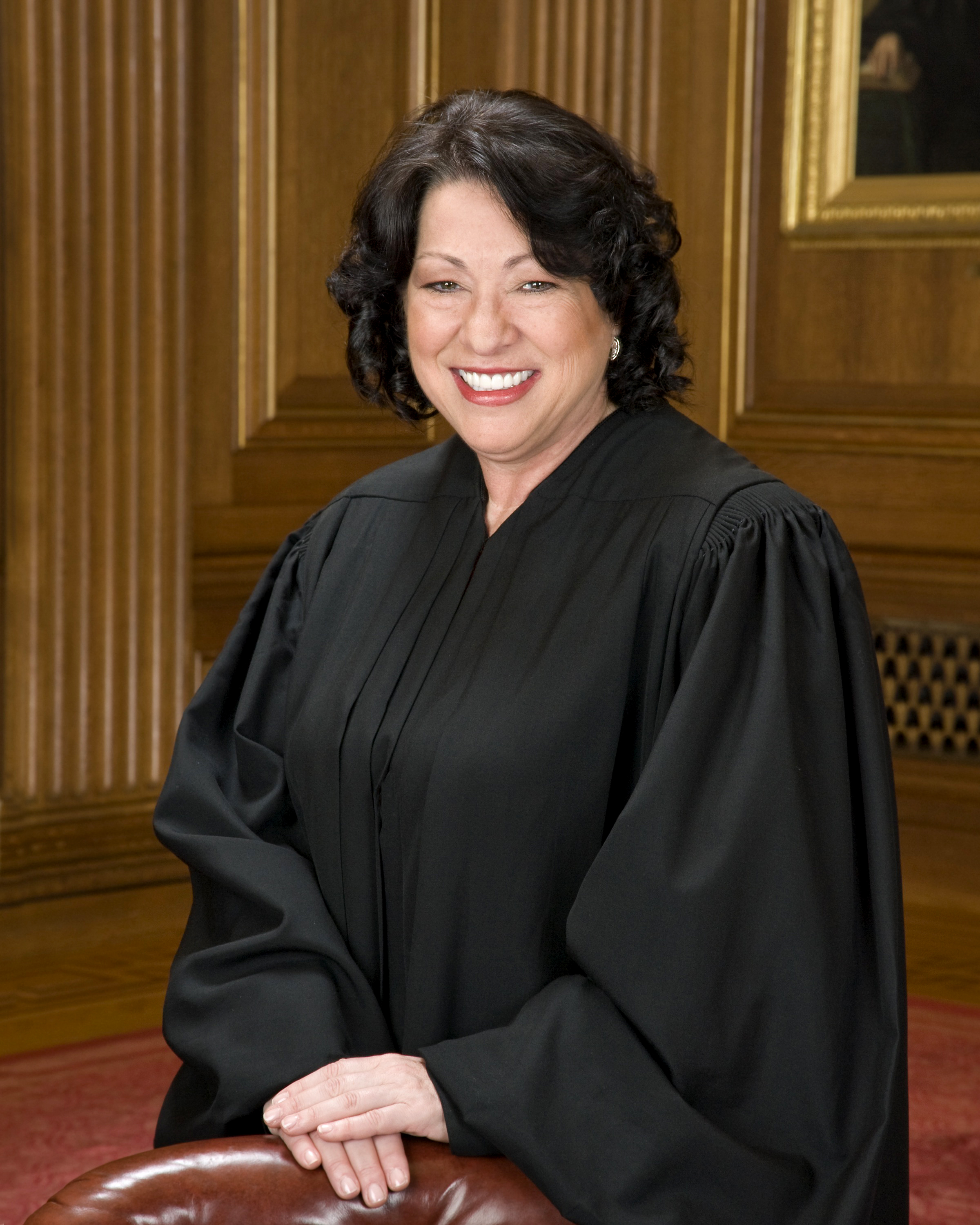
Currently serving · Supreme Court of the United States
Sonia Sotomayor
Currently serving
Associate Justice · Supreme Court of the United States · 2009–present · Appointed by Barack Obama
Sonia Sotomayor serves as an Associate Justice of the Supreme Court of the United States (2009–present) was appointed by Barack Obama. The page below collects sourced biographical facts, the appointment record, and provenance for Sotomayor.
FJC ID: 1388091
Key facts
- Full name
- Sonia Sotomayor
- Court
- Supreme Court of the United States
- Role
- Associate Justice
- Status
- Currently serving
- Seat
- SCT0417
- Appointed by
- Barack Obama
- Appointment
- Senate-confirmed
- Confirmed
- 2009-08-06
- Supreme Court service
- 2009–present
- Took seat
- 2009
- Born
- —
- Died
- —
- Dataset version
- 1.20260711
Appointment & service record
Associate Justice of the Supreme Court of the United States · 2009–present
- Seat
- SCT0417
- Appointing president
- Barack Obama
- Appointment
- Senate-confirmed
- Confirmed
- August 6, 2009
Seat, appointing president, appointment type, confirmation date, and service dates are drawn from the Federal Judicial Center Biographical Directory and the Supreme Court's own members roster.[1][2][3]
Sources
- [1]https://www.fjc.gov/node/1388091fjc · retrieved 2026-06-16
- [2]https://www.supremecourt.gov/about/members_text.aspxsupremecourt.gov · retrieved 2026-06-16
- [3]https://www.fjc.gov/history/judges/biographical-directory-article-iii-federal-judges-exportfjc-directory · retrieved 2026-06-16
Biographical narrative
960 words · sourced from the Wikipedia REST extract
Sonia Maria Sotomayor, born June 25 1954, serves as an associate justice of the Supreme Court of the United States. She was nominated by President Barack Obama on May 26 2009 and has occupied her seat since August 8 2009. As the first Hispanic member of the Court and the third woman to serve in that capacity, Sotomayor’s appointment marked a significant milestone for diversity within the federal judiciary.
Early life and legal career
Sotomayor entered the world on June 25 1954 in the Bronx borough of New York City. Her parents were Puerto Rican immigrants: her father, Juan Sotomayor (c. 1921–1964), hailed from Santurce in San Juan, while her mother, Celina Báez (1927–2021), was an orphan from Santa Rosa in Lajas on the island’s southwest coast. The couple met and married during World War II after Celina served in the Women’s Army Corps; Juan worked as a tool‑and‑die worker and did not speak English, whereas Celina began her career as a telephone operator before becoming a practical nurse.
The family lived first in a South Bronx tenement and later moved in 1957 to the Bronxdale Houses housing project in Soundview. The community was racially and ethnically mixed, and the houses would be renamed in Sotomayor’s honor in 2010. Growing up in this environment, she identified as a “Nuyorican” and maintained a lifelong affection for the New York Yankees, whose stadium lay nearby.
Sotomayor’s early years were shaped by both adversity and determination. She was diagnosed with type 1 diabetes at age seven, requiring daily insulin injections. Her father died of heart disease when she was nine, after which her mother became the primary caregiver. Despite these challenges, Celina emphasized education; she purchased an Encyclopædia Britannica for her children—a gesture that underscored the value placed on learning within the household.
Her academic achievements were evident from a young age. At Blessed Sacrament School in Soundview, Sotomayor graduated as valedictorian and maintained near‑perfect attendance. She worked part‑time at a local retail store and hospital while still underage. The influence of detective fiction—first Nancy Drew, later Perry Mason—fueled her aspiration to pursue law.
Sotomayor attended Cardinal Spellman High School in the Bronx, where she joined the forensics team and was elected to student government. She graduated as valedictorian in 1972. During this period, rising crime and gang activity prompted the family’s relocation to Co‑op City in Northeast Bronx.
She earned her undergraduate degree from Princeton University in 1976, graduating with high honors. Her admission had been facilitated by both her academic record and affirmative action policies that addressed standardized test disparities. She then attended Yale Law School, where she graduated in 1979 as a member of the Yale Law Journal editorial board.
Following law school, Sotomayor served as an assistant district attorney in New York for four and a half years before transitioning to private practice in 1984. Her legal career was complemented by service on several boards: the Puerto Rican Legal Defense and Education Fund, the State of New York Mortgage Agency, and the New York City Campaign Finance Board.
Her judicial appointments began with a nomination by President George H.W. Bush to the U.S. District Court for the Southern District of New York in 1991; she was confirmed in 1992. In 1997, President Bill Clinton nominated her to the U.S. Court of Appeals for the Second Circuit. The Senate’s Republican majority delayed confirmation due to concerns about a potential Supreme Court elevation, but she ultimately received approval in 1998. On the Second Circuit, Sotomayor heard appeals in more than 3,000 cases and authored approximately 380 opinions. She also contributed to legal education as an adjunct professor at New York University School of Law and Columbia Law School.
Supreme Court tenure
Sotomayor’s nomination to the Supreme Court followed Justice David Souter’s retirement. President Barack Obama announced her candidacy on May 26 2009, and she was confirmed by a Senate vote of 68–31 on August 6 2009. She assumed office on August 8 2009, occupying seat SCT0417.
During her tenure, Sotomayor has aligned with the informal liberal bloc of justices when the Court’s decisions have reflected commonly perceived ideological divisions. Her jurisprudence frequently emphasizes protections for criminal defendants and broader criminal justice reform. Notable majority opinions in this domain include *J.D.B. v. North Carolina* and *Glossip v. Oklahoma*. In addition, she has delivered dissents that address issues of race and ethnic identity, such as *Schuette v. BAMN*, *Utah v. Strieff*, and *Trump v. Hawaii*. These dissents are characterized by a passionate articulation of her perspectives on civil rights and equal protection.
Sotomayor’s presence on the Court has also been significant symbolically, representing both Hispanic heritage and female participation at the highest judicial level. Her appointment expanded the demographic breadth of the Supreme Court and provided a role model for aspiring jurists from underrepresented communities.
Jurisprudence and legacy
Justice Sotomayor’s legal philosophy centers on safeguarding individual rights within the criminal justice system and ensuring that the law remains responsive to societal changes. Her majority opinions in *J.D.B.* and *Glossip* illustrate her commitment to protecting defendants’ constitutional safeguards, particularly regarding due process and the right to a fair trial.
Her dissents on matters of race and ethnicity demonstrate a willingness to confront complex social issues head‑on. In *Schuette*, she argued for robust protections against discriminatory practices; in *Utah*, she emphasized the importance of procedural fairness in law enforcement encounters; and in *Trump*, she underscored concerns about national security measures infringing upon civil liberties.
Beyond her judicial work, Sotomayor has contributed to legal scholarship through teaching positions at NYU Law School and Columbia Law School. Her academic involvement reflects a dedication to mentoring the next generation of lawyers and judges.
Sotomayor’s legacy is multifaceted: she stands as a pioneering figure for Hispanic
Sources & provenance
Every quantitative or attributable claim above carries a per-section [N] marker that resolves to the corresponding URL below. Each entry records the upstream provider, the canonical URL, and the timestamp at which the underlying source was retrieved.
Key facts
- https://www.fjc.gov/node/1388091fjc · retrieved 2026-06-16
- https://www.supremecourt.gov/about/members_text.aspxsupremecourt.gov · retrieved 2026-06-16
- https://www.fjc.gov/history/judges/biographical-directory-article-iii-federal-judges-exportfjc-directory · retrieved 2026-06-16
Biographical narrative
- https://en.wikipedia.org/wiki/Sonia_SotomayorWikipedia · retrieved 2026-06-16
Explore the federal judiciary
Fewer than 120 people have served on the Supreme Court of the United States in its history. Browse the full roster of current and former justices, or explore how the appointed federal judiciary fits into the federal government.