
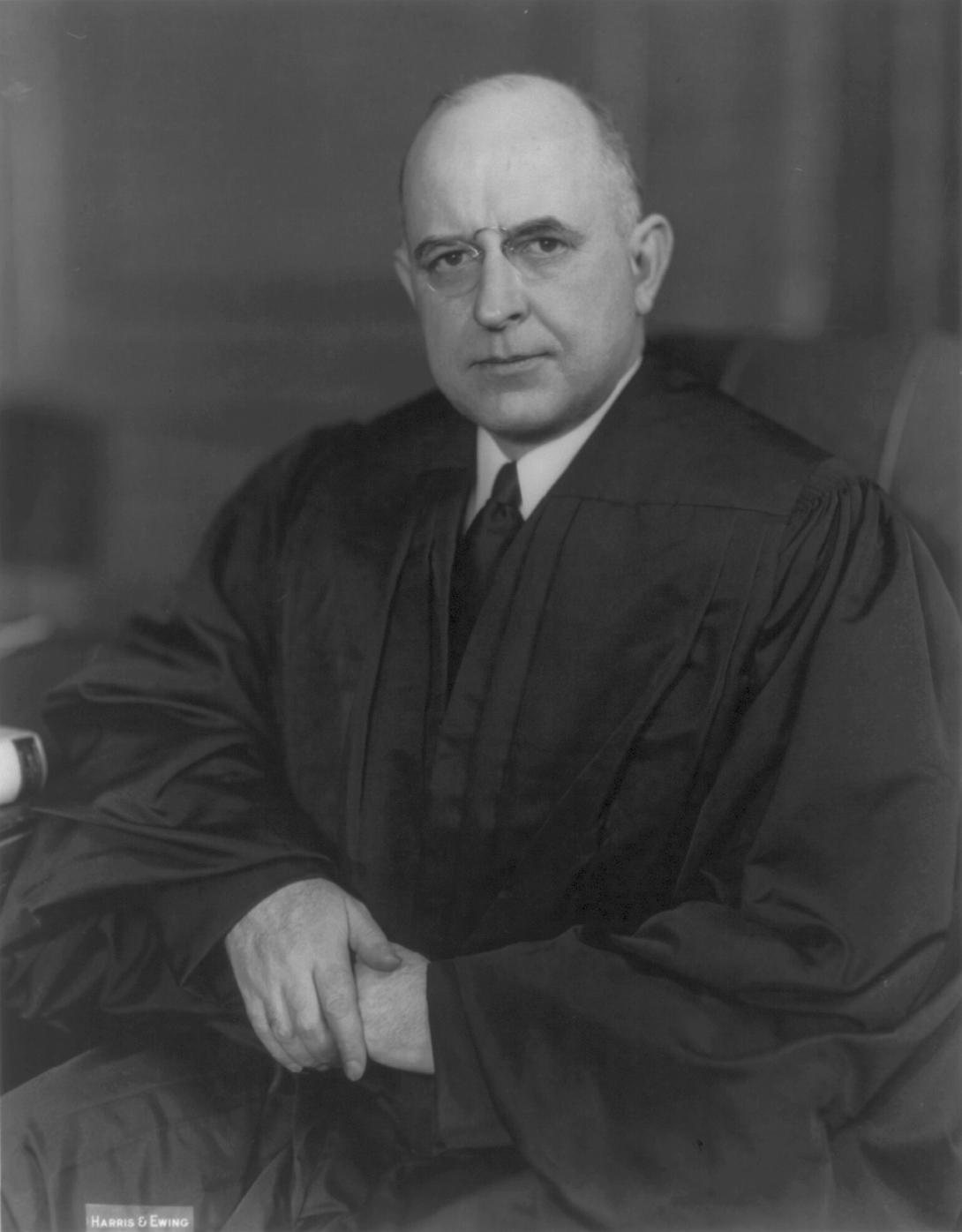
Historical · Supreme Court of the United States
Stanley Forman Reed
Former justice
Former Associate Justice · Supreme Court of the United States · 1938–1957 · Appointed by Franklin D Roosevelt
Stanley Forman Reed served as an Associate Justice of the Supreme Court of the United States (1938–1957) was appointed by Franklin D Roosevelt. The page below collects sourced biographical facts, the appointment record, and provenance for Reed.
FJC ID: 1386811
Key facts
- Full name
- Stanley Forman Reed
- Court
- Supreme Court of the United States
- Role
- Associate Justice
- Status
- Former justice
- Seat
- SCT0710
- Appointed by
- Franklin D Roosevelt
- Appointment
- Senate-confirmed
- Confirmed
- 1938-01-25
- Supreme Court service
- 1938–1957
- Took seat
- 1938
- Born
- 1884
- Died
- 1980
- Dataset version
- 1.20260711
Appointment & service record
Associate Justice of the Supreme Court of the United States · 1938–1957
- Seat
- SCT0710
- Appointing president
- Franklin D Roosevelt
- Appointment
- Senate-confirmed
- Confirmed
- January 25, 1938
Seat, appointing president, appointment type, confirmation date, and service dates are drawn from the Federal Judicial Center Biographical Directory and the Supreme Court's own members roster.[1][2][3]
Sources
- [1]https://www.fjc.gov/node/1386811fjc · retrieved 2026-06-17
- [2]https://www.supremecourt.gov/about/members_text.aspxsupremecourt.gov · retrieved 2026-06-17
- [3]https://www.fjc.gov/history/judges/biographical-directory-article-iii-federal-judges-exportfjc-directory · retrieved 2026-06-17
Biographical narrative
869 words · sourced from the Wikipedia REST extract
Stanley Forman Reed (December 31, 1884 – April 2, 1980) was an American lawyer and jurist whose career spanned private practice, federal administration, and the highest court in the land. He served as a United States Solicitor General from 1935 to 1938 before being appointed by President Franklin D. Roosevelt to the Supreme Court, where he remained an associate justice for nineteen years, retiring in 1957.
Early life and legal career
Reed was born on December 31, 1884, in the small town of Minerva in Mason County, Kentucky. His father, John Reed, was a prosperous physician, while his mother, Frances (Forman) Reed, came from a family with deep colonial roots that shaped young Stanley’s sense of heritage. When he was ten years old, the family relocated to Maysville, Kentucky, where they lived in a prominent downtown residence known as Phillips’ Folly.
He pursued higher education at Kentucky Wesleyan College, earning a Bachelor of Arts degree in 1902, and then continued his undergraduate studies at Yale University, receiving a second Bachelor of Arts in 1906. Reed also studied law at the University of Virginia—where he was a member of St. Elmo Hall—and at Columbia University; however, he did not complete a formal law degree. His status as the most recent Supreme Court justice to serve without graduating from law school remains a noted fact about his career.
In May 1908, Reed married Winifred Elgin, and together they had two sons, John A. and Stanley Jr., both of whom would later become attorneys. The family spent time abroad in 1909 when Reed studied at the Sorbonne in France as an auditeur bénévole.
Reed was admitted to the Kentucky bar in 1910 and practiced law in Maysville for nine years. His early political involvement saw him elected as a Democratic member of the Kentucky House of Representatives in 1911, with reelection in 1913; he lost his bid for a third term in 1915 to Republican Harry P. Purnell.
When the United States entered World War I in April 1917, Reed joined the Army and served as a lieutenant in the intelligence division until the war’s end in 1918. After returning to civilian life, he reestablished his private practice and quickly gained prominence as a corporate attorney. He represented major clients such as the Chesapeake and Ohio Railway and the Kentucky Burley Tobacco Growers Association, among other large corporations.
Reed was active in heritage societies; he served with the Sons of the American Revolution and the Society of Colonial Wars, while his wife held a national officer position in the Daughters of the American Revolution. The family also maintained a farm near Maysville where Reed raised prize‑winning Holstein cattle during his spare time.
Supreme Court tenure
Reed’s reputation as an expert on agricultural law brought him to the attention of federal officials during the late 1920s and early 1930s. President Herbert Hoover appointed him general counsel of the Federal Farm Board on November 7, 1929, a position he held until December 1932. The Federal Farm Board was created by Congress under the Agriculture Marketing Act to stabilize agricultural prices and support farmers during a period of economic distress.
When the Reconstruction Finance Corporation (RFC) needed new leadership in December 1932, Hoover again selected Reed as its general counsel; his tenure continued into the Roosevelt administration, during which he mentored several young attorneys who would later play significant roles in federal government. The RFC was established to provide financial support to banks and other institutions during the Great Depression, and Reed’s legal guidance helped shape its operations.
In 1935, President Franklin D. Roosevelt appointed Reed as Solicitor General of the United States, a role he occupied until 1938. In that capacity, he defended the constitutionality of various New Deal measures before the Supreme Court, representing the federal government in numerous cases that tested the limits of executive and legislative power during a time of nationwide economic reform.
Following the retirement of Associate Justice George Sutherland, Roosevelt nominated Reed to fill the vacancy on the Supreme Court. The Senate confirmed his appointment on January 25, 1938, and he took the seat designated SCT0710. Reed served as an associate justice until his voluntary retirement in April 1957, at which point Charles Evans Whittaker succeeded him.
Jurisprudence and legacy
During his nearly two decades on the Court, Reed authored several majority opinions that reflected his legal philosophy and background. Notable cases include *Smith v. Allwright*, which addressed voting rights; *Gorin v. United States*; and *Adamson v. California*. He also wrote dissenting opinions in decisions such as *Illinois ex rel. McCollum v. Board of Education*.
Reed’s tenure on the Supreme Court coincided with a period of significant constitutional development, particularly regarding federal economic regulation and civil rights. His contributions to the Court’s jurisprudence were shaped by his extensive experience in corporate law and his service in federal agencies that dealt directly with economic policy during the Great Depression.
After retiring from the bench, Reed remained a respected figure in legal circles until his death on April 2, 1980. His legacy is marked by a career that bridged private practice, federal administration, and judicial leadership, illustrating the diverse pathways through which individuals can influence American law.
Sources & provenance
Every quantitative or attributable claim above carries a per-section [N] marker that resolves to the corresponding URL below. Each entry records the upstream provider, the canonical URL, and the timestamp at which the underlying source was retrieved.
Key facts
- https://www.fjc.gov/node/1386811fjc · retrieved 2026-06-17
- https://www.supremecourt.gov/about/members_text.aspxsupremecourt.gov · retrieved 2026-06-17
- https://www.fjc.gov/history/judges/biographical-directory-article-iii-federal-judges-exportfjc-directory · retrieved 2026-06-17
Biographical narrative
- https://en.wikipedia.org/wiki/Stanley_Forman_ReedWikipedia · retrieved 2026-06-17
Explore the federal judiciary
Fewer than 120 people have served on the Supreme Court of the United States in its history. Browse the full roster of current and former justices, or explore how the appointed federal judiciary fits into the federal government.