
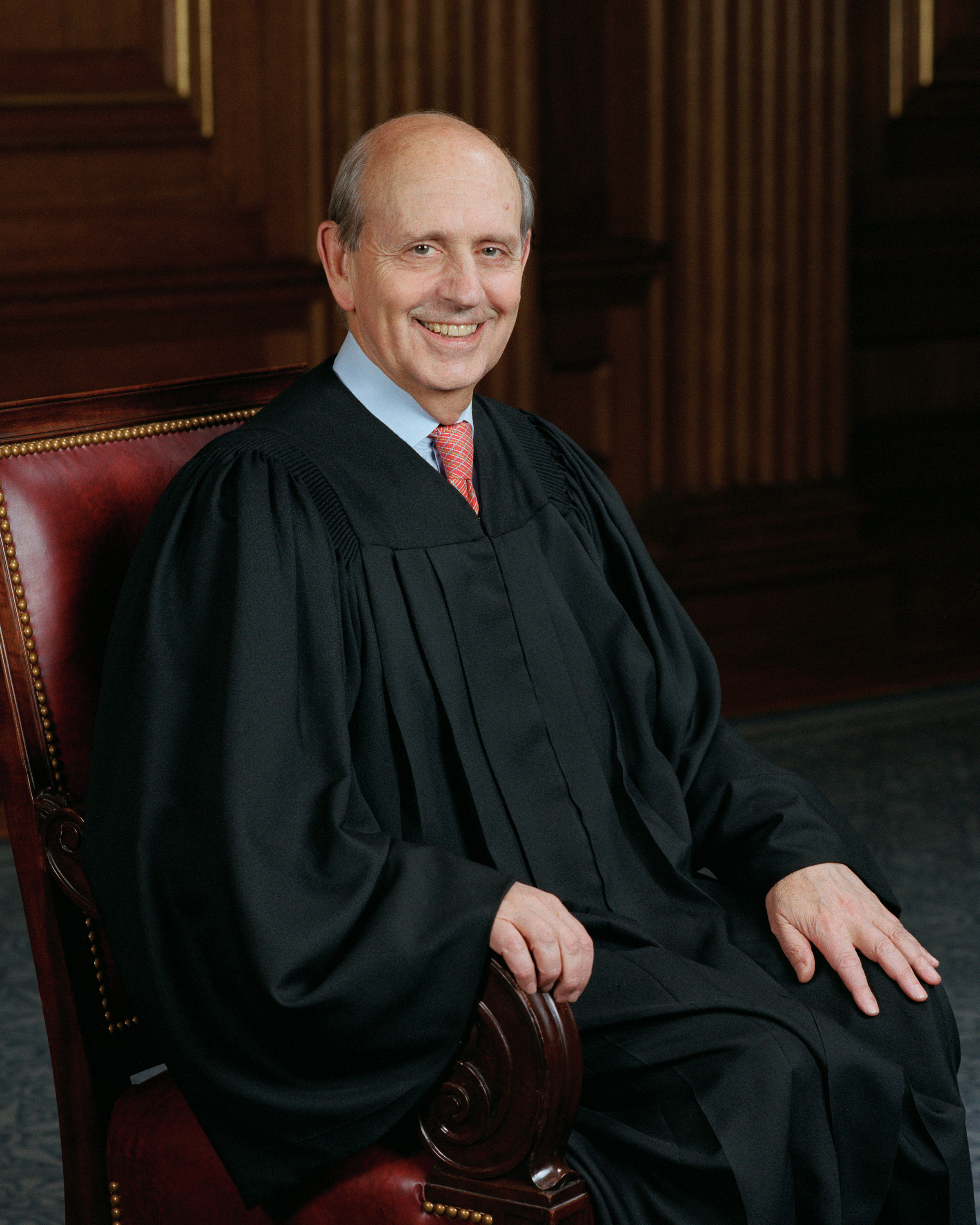
Historical · Supreme Court of the United States
Stephen Gerald Breyer
Former justice
Former Associate Justice · Supreme Court of the United States · 1994–2022 · Appointed by Bill Clinton
Stephen Gerald Breyer served as an Associate Justice of the Supreme Court of the United States (1994–2022) was appointed by Bill Clinton. The page below collects sourced biographical facts, the appointment record, and provenance for Breyer.
FJC ID: 1378241
Key facts
- Full name
- Stephen Gerald Breyer
- Court
- Supreme Court of the United States
- Role
- Associate Justice
- Status
- Former justice
- Seat
- SCT0313
- Appointed by
- Bill Clinton
- Appointment
- Senate-confirmed
- Confirmed
- 1994-07-29
- Supreme Court service
- 1994–2022
- Took seat
- 1994
- Born
- —
- Died
- —
- Dataset version
- 1.20260711
Appointment & service record
Associate Justice of the Supreme Court of the United States · 1994–2022
- Seat
- SCT0313
- Appointing president
- Bill Clinton
- Appointment
- Senate-confirmed
- Confirmed
- July 29, 1994
Seat, appointing president, appointment type, confirmation date, and service dates are drawn from the Federal Judicial Center Biographical Directory and the Supreme Court's own members roster.[1][2][3]
Sources
- [1]https://www.fjc.gov/node/1378241fjc · retrieved 2026-06-16
- [2]https://www.supremecourt.gov/about/members_text.aspxsupremecourt.gov · retrieved 2026-06-16
- [3]https://www.fjc.gov/history/judges/biographical-directory-article-iii-federal-judges-exportfjc-directory · retrieved 2026-06-16
Biographical narrative
996 words · sourced from the Wikipedia REST extract
Stephen Gerald Breyer served as an associate justice of the United States Supreme Court for nearly three decades, from his appointment in 1994 until his retirement at the end of 2022. A former professor and scholar of administrative law, Breyer’s tenure on the Court was marked by a focus on the practical implications of legal rules and a commitment to fostering public engagement with governmental decision‑making. After leaving the bench, he returned to academia as the Byrne Professor of Administrative Law and Process at Harvard Law School.
Early life and legal career
Born on August 15, 1938, in San Francisco, California, Breyer grew up in a middle‑class Reform Jewish family. His father was a lawyer who served as counsel to the San Francisco Board of Education, and his younger brother Charles would later become a federal district judge. The brothers were active participants in the Boy Scouts of America, both achieving the rank of Eagle Scout; Stephen received the Distinguished Eagle Scout Award in 2007.
Breyer attended Lowell High School, where he joined the Lowell Forensic Society and competed in debate tournaments against notable future figures such as California governor Jerry Brown and Harvard Law professor Laurence Tribe. After high school graduation in 1955, he entered Stanford University to study philosophy. He earned a Bachelor of Arts degree with highest honors in 1959, was elected to Phi Beta Kappa, and received a Marshall Scholarship that enabled him to pursue graduate studies at Magdalen College, Oxford. There he completed a B.A. in philosophy, politics, and economics with first‑class honors in 1961.
Returning to the United States, Breyer enrolled at Harvard Law School. He served as an articles editor for the Harvard Law Review and graduated in 1964 with a Bachelor of Laws degree magna cum laude. During his time in law school he also fulfilled service obligations in the United States Army Reserve; he spent eight years in the Reserve during the Vietnam War, including six months on active duty in the Army Strategic Intelligence Corps, achieving the rank of corporal before being honorably discharged in 1965.
After law school, Breyer clerked for Associate Justice Arthur Goldberg from 1964 to 1965. During that period he drafted the first version of Goldberg’s concurrence in *Griswold v. Connecticut* (1965), which argued that a right to privacy could be derived from the Ninth Amendment. He also worked briefly as a fact‑checker for the Warren Commission and spent two years in the Department of Justice’s Antitrust Division as a special assistant to its assistant attorney general.
In 1967, Breyer returned to Harvard Law School as an assistant professor, a position he held until 1980. While teaching at Harvard, he also maintained a joint appointment with the Harvard Kennedy School from 1977 to 1980. He became recognized as a leading authority on administrative law and wrote several influential texts, including *Breaking the Vicious Circle: Toward Effective Risk Regulation*, *Regulation and Its Reform*, and *The Uneasy Case for Copyright* (1970). In 1979 he co‑authored *Administrative Law and Regulatory Policy* with Richard Stewart. Breyer also served as a visiting professor at institutions such as the College of Law in Sydney, the University of Rome, and Tulane University Law School.
During his academic career, Breyer took multiple leaves of absence to serve in government positions. In 1973 he was an assistant special prosecutor on the Watergate Special Prosecution Force. From 1974 to 1975 he served as a special counsel to the U.S. Senate Committee on the Judiciary, and from 1979 to 1980 he acted as chief counsel for that committee. He worked closely with Senator Edward M. Kennedy in drafting and passing the Airline Deregulation Act, which eliminated the Civil Aeronautics Board.
In 1967, Breyer married Joanna Freda Hare, a psychologist and member of British aristocracy; they have three adult children: Chloe, an Episcopal priest; Nell; and Michael.
Supreme Court tenure
President Bill Clinton nominated Breyer to the U.S. Supreme Court in 1994 to fill the seat vacated by Justice Harry Blackmun. The Senate confirmed his appointment on July 29, 1994, and he took the oath of office later that year. He served as an associate justice from 1994 until his retirement at the end of June 2022, a period during which he participated in numerous landmark decisions.
On January 27, 2022, Breyer announced his intention to retire, and President Joe Biden nominated Ketanji Brown Jackson on February 25, 2022. Jackson was confirmed by the Senate and succeeded Breyer on June 30, 2022. Throughout his tenure, Breyer authored majority opinions in cases such as *Mahanoy Area School District v. B.L.*, *United States v. Lara*, and *Google v. Oracle*. He also wrote dissents that questioned the constitutionality of the death penalty, notably in *Glossip v. Gross*.
Jurisprudence and legacy
Breyer’s judicial philosophy emphasized the practical effects of legal rules and the importance of public participation in governmental processes. In his 2005 book *Active Liberty*, he articulated a vision of the judiciary that seeks to resolve disputes in ways that encourage citizens’ involvement in policy decisions. His scholarship on administrative law, developed during his years at Harvard, continued to influence his approach to cases involving regulatory agencies and executive authority.
During his time on the Court, Breyer was generally associated with the liberal wing of the bench, though he maintained a reputation for pragmatism and a willingness to consider the real‑world implications of legal doctrines. His opinions often reflected a careful balance between protecting individual rights and recognizing the role of government in regulating complex societal issues.
After retiring from the Supreme Court, Breyer returned to Harvard Law School as the Byrne Professor of Administrative Law and Process. In this capacity he continues to contribute to academic discussions on administrative law and public policy, drawing upon his extensive experience both as a jurist and as a scholar. His long career has left an enduring impact on the field of administrative law and on the broader understanding of how courts can engage with democratic governance.
Sources & provenance
Every quantitative or attributable claim above carries a per-section [N] marker that resolves to the corresponding URL below. Each entry records the upstream provider, the canonical URL, and the timestamp at which the underlying source was retrieved.
Key facts
- https://www.fjc.gov/node/1378241fjc · retrieved 2026-06-16
- https://www.supremecourt.gov/about/members_text.aspxsupremecourt.gov · retrieved 2026-06-16
- https://www.fjc.gov/history/judges/biographical-directory-article-iii-federal-judges-exportfjc-directory · retrieved 2026-06-16
Biographical narrative
- https://en.wikipedia.org/wiki/Stephen_BreyerWikipedia · retrieved 2026-06-16
Explore the federal judiciary
Fewer than 120 people have served on the Supreme Court of the United States in its history. Browse the full roster of current and former justices, or explore how the appointed federal judiciary fits into the federal government.