
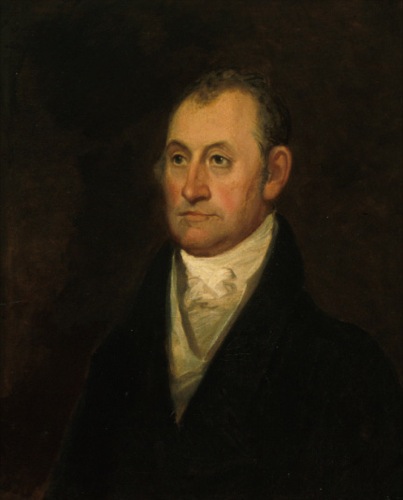
Historical · Supreme Court of the United States
Thomas Todd
Former justice
Former Associate Justice · Supreme Court of the United States · 1807–1826 · Appointed by Thomas Jefferson
Thomas Todd served as an Associate Justice of the Supreme Court of the United States (1807–1826) was appointed by Thomas Jefferson. The page below collects sourced biographical facts, the appointment record, and provenance for Todd.
FJC ID: 1388851
Key facts
- Full name
- Thomas Todd
- Court
- Supreme Court of the United States
- Role
- Associate Justice
- Status
- Former justice
- Seat
- SCT0701
- Appointed by
- Thomas Jefferson
- Appointment
- Senate-confirmed
- Confirmed
- 1807-03-02
- Supreme Court service
- 1807–1826
- Took seat
- 1807
- Born
- 1765
- Died
- 1826
- Dataset version
- 1.20260711
Appointment & service record
Associate Justice of the Supreme Court of the United States · 1807–1826
- Seat
- SCT0701
- Appointing president
- Thomas Jefferson
- Appointment
- Senate-confirmed
- Confirmed
- March 2, 1807
Seat, appointing president, appointment type, confirmation date, and service dates are drawn from the Federal Judicial Center Biographical Directory and the Supreme Court's own members roster.[1][2][3]
Sources
- [1]https://www.fjc.gov/node/1388851fjc · retrieved 2026-06-16
- [2]https://www.supremecourt.gov/about/members_text.aspxsupremecourt.gov · retrieved 2026-06-16
- [3]https://www.fjc.gov/history/judges/biographical-directory-article-iii-federal-judges-exportfjc-directory · retrieved 2026-06-16
Biographical narrative
956 words · sourced from the Wikipedia REST extract
Thomas Todd (January 23 1765 – February 7 1826) was an associate justice of the United States Supreme Court who served from 1807 until his death in 1826. Born in the Colony of Virginia, he spent his early years in a family that had long been involved in colonial commerce and public service. After a brief stint as a private in the Continental Army during the final months of the American Revolution, Todd pursued legal studies in the western frontier, establishing himself as a lawyer, clerk, and judge in Kentucky before being elevated to the nation’s highest court by President Thomas Jefferson.
Early life and legal career
Todd entered the world on January 23 1765 in King and Queen County, Virginia. He was the youngest of five children; his parents, Richard Todd and Elizabeth Richards, died when he was still a boy, leaving the family orphaned. The Todd lineage traced back to an English sea captain who had settled in colonial Virginia and Maryland in the mid‑17th century, acquiring land and holding local offices such as justice of the peace. Although the early generations of the family were involved in maritime trade and plantation management, Thomas Todd’s own upbringing was marked by the hardships of a frontier life.
Education opportunities in colonial Virginia were limited, especially for those outside the planter aristocracy. Todd’s schooling was therefore informal; he learned to read and write at home before joining the Continental Army as a private in 1781 when he was sixteen years old. He served with a cavalry company from Manchester during the concluding phase of the American Revolutionary War, participating in the Siege of Yorktown. The war ended after only six months of active service for Todd, and he returned to civilian life.
Seeking further education, Todd moved westward to Lexington, Kentucky (then part of Virginia), where he enrolled at Liberty Hall Academy—later known as Washington & Lee University. He graduated in 1783 at the age of eighteen while simultaneously tutoring students there. His academic pursuits were complemented by a move to Kentucky County with his cousin, Judge Harry Innes, who had been appointed a judge of the United States District Court for the District of Kentucky. Todd tutored Innes’s children in Danville and studied law through apprenticeship, eventually being admitted to the Kentucky bar in 1786.
From 1788 until 1801, Todd maintained a private practice in Danville, the seat of Lincoln County and, during his lifetime, the first capital of Kentucky. His legal career was intertwined with public service: he served as court reporter for the county, secretary to the Kentucky State Legislature after statehood, and secretary to ten conventions between 1784 and 1792 that advocated for Kentucky’s separation from Virginia and drafted its constitution. Todd also represented Lincoln County in the Virginia House of Delegates during the term that concluded with Kentucky’s admission as a state.
Politically aligned with the Jeffersonian Republicans, Todd ran unsuccessfully for governor of Kentucky twice, in 1795 and again in 1800. In 1801 he was elected by legislators to serve on the Kentucky Court of Appeals, becoming its first clerk and later being chosen by his fellow judges as chief judge in 1806. The position placed him at the center of Kentucky’s judicial system during a formative period for the state.
At the time of the 1820 census, Todd owned twenty‑six enslaved individuals, reflecting the common practice among many white Kentuckians of that era who held property and participated in the institution of slavery.
Supreme Court tenure
On February 28 1807, President Thomas Jefferson nominated Todd to fill a newly created seat on the United States Supreme Court. The expansion from six to seven justices had been authorized by Congress earlier that year. The Senate confirmed Todd’s appointment on March 2 1807, and he was sworn into office on May 4 1807.
Todd served as an associate justice for nineteen years, until his death in 1826. He worked under Chief Justice John Marshall, who presided over the Court during a period of significant development in American constitutional law. As the justice responsible for the circuit that included Kentucky, Tennessee, and Ohio, Todd traveled twice annually to hold court sessions in Nashville, Frankfort, and Chillicothe, ensuring that federal judicial matters were addressed throughout his jurisdiction.
Throughout his tenure, Todd’s participation in the Court was relatively modest compared to some of his colleagues. He contributed to a small number of opinions, most of which dealt with land‑claim disputes—a common issue in the early republic as settlers moved westward and property rights required clarification at the federal level.
Jurisprudence and legacy
Todd’s judicial output on the Supreme Court was limited; he authored only a handful of opinions during his nineteen years on the bench. The majority of these addressed land‑claim cases, reflecting the practical concerns of a nation expanding into new territories. Because of the scarcity of his written work, legal scholars have often viewed him as one of the less influential members of the Court.
In 1983, legal historian Frank H. Easterbrook described Todd in an article titled “The Most Insignificant Justice: Further Evidence,” arguing that Todd’s contributions were minimal compared to those of other justices who served during the same period. This assessment has been cited by scholars studying the early composition and influence of the Supreme Court.
Todd died on February 7 1826, concluding a career that spanned military service, frontier legal practice, state judicial leadership, and federal constitutional adjudication. His life illustrates the trajectory of an individual who moved from colonial Virginia to the western frontier, engaged in public service at multiple levels, and ultimately participated in shaping the early jurisprudence of the United States, even if his personal impact on the Court’s legacy was modest.
Sources & provenance
Every quantitative or attributable claim above carries a per-section [N] marker that resolves to the corresponding URL below. Each entry records the upstream provider, the canonical URL, and the timestamp at which the underlying source was retrieved.
Key facts
- https://www.fjc.gov/node/1388851fjc · retrieved 2026-06-16
- https://www.supremecourt.gov/about/members_text.aspxsupremecourt.gov · retrieved 2026-06-16
- https://www.fjc.gov/history/judges/biographical-directory-article-iii-federal-judges-exportfjc-directory · retrieved 2026-06-16
Biographical narrative
- https://en.wikipedia.org/wiki/Thomas_ToddWikipedia · retrieved 2026-06-16
Explore the federal judiciary
Fewer than 120 people have served on the Supreme Court of the United States in its history. Browse the full roster of current and former justices, or explore how the appointed federal judiciary fits into the federal government.