
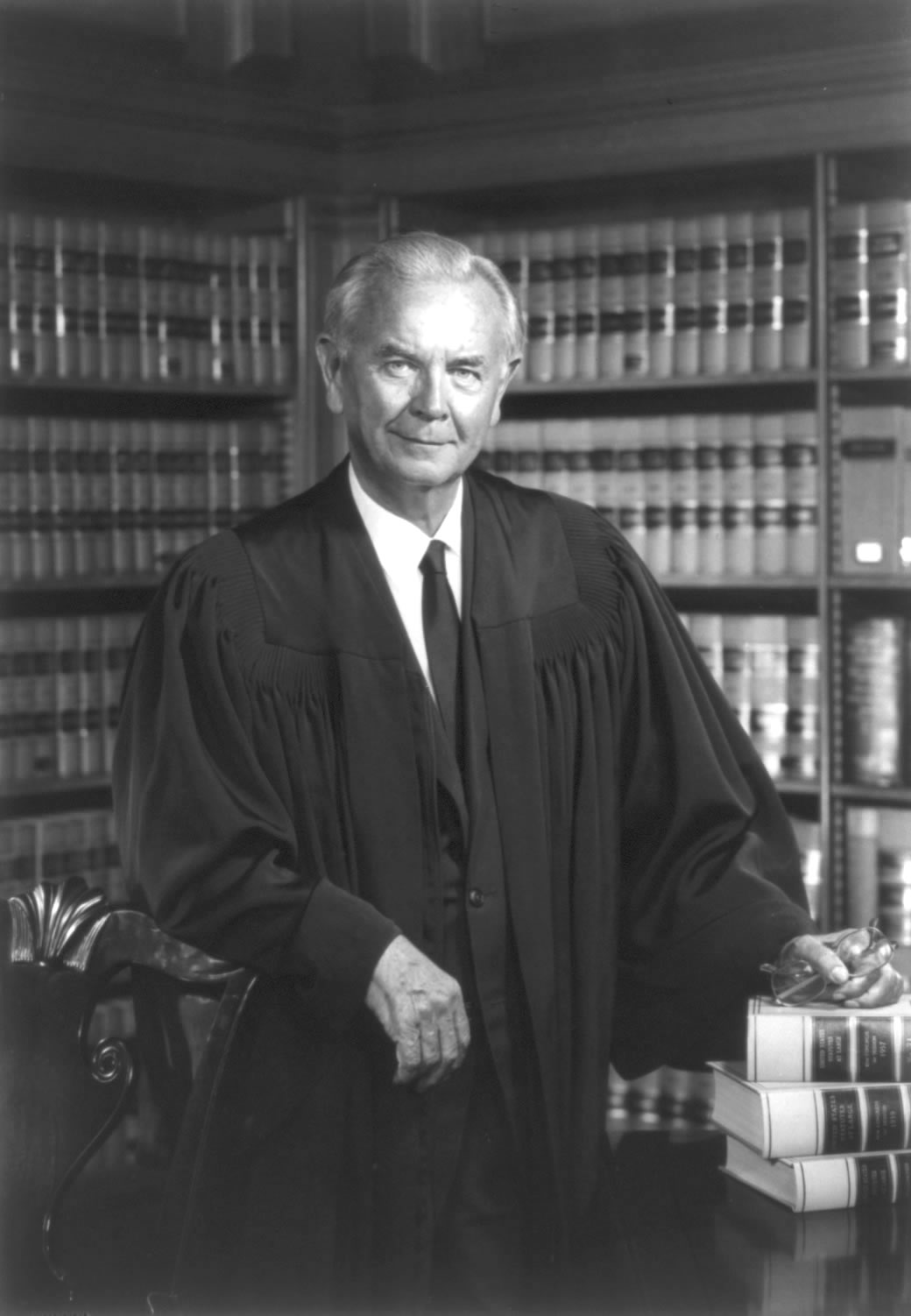
Historical · Supreme Court of the United States
William Joseph Brennan Jr.
Former justice
Former Associate Justice · Supreme Court of the United States · 1957–1990 · Appointed by Dwight D Eisenhower
William Joseph Brennan Jr. served as an Associate Justice of the Supreme Court of the United States (1957–1990) was appointed by Dwight D Eisenhower. The page below collects sourced biographical facts, the appointment record, and provenance for Jr..
FJC ID: 1378211
Key facts
- Full name
- William Joseph Brennan Jr.
- Court
- Supreme Court of the United States
- Role
- Associate Justice
- Status
- Former justice
- Seat
- SCT0415
- Appointed by
- Dwight D Eisenhower
- Appointment
- Senate-confirmed
- Confirmed
- 1957-03-19
- Supreme Court service
- 1957–1990
- Took seat
- 1957
- Born
- 1906
- Died
- 1997
- Dataset version
- 1.20260711
Appointment & service record
Associate Justice of the Supreme Court of the United States · 1957–1990
- Seat
- SCT0415
- Appointing president
- Dwight D Eisenhower
- Appointment
- Senate-confirmed
- Confirmed
- March 19, 1957
Seat, appointing president, appointment type, confirmation date, and service dates are drawn from the Federal Judicial Center Biographical Directory and the Supreme Court's own members roster.[1][2][3]
Sources
- [1]https://www.fjc.gov/node/1378211fjc · retrieved 2026-06-17
- [2]https://www.supremecourt.gov/about/members_text.aspxsupremecourt.gov · retrieved 2026-06-17
- [3]https://www.fjc.gov/history/judges/biographical-directory-article-iii-federal-judges-exportfjc-directory · retrieved 2026-06-17
Biographical narrative
937 words · sourced from the Wikipedia REST extract
William Joseph Brennan Jr. (April 25, 1906 – July 24, 1997) was an American jurist who served as an associate justice of the Supreme Court of the United States from 1957 until his retirement in 1990. Appointed by President Dwight D. Eisenhower, Brennan became one of the longest‑serving members of the Court and a prominent figure within its liberal wing. During his tenure he authored or joined numerous opinions that shaped modern American constitutional law, particularly in areas such as civil liberties, equal protection, and individual rights.
Early life and legal career
Brennan was born in Newark, New Jersey, to Irish immigrant parents William and Agnes (McDermott) Brennan. He grew up as the second of eight children in a family that valued education despite modest beginnings; his father worked as a metal polisher before serving as Commissioner of Public Safety for Newark from 1927 to 1930. Brennan attended public schools in Newark, graduating from Barringer High School in 1924.
He entered higher education at the University of Pennsylvania, following his father's preference over an initial offer from Princeton. After one year in the College of Arts & Sciences, he transferred to the Wharton School and earned a Bachelor of Arts in economics cum laude in 1928. While there, he joined the Delta Tau Delta fraternity. He then pursued legal studies at Harvard Law School, where he was active in the Harvard Legal Aid Bureau. Brennan graduated with a Bachelor of Laws in 1931 near the top of his class.
In 1930, at age 21, he married Marjorie Leonard, whom he had met during high school. The couple would have three children: William III, Nancy, and Hugh.
Following law school, Brennan entered private practice in New Jersey, focusing on labor law with the firm of Pitney Hardin (later known as Day Pitney). His early career was marked by a commitment to workers’ rights and a growing reputation for legal acumen. In 1942 he joined the United States Army as a major; during World War II he served in the ordnance division, rising to the rank of colonel before leaving active duty in 1946. For his service he received the Legion of Merit Award. After the war, he briefly worked on staff for the United States Undersecretary of War before returning to Pitney Hardin, where his partners added his name to the firm’s title.
Brennan’s judicial career began with a state appointment. In 1949 Governor Alfred E. Driscoll named him to the New Jersey Superior Court, a trial court. Two years later, in 1951, Driscoll elevated him to the New Jersey Supreme Court, where he served as an associate justice until his elevation to the federal bench.
Supreme Court tenure
Brennan received a recess appointment from President Dwight D. Eisenhower on October 15, 1956, shortly before the 1956 presidential election. He was sworn into office the following day and subsequently faced a confirmation process that included scrutiny over his Catholic faith and remarks about anti‑Communist investigations. After hearings in which he emphasized his commitment to ruling solely on constitutional grounds, he was confirmed by the Senate on March 19, 1957, with only Senator Joseph McCarthy voting against him.
He occupied seat SCT0415 as an associate justice from 1957 until his retirement in 1990. During this period, Brennan became known for his leadership within the Court’s liberal bloc and for his skillful negotiation of votes on complex cases. His tenure spanned multiple administrations and a wide range of legal issues, allowing him to influence the development of constitutional doctrine across several decades.
Upon retiring, he was succeeded by David Souter. Brennan lived until July 24, 1997, leaving behind a legacy that continues to be studied in law schools and cited in contemporary jurisprudence.
Jurisprudence and legacy
Brennan’s judicial philosophy emphasized the protection of individual rights and the expansion of civil liberties. He authored or joined opinions that became foundational to modern constitutional interpretation. In Baker v. Carr (1962), he held that apportionment of legislative districts was a justiciable issue, thereby enabling courts to address malapportioned representation. His concurrence in New York Times Co. v. Sullivan (1964) helped establish the “actual malice” standard for libel cases involving public officials, reinforcing protections for free speech and press.
In Eisenstadt v. Baird (1972), Brennan contributed to a decision that recognized a legal right to contraception for unmarried individuals, thereby expanding personal privacy rights during a period of social change. His opinion in Craig v. Boren (1976) established heightened scrutiny for laws discriminating on the basis of sex under the Equal Protection Clause, setting a precedent for subsequent gender‑based equal protection analysis.
Beyond these landmark cases, Brennan was noted for his opposition to capital punishment; he dissented in more than 1,400 cases where the Supreme Court declined to review death sentences. He also supported abortion rights and gay rights, reflecting a broader commitment to expanding individual autonomy within constitutional limits.
Brennan’s influence extended beyond the opinions he authored. His ability to shape a wide array of decisions and negotiate support from colleagues earned him recognition as one of the most powerful justices on the Court. In 1990, former associate justice Antonin Scalia remarked that Brennan was “probably the most influential Justice of the [20th] century,” underscoring the respect he commanded across ideological lines.
As the eighth‑longest serving justice in Supreme Court history, Brennan’s tenure spanned more than three decades of evolving legal and social landscapes. His contributions to jurisprudence—particularly in civil liberties, equal protection, and individual rights—continue to inform contemporary legal debates and academic scholarship. He passed away on July 24, 1997, leaving a lasting imprint on the American constitutional order.
Sources & provenance
Every quantitative or attributable claim above carries a per-section [N] marker that resolves to the corresponding URL below. Each entry records the upstream provider, the canonical URL, and the timestamp at which the underlying source was retrieved.
Key facts
- https://www.fjc.gov/node/1378211fjc · retrieved 2026-06-17
- https://www.supremecourt.gov/about/members_text.aspxsupremecourt.gov · retrieved 2026-06-17
- https://www.fjc.gov/history/judges/biographical-directory-article-iii-federal-judges-exportfjc-directory · retrieved 2026-06-17
Biographical narrative
- https://en.wikipedia.org/wiki/William_J._Brennan_Jr.Wikipedia · retrieved 2026-06-17
Explore the federal judiciary
Fewer than 120 people have served on the Supreme Court of the United States in its history. Browse the full roster of current and former justices, or explore how the appointed federal judiciary fits into the federal government.