
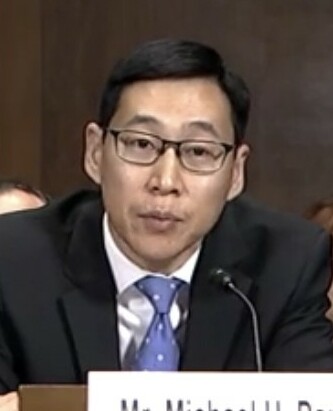
Currently serving · U.S. Court of Appeals for the Second Circuit
Michael Hun Park
Currently serving
Circuit Judge · U.S. Court of Appeals for the Second Circuit · 2019–present · Appointed by Donald Trump
Michael Hun Park serves as a circuit judge of the U.S. Court of Appeals for the Second Circuit (2019–present). Park was appointed by Donald Trump.
Key facts
- Full name
- Michael Hun Park
- Court
- U.S. Court of Appeals for the Second Circuit
- Office
- Circuit Judge (U.S. Court of Appeals)
- Status
- Active circuit judge
- Duty status
- Active
- Appointment
- Senate-confirmed
- FJC seat
- CA21007
- Tenure
- 2019–present
- Confirmed
- 2019-05-09
- Born
- 1976
- Died
- —
- First year on the bench
- 2019
- Dataset version
- 1.20260705
Appointment & service record
U.S. Court of Appeals for the Second Circuit · 2019–present
- Seat
- CA21007
- Appointment
- Senate-confirmed
- Appointing president
- Donald Trump
- Confirmed
- 2019-05-09
- Commissioned
- 2019-05-13
- Senior status
- —
Court, FJC seat, appointment type (Senate-confirmed or recess), appointing president, confirmation and commission dates, and senior-status date are drawn from the Federal Judicial Center Biographical Directory and Wikidata.[1][2][3]
Sources
- [1]https://www.fjc.gov/node/6420566fjc · retrieved 2026-07-05
- [2]https://www.fjc.gov/history/judges/biographical-directory-article-iii-federal-judges-exportfjc-directory · retrieved 2026-07-05
- [3]https://www.wikidata.org/wiki/Q57242770Wikidata · retrieved 2026-07-05
Biographical narrative
1,131 words · sourced from the Wikipedia REST extract
Michael Hun Park (born 1976) is an American jurist who serves as a United States circuit judge on the Court of Appeals for the Second Circuit. Appointed by President Donald J. Trump and confirmed in May 2019, Judge Park became the second Asian Pacific American and the first Korean American to sit on that court. Prior to his elevation to the federal bench, he practiced law at several prominent firms, clerked for Justice Samuel Alito at both the appellate and Supreme Court levels, and held a position as an attorney‑advisor in the Department of Justice’s Office of Legal Counsel. He also teaches as an adjunct professor at two law schools and participates in a range of professional and civic organizations.
Early life and legal career
Michael Hun Park grew up in Virginia and attended Thomas Jefferson High School for Science and Technology, a specialized public magnet school known for its rigorous curriculum. He pursued his undergraduate studies at Princeton University, graduating magna cum laude with a Bachelor of Arts degree. Continuing his academic trajectory, he enrolled at Yale Law School, where he earned his Juris Doctor in 2001 and served as managing editor of the Yale Law Journal.
Following law school, Park began his legal career by clerking for Judge Samuel Alito of the United States Court of Appeals for the Third Circuit. After completing that clerkship, he joined the New York City office of Wilmer Cutler Pickering Hale and Dorr as an associate, where he worked from 2002 until 2006. He then entered public service as an attorney‑advisor in the Office of Legal Counsel within the Department of Justice, a role he held for two years.
When Alito was appointed to the United States Supreme Court, Park returned to clerk for him during the 2008–2009 term, sharing the clerkship with Andy Oldham. After his second clerkship, Park entered private practice at Dechert LLP, serving as counsel from 2009 to 2011 and becoming a partner in 2012. He remained with Dechert until 2015, after which he joined the boutique litigation firm Consovoy McCarthy Park PLLC as a name partner, a position he held through 2019.
During his time in private practice, Park represented clients in several high‑profile matters that attracted public attention. In 2016, he acted for the Kansas Department of Health and Environment in its effort to terminate Medicaid funding to Planned Parenthood. The following year, he led litigation challenging an Environmental Protection Agency rule under the Clean Water Act that sought to broaden federal protection of wetlands. In 2018, Park worked on behalf of the Project on Fair Representation to defend the Trump administration’s attempt to add a citizenship question to the 2020 United States census.
In addition to his practice, Park has contributed to legal education as an adjunct professor. He teaches in the Supreme Court Clinic at Antonin Scalia Law School and also holds an adjunct appointment at Columbia Law School. His professional affiliations include membership on the Board of Trustees of the Supreme Court Historical Society, service on the Board of Directors of Operation Exodus Inner City, participation in the Asian American Bar Association of New York, and involvement with the Federalist Society.
Federal appellate service
President Donald J. Trump announced his intent to nominate Park to the United States Court of Appeals for the Second Circuit on October 10, 2018. The nomination was formally transmitted to the Senate on November 13, 2018 to fill the seat vacated by Judge Gerard E. Lynch, who had taken senior status in September 2016. Although New York’s Democratic senators declined to return a blue slip for the nomination, the Senate Judiciary Committee proceeded with consideration.
Park’s confirmation process included a hearing before the Judiciary Committee on February 13, 2019. The committee reported his nomination out of committee by a party‑line vote of 12–10 on March 7, 2019. The full Senate invoked cloture on May 8, 2019 with a vote of 51–43 and confirmed Park the following day by a vote of 52–41. He received his judicial commission on May 13, 2019 and has served as an active circuit judge on the Second Circuit since that time.
His appointment marked a notable milestone for representation on the federal bench: he became the second Asian Pacific American and the first Korean American to serve on the Second Circuit. Throughout his tenure, Judge Park has participated in panels addressing a broad array of legal issues typical of the circuit’s jurisdiction, which includes New York, Connecticut, and Vermont. While specific opinions authored by him are not detailed here, his background in appellate advocacy, constitutional litigation, and regulatory challenges informs his contributions to the court’s work.
Jurisprudence and legacy
Judge Park’s professional record reflects a focus on issues at the intersection of federal regulation, administrative law, and civil rights. His pre‑judicial advocacy involved challenging expansions of environmental protections under the Clean Water Act, defending state actions that affect reproductive health funding, and supporting executive authority in census administration. These experiences suggest an analytical approach attentive to statutory interpretation and the limits of governmental power.
On the bench, Park’s participation in Second Circuit panels contributes to the development of precedent within a circuit known for influential decisions on securities law, antitrust matters, and First Amendment jurisprudence. Although specific rulings authored by him are not enumerated in this biography, his role as an active judge entails drafting opinions, joining majority or dissenting positions, and engaging in oral argument—all core functions that shape the body of federal appellate law.
Beyond casework, Judge Park continues to influence the legal community through teaching and service. His involvement with the Supreme Court Clinic provides law students with practical experience in high‑level appellate advocacy, while his affiliation with the Federalist Society connects him to a network of scholars and practitioners dedicated to discussions of constitutional interpretation. Membership on the Board of Trustees of the Supreme Court Historical Society underscores a commitment to preserving judicial history.
Judge Park’s personal background also contributes to the broader narrative of diversity within the federal judiciary. As an Asian American jurist, his presence on the Second Circuit adds to the representation of minority groups in senior legal positions and may serve as a point of reference for aspiring lawyers from similar backgrounds. His marriage to Sarah Seo, a legal historian and professor at Columbia Law School, reflects a shared engagement with academic scholarship and the law.
In sum, Michael Hun Park’s career spans distinguished clerkships, substantive private‑practice advocacy, academic instruction, and federal judicial service. Appointed by a Republican president and confirmed amid partisan debate, he occupies an influential role on one of the nation’s most prominent appellate courts. His contributions to legal discourse—both through his prior litigation work and ongoing judicial responsibilities—form part of his emerging legacy within the United States legal system.
Sources & provenance
Every quantitative or attributable claim above carries a per-section [N] marker that resolves to the corresponding URL below. Each entry records the upstream provider, the canonical URL, and the timestamp at which the underlying source was retrieved.
Key facts
- https://www.fjc.gov/node/6420566fjc · retrieved 2026-07-05
- https://www.fjc.gov/history/judges/biographical-directory-article-iii-federal-judges-exportfjc-directory · retrieved 2026-07-05
- https://www.wikidata.org/wiki/Q57242770Wikidata · retrieved 2026-07-05
Biographical narrative
- https://en.wikipedia.org/wiki/Michael_H._ParkWikipedia · retrieved 2026-07-05
Explore the federal judiciary
The U.S. Courts of Appeals are the intermediate appellate courts of the federal judiciary — thirteen circuits sitting between the district courts and the Supreme Court. Browse the full roster of judges on the U.S. Court of Appeals for the Second Circuit, or explore how the appointed federal judiciary fits into the federal government.