
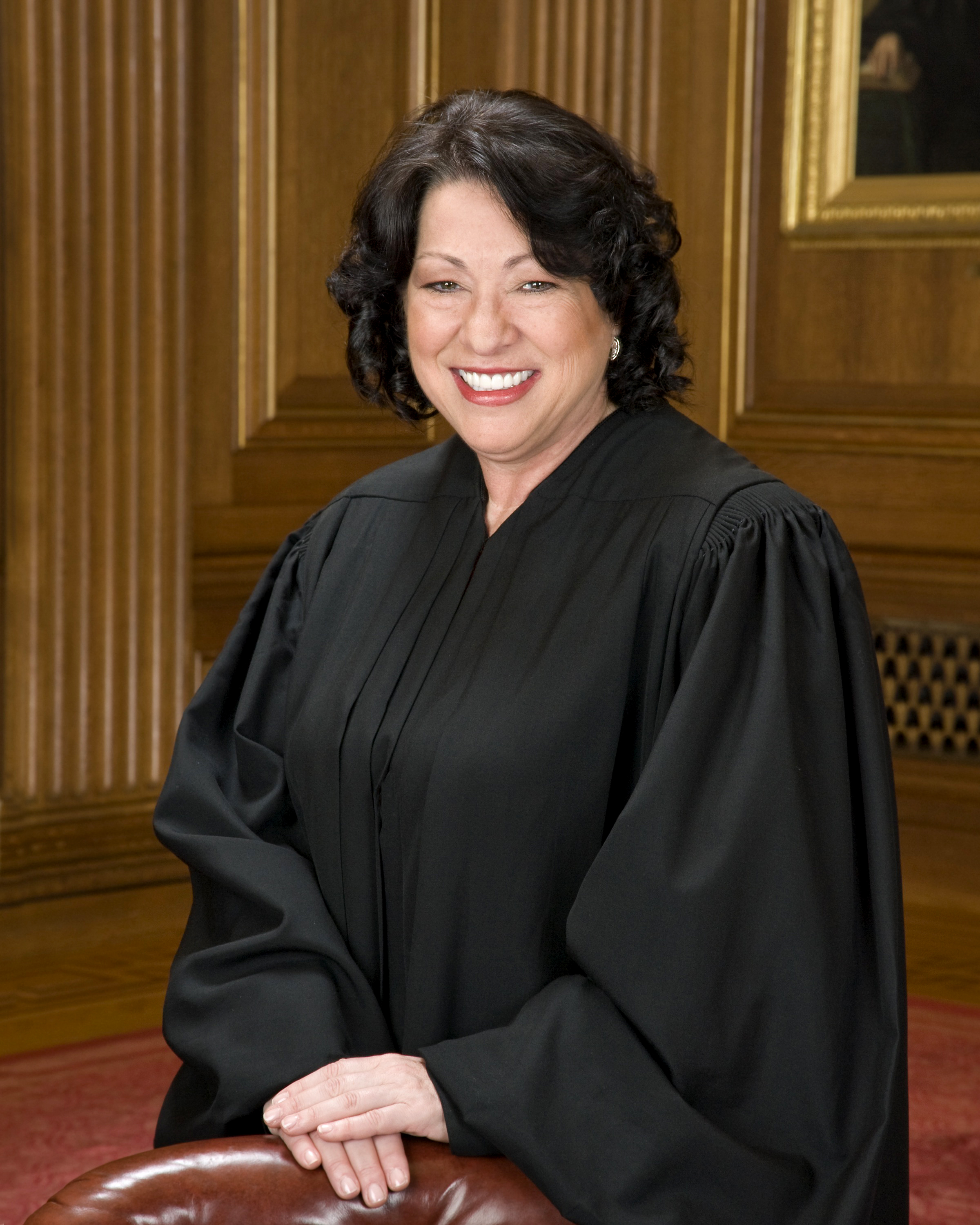
Historical · U.S. Court of Appeals for the Second Circuit
Sonia Sotomayor
Former Circuit Judge · U.S. Court of Appeals for the Second Circuit · 1998–2009 · Appointed by Bill Clinton
Sonia Sotomayor served as a circuit judge of the U.S. Court of Appeals for the Second Circuit (1998–2009). Sotomayor was appointed by Bill Clinton.
Key facts
- Full name
- Sonia Sotomayor
- Court
- U.S. Court of Appeals for the Second Circuit
- Office
- Circuit Judge (U.S. Court of Appeals)
- Status
- Former circuit judge
- Duty status
- Not serving
- Appointment
- Senate-confirmed
- FJC seat
- CA21502
- Tenure
- 1998–2009
- Confirmed
- 1998-10-02
- Born
- 1954
- Died
- —
- First year on the bench
- 1998
- Dataset version
- 1.20260711
Appointment & service record
U.S. Court of Appeals for the Second Circuit · 1998–2009
- Seat
- CA21502
- Appointment
- Senate-confirmed
- Appointing president
- Bill Clinton
- Confirmed
- 1998-10-02
- Commissioned
- 1998-10-07
- Senior status
- —
Court, FJC seat, appointment type (Senate-confirmed or recess), appointing president, confirmation and commission dates, and senior-status date are drawn from the Federal Judicial Center Biographical Directory and Wikidata.[1][2][3]
Sources
- [1]https://www.fjc.gov/node/1388091fjc · retrieved 2026-07-11
- [2]https://www.fjc.gov/history/judges/biographical-directory-article-iii-federal-judges-exportfjc-directory · retrieved 2026-07-11
- [3]https://www.wikidata.org/wiki/Q11107Wikidata · retrieved 2026-07-11
Biographical narrative
1,257 words · sourced from the Wikipedia REST extract
Sonia Sotomayor served as a judge on the United States Court of Appeals for the Second Circuit from 1998 to 2009, following her appointment by President William J. Clinton, a Democrat. Born in 1954 in the Bronx, New York, she brought to the federal appellate bench extensive experience as both a prosecutor and a private attorney, as well as prior service on the federal district court. Her tenure on the Second Circuit represented an important step in a distinguished judicial career that would later lead to service on the nation's highest court.
Early life and legal career
Sotomayor was born in the New York City borough of the Bronx to parents who had emigrated from Puerto Rico. Her father, Juan Sotomayor, came from the Santurce area of San Juan and worked as a tool and die worker despite having only a third-grade education and limited English proficiency. Her mother, Celina Báez, was an orphan from the rural southwestern Puerto Rican town of Lajas who served in the Women's Army Corps during World War II before working as a telephone operator and later as a practical nurse. The couple met and married in New York after leaving Puerto Rico separately.
Growing up in Puerto Rican communities in the South Bronx and East Bronx, Sotomayor was raised in a Catholic household and has described herself as a "Nuyorican." The family initially lived in a South Bronx tenement before relocating in 1957 to the Bronxdale Houses, a well-maintained, racially and ethnically diverse working-class housing project in the Soundview neighborhood. Her childhood was marked by significant challenges: she was diagnosed with type 1 diabetes at age seven, requiring daily insulin injections, and her father struggled with alcoholism. When she was nine years old, her father died of heart problems at age forty-two. Following his death, she became fluent in English and grew closer to her mother, though their relationship remained complicated for many years. Her mother placed tremendous emphasis on education, going so far as to purchase the Encyclopædia Britannica for her children, an uncommon investment in the housing projects.
Sotomayor attended Blessed Sacrament School in Soundview for grammar school, where she served as valedictorian and maintained a near-perfect attendance record. Despite being underage, she worked at a local retail store and hospital. After her diabetes diagnosis led doctors to discourage her initial career aspirations, she found inspiration in the television series Perry Mason and decided at age ten to become an attorney and a judge. She went on to attend Cardinal Spellman High School in the Bronx, where she participated on the forensics team and was elected to student government, graduating as valedictorian in 1972.
She attended Princeton University, where she has acknowledged that affirmative action played a role in her admission, helping to compensate for standardized test scores that she said were not comparable to those of her peers at Princeton and Yale. She graduated from Princeton with high honors in 1976. She then attended Yale Law School, where she served as an editor of the Yale Law Journal and earned her Juris Doctor degree in 1979.
After completing law school, Sotomayor began her legal career as an assistant district attorney in New York, a position she held for four and a half years. In 1984, she transitioned to private practice. Throughout this period, she remained actively engaged in civic and public service, serving on the boards of directors for several organizations, including the Puerto Rican Legal Defense and Education Fund, the State of New York Mortgage Agency, and the New York City Campaign Finance Board. She also taught at both the New York University School of Law and Columbia Law School.
In 1991, President George H. W. Bush, a Republican, nominated Sotomayor to serve as a judge on the United States District Court for the Southern District of New York. She was confirmed to that position in 1992, beginning her service on the federal trial court.
Federal appellate service
President William J. Clinton nominated Sotomayor to the United States Court of Appeals for the Second Circuit in 1997. The nomination process proved lengthy and contentious, as the Republican majority in the United States Senate delayed the appointment due to concerns that the position might serve as a stepping stone to a Supreme Court nomination. Despite these obstacles, she was confirmed on October 2, 1998, and assumed her seat on the Second Circuit.
During her service on the Second Circuit, which lasted from 1998 until 2009, Sotomayor participated in a substantial volume of appellate work. She heard appeals in more than three thousand cases over the course of her eleven-year tenure on the court. During this period, she authored approximately three hundred eighty opinions, contributing significantly to the development of federal law within the Second Circuit's jurisdiction, which encompasses New York, Connecticut, and Vermont.
Her time on the Second Circuit provided her with extensive experience in federal appellate procedure and a wide range of substantive legal areas. The Second Circuit is known for handling complex commercial litigation, securities cases, and other matters arising from New York's role as a major financial and commercial center, in addition to the full spectrum of federal legal issues including criminal law, civil rights, immigration, and administrative law.
Throughout her appellate service, Sotomayor continued her teaching activities at major law schools, maintaining connections to legal education while serving on the bench. This combination of judicial service and academic engagement reflected her commitment to both the practice and the teaching of law.
Jurisprudence and legacy
Sotomayor's tenure on the Second Circuit came to an end in 2009 when she was elevated to higher judicial office. In May 2009, President Barack Obama, a Democrat, nominated her to serve as an Associate Justice of the Supreme Court of the United States following the retirement of Justice David Souter. The Senate confirmed her nomination in August 2009 by a vote of 68 to 31, and she began her service on the Supreme Court on August 8, 2009.
Her appointment to the Supreme Court made her the first Hispanic justice in the Court's history and the third woman to serve on the nation's highest tribunal. This historic significance reflected both her personal journey from the Bronx housing projects to the pinnacle of the American legal system and the increasing diversity of the federal judiciary.
The Second Circuit experience provided crucial preparation for Supreme Court service, exposing her to the full range of federal legal questions and the demands of appellate decision-making at the highest levels. Her substantial output of opinions during her eleven years on that court demonstrated her work ethic and her engagement with complex legal issues across multiple areas of law.
In recognition of her achievements and her roots in the Bronx, the Bronxdale Houses where she grew up were renamed in her honor in 2010, shortly after she joined the Supreme Court. This gesture acknowledged both her personal accomplishments and her significance as a role model for residents of the community where she was raised.
Her path from assistant district attorney to private practitioner, then to the federal district court, the Second Circuit, and ultimately the Supreme Court, represents a comprehensive progression through multiple levels of the American legal system. Each stage of this career provided different perspectives and experiences that informed her judicial approach. Her service on the Second Circuit, in particular, represented a critical period of development as a federal appellate judge, during which she handled thousands of cases and contributed hundreds of written opinions to the body of federal law.
Sources & provenance
Every quantitative or attributable claim above carries a per-section [N] marker that resolves to the corresponding URL below. Each entry records the upstream provider, the canonical URL, and the timestamp at which the underlying source was retrieved.
Key facts
- https://www.fjc.gov/node/1388091fjc · retrieved 2026-07-11
- https://www.fjc.gov/history/judges/biographical-directory-article-iii-federal-judges-exportfjc-directory · retrieved 2026-07-11
- https://www.wikidata.org/wiki/Q11107Wikidata · retrieved 2026-07-11
Biographical narrative
- https://en.wikipedia.org/wiki/Sonia_SotomayorWikipedia · retrieved 2026-07-11
Explore the federal judiciary
The U.S. Courts of Appeals are the intermediate appellate courts of the federal judiciary — thirteen circuits sitting between the district courts and the Supreme Court. Browse the full roster of judges on the U.S. Court of Appeals for the Second Circuit, or explore how the appointed federal judiciary fits into the federal government.