
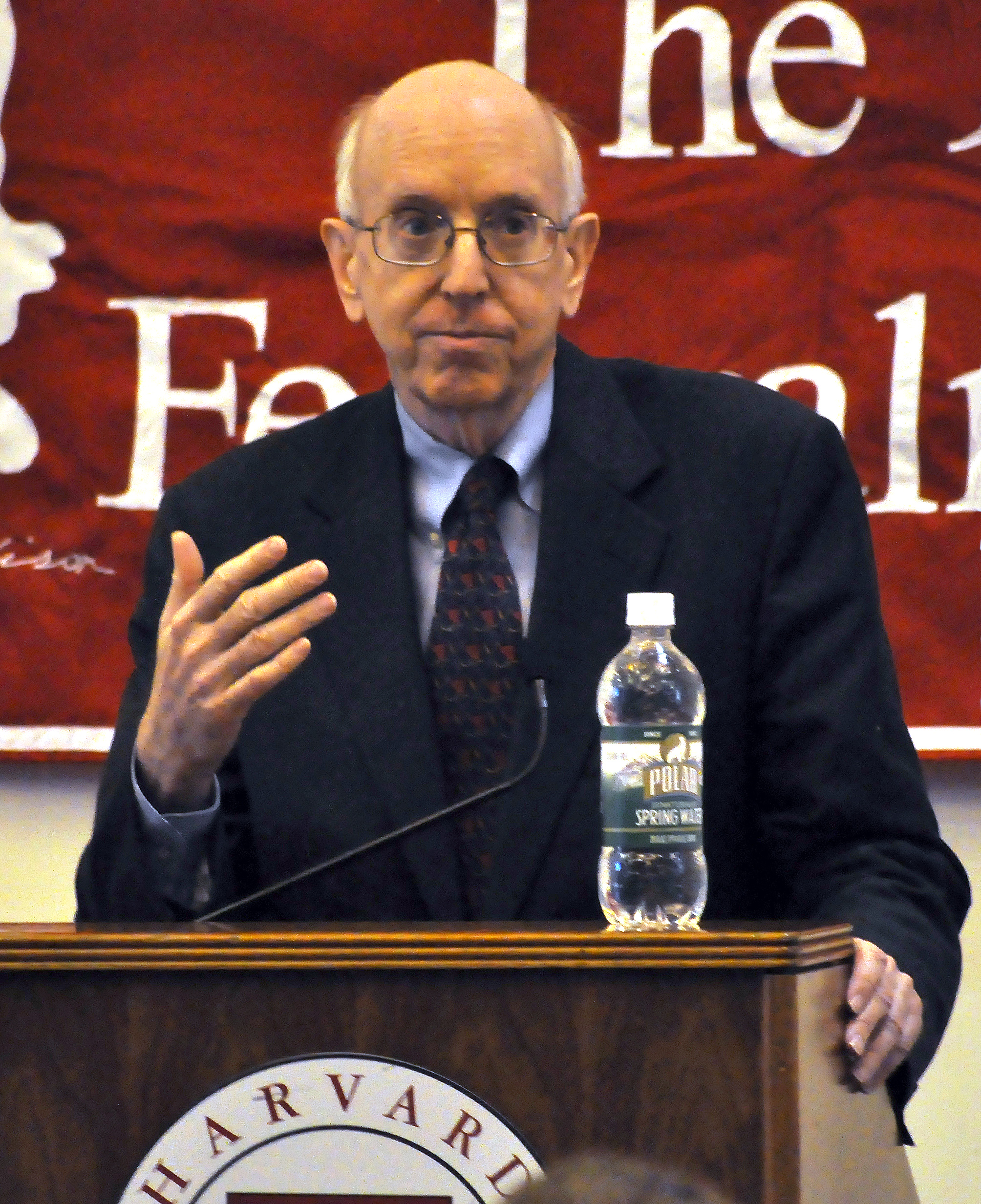
Historical · U.S. Court of Appeals for the Seventh Circuit
Richard Allen Posner
Former Circuit Judge · U.S. Court of Appeals for the Seventh Circuit · 1981–2017 · Appointed by Ronald Reagan
Richard Allen Posner served as a circuit judge of the U.S. Court of Appeals for the Seventh Circuit (1981–2017). Posner was appointed by Ronald Reagan.
Key facts
- Full name
- Richard Allen Posner
- Court
- U.S. Court of Appeals for the Seventh Circuit
- Office
- Circuit Judge (U.S. Court of Appeals)
- Status
- Former circuit judge
- Duty status
- Not serving
- Appointment
- Senate-confirmed
- FJC seat
- CA70705
- Tenure
- 1981–2017
- Confirmed
- 1981-11-24
- Born
- 1939
- Died
- —
- First year on the bench
- 1981
- Dataset version
- 1.20260711
Appointment & service record
U.S. Court of Appeals for the Seventh Circuit · 1981–2017
- Seat
- CA70705
- Appointment
- Senate-confirmed
- Appointing president
- Ronald Reagan
- Confirmed
- 1981-11-24
- Commissioned
- 1981-12-01
- Senior status
- —
- Chief Judge
- 1993–2000
Court, FJC seat, appointment type (Senate-confirmed or recess), appointing president, confirmation and commission dates, and senior-status date are drawn from the Federal Judicial Center Biographical Directory and Wikidata.[1][2][3]
Sources
- [1]https://www.fjc.gov/node/1386511fjc · retrieved 2026-07-11
- [2]https://www.fjc.gov/history/judges/biographical-directory-article-iii-federal-judges-exportfjc-directory · retrieved 2026-07-11
- [3]https://www.wikidata.org/wiki/Q533583Wikidata · retrieved 2026-07-11
Biographical narrative
1,416 words · sourced from the Wikipedia REST extract
Richard Allen Posner is a retired United States circuit judge who served on the U.S. Court of Appeals for the Seventh Circuit from 1981 to 2017. Born in 1939, he was appointed to the federal bench by President Ronald Reagan, a Republican, and served as chief judge of the Seventh Circuit from 1993 to 2000. Beyond his judicial service, Posner is recognized as one of the most influential and frequently cited legal scholars in American history, having been identified as the most-cited legal scholar of the twentieth century and, as of 2021, the most-cited American legal scholar of all time. A prolific author and former law professor at the University of Chicago, he has written extensively on law and economics, jurisprudence, and numerous other subjects both within and outside the legal field.
Early life and legal career
Richard Allen Posner was born on January 11, 1939, in New York City, to Max Posner and Blanche Hofrichter. His family background was Jewish, with his father's family having Romanian Jewish roots and his mother's family being Ashkenazi Jews from Galicia, a region that was part of the Austrian Empire. Posner's academic career began with exceptional distinction. He pursued undergraduate studies at Yale University, where he focused on English literature rather than pre-law studies. He graduated from Yale in 1959 with a Bachelor of Arts degree, earning summa cum laude honors and membership in the prestigious Phi Beta Kappa honor society.
Following his undergraduate education, Posner attended Harvard Law School, where he quickly established himself as an outstanding student. He served as president of the Harvard Law Review, one of the most prestigious positions available to law students and traditionally a marker of exceptional academic achievement. In 1962, he graduated from Harvard Law School with an LL.B. degree, magna cum laude, finishing first in his class—a remarkable accomplishment that positioned him for elite opportunities in the legal profession.
After completing law school, Posner secured a clerkship with Justice William J. Brennan Jr. of the United States Supreme Court, serving from 1962 to 1963. This clerkship provided him with invaluable experience at the highest level of the American judiciary. Following his Supreme Court clerkship, Posner worked as an attorney-advisor to Commissioner Philip Elman at the Federal Trade Commission. Interestingly, he would later in his career argue for the abolition of the FTC, demonstrating the evolution of his economic and regulatory thinking. He subsequently joined the Office of the Solicitor General at the United States Department of Justice, working under Solicitor General Thurgood Marshall, who would himself later become a Supreme Court Justice.
In 1968, Posner transitioned to academia, accepting a teaching position at Stanford Law School. His academic career took a significant turn in 1969 when he joined the faculty of the University of Chicago Law School, an institution with which he would maintain a long association. At Chicago, Posner became deeply involved in the law and economics movement, which applies economic analysis to legal questions. In 1972, he became a founding editor of The Journal of Legal Studies, a publication that would become central to the development and dissemination of law and economics scholarship. Throughout his subsequent judicial career, Posner maintained his connection to the University of Chicago, continuing to serve as a part-time senior lecturer even while sitting on the federal bench.
Federal appellate service
On October 27, 1981, President Ronald Reagan nominated Posner to serve as a judge on the United States Court of Appeals for the Seventh Circuit. The nomination was to fill a seat that had been vacated by Judge Philip Willis Tone. The United States Senate confirmed Posner's appointment on November 24, 1981, and he received his commission on December 1, 1981, officially beginning his tenure on the federal appellate bench. He would serve on the Seventh Circuit for thirty-six years.
During his time on the Seventh Circuit, Posner served as chief judge from 1993 to 2000, a seven-year period during which he held administrative responsibility for the court in addition to his judicial duties. Even while serving as chief judge and throughout his tenure on the bench, he maintained his academic appointment at the University of Chicago Law School, continuing to teach and write as a part-time senior lecturer. This dual role as both judge and scholar was relatively unusual and allowed him to maintain active engagement with both the practical application of law and its theoretical development.
Posner retired from the federal bench on September 2, 2017, at the age of seventy-eight. He had originally planned to retire at age eighty, but he chose to step down earlier than anticipated. According to his own statements, his decision to retire ahead of schedule was influenced by disputes with other judges on the Seventh Circuit concerning the treatment of pro se litigants—parties who represent themselves in court without attorneys. This departure from the bench marked the end of more than three and a half decades of federal judicial service, though Posner remained active in legal scholarship and public commentary following his retirement.
Jurisprudence and legacy
Posner's intellectual approach to law has been characterized by pragmatism in philosophy and the application of economic analysis to legal questions. He has been extraordinarily prolific as a legal writer, authoring nearly forty books covering a wide range of subjects. His major works include treatises and scholarly books on law and economics, antitrust law, and jurisprudence, with notable titles including Economic Analysis of Law, The Economics of Justice, The Problems of Jurisprudence, Sex and Reason, Law, Pragmatism and Democracy, and The Crisis of Capitalist Democracy. These works have established him as a central figure in multiple fields of legal scholarship.
Beyond traditional legal subjects, Posner has written extensively on topics that extend well outside conventional legal analysis. His scholarly range encompasses animal rights, feminism, drug prohibition, same-sex marriage, Keynesian economics, the intersection of law and literature, and academic moral philosophy, among many other subjects. This breadth of intellectual engagement has distinguished him from many other legal scholars and judges, making him a prominent public intellectual as well as a jurist.
Posner's influence on law and economics has been particularly significant. He has been described by The New York Times as one of the most important antitrust scholars of the past half-century, and his economic approach to legal analysis has shaped how generations of lawyers, judges, and scholars think about legal rules and institutions. His work has emphasized the importance of efficiency and practical consequences in legal decision-making, often challenging traditional doctrinal approaches.
In December 2004, Posner launched a joint blog with Gary Becker, a Nobel Prize-winning economist, titled "The Becker-Posner Blog." The two scholars contributed regular posts to the blog, engaging with current events and policy questions from economic and legal perspectives, until shortly before Becker's death in May 2014. Following Becker's death, Posner announced the blog's discontinuation. He also maintained a blog at The Atlantic, where he analyzed the financial crisis and economic recession that began in 2008.
Posner's willingness to engage with contemporary political and social controversies has been a notable feature of his career. He has written on subjects including the 2000 presidential election recount controversy, President Bill Clinton's impeachment proceedings, and the 2003 invasion of Iraq. His analysis of the Clinton-Lewinsky scandal was noted for cutting across partisan and ideological divisions, demonstrating his independent analytical approach.
In 2005, Posner was mentioned as a potential nominee to the United States Supreme Court to replace Justice Sandra Day O'Connor, reflecting his prominence as both a scholar and appellate judge. However, commentary at the time suggested that despite his obvious intellectual qualifications, his appointment might face obstacles due to some of his more provocative scholarly positions, including arguments about the rule of law, proposals involving market mechanisms for adoption, and support for drug legalization.
Posner's jurisprudential evolution over his career has been notable. While he was generally considered liberal during his youth and his clerkship with Justice Brennan in the 1960s, he later became identified with conservative and libertarian approaches to law and economics. However, toward the end of his judicial tenure, he distanced himself from Republican Party positions, authoring opinions in cases involving same-sex marriage and abortion that reflected more liberal positions. In his book A Failure of Capitalism, written in response to the 2008 financial crisis, Posner indicated that the crisis had caused him to question aspects of the rational-choice, laissez-faire economic model that had been central to his law and economics scholarship, demonstrating his continued intellectual evolution even late in his career.
Sources & provenance
Every quantitative or attributable claim above carries a per-section [N] marker that resolves to the corresponding URL below. Each entry records the upstream provider, the canonical URL, and the timestamp at which the underlying source was retrieved.
Key facts
- https://www.fjc.gov/node/1386511fjc · retrieved 2026-07-11
- https://www.fjc.gov/history/judges/biographical-directory-article-iii-federal-judges-exportfjc-directory · retrieved 2026-07-11
- https://www.wikidata.org/wiki/Q533583Wikidata · retrieved 2026-07-11
Biographical narrative
- https://en.wikipedia.org/wiki/Richard_PosnerWikipedia · retrieved 2026-07-11
Explore the federal judiciary
The U.S. Courts of Appeals are the intermediate appellate courts of the federal judiciary — thirteen circuits sitting between the district courts and the Supreme Court. Browse the full roster of judges on the U.S. Court of Appeals for the Seventh Circuit, or explore how the appointed federal judiciary fits into the federal government.