
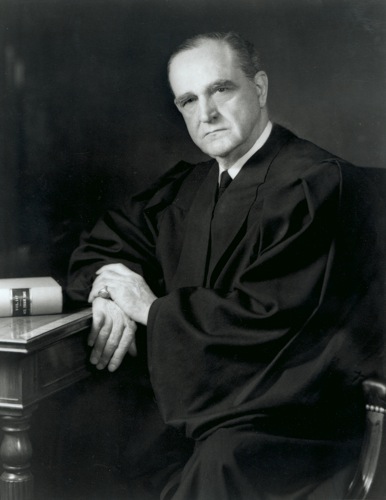
Historical · U.S. Court of Appeals for the Seventh Circuit
Sherman Minton
Former Circuit Judge · U.S. Court of Appeals for the Seventh Circuit · 1941–1949 · Appointed by Franklin D Roosevelt
Sherman Minton served as a circuit judge of the U.S. Court of Appeals for the Seventh Circuit (1941–1949). Minton was appointed by Franklin D Roosevelt.
Key facts
- Full name
- Sherman Minton
- Court
- U.S. Court of Appeals for the Seventh Circuit
- Office
- Circuit Judge (U.S. Court of Appeals)
- Status
- Former circuit judge
- Duty status
- Not serving
- Appointment
- Senate-confirmed
- FJC seat
- CA70305
- Tenure
- 1941–1949
- Confirmed
- 1941-05-19
- Born
- 1890-10-20
- Died
- 1965-04-09
- First year on the bench
- 1941
- Dataset version
- 1.20260711
Appointment & service record
U.S. Court of Appeals for the Seventh Circuit · 1941–1949
- Seat
- CA70305
- Appointment
- Senate-confirmed
- Appointing president
- Franklin D Roosevelt
- Confirmed
- 1941-05-19
- Commissioned
- 1941-05-22
- Senior status
- —
Court, FJC seat, appointment type (Senate-confirmed or recess), appointing president, confirmation and commission dates, and senior-status date are drawn from the Federal Judicial Center Biographical Directory and Wikidata.[1][2][3]
Sources
- [1]https://www.fjc.gov/node/1385206fjc · retrieved 2026-07-11
- [2]https://www.fjc.gov/history/judges/biographical-directory-article-iii-federal-judges-exportfjc-directory · retrieved 2026-07-11
- [3]https://www.wikidata.org/wiki/Q1849894Wikidata · retrieved 2026-07-11
Biographical narrative
1,560 words · sourced from the Wikipedia REST extract
Sherman Minton was a United States circuit judge who served on the U.S. Court of Appeals for the Seventh Circuit from 1941 to 1949. Born on October 20, 1890, in Georgetown, Indiana, he was appointed to the federal appellate bench by President Franklin D. Roosevelt, a Democrat, and confirmed by the Senate on May 19, 1941. His service on the Seventh Circuit represented a significant chapter in his legal career, coming after his tenure as a U.S. Senator from Indiana and preceding his later appointment to the Supreme Court of the United States. Minton remained on the Seventh Circuit until 1949, when he transitioned to the nation's highest court. He passed away on April 9, 1965.
Early life and legal career
Minton was born to John Evan and Emma Livers Minton in their home in Georgetown, Indiana. He was the third of four children in the family and acquired the nickname "Shay" due to his younger brother's difficulty pronouncing his given name. His early education took place in a modest two-room schoolhouse in Georgetown, where he studied through the eighth grade. From a young age, Minton was exposed to the world of politics and public affairs; when he was only five years old, his father brought him to hear a speech delivered by William Jennings Bryan, a figure Minton would continue to admire throughout his life.
The Minton family faced considerable hardship during his childhood. In 1898, his father, who worked as a railroad laborer, became disabled after suffering heat stroke while on the job. Following this injury, John Minton attempted to support the family through various occupations, including farming, butchering, and running a grocery. The family's financial instability required young Sherman to take on odd jobs to contribute to the household income. Tragedy struck again in 1900 when Minton's mother was diagnosed with breast cancer. A physician attempted to remove her tumors in April of that year, performing the surgery on the family's dinner table, but she died during the operation. This traumatic loss had a profound emotional impact on the young Minton and led him to question religious faith, causing him to distance himself from organized religion for much of his life. His father remarried on December 3, 1901, to Sarah Montague.
Despite enjoying his studies, Minton was known as a mischievous youth. In 1904, he was arrested for the offense of riding his bicycle on the sidewalk and was brought before a justice of the peace, who imposed a fine of one dollar plus court costs. Minton later identified this incident as the catalyst for his ambition to pursue a legal career. To earn money for further education, he joined his older brother Herbert in Fort Worth, Texas, where he found employment at a Swift & Company meatpacking facility. His father, stepmother, and younger siblings eventually relocated to Texas as well. After accumulating sufficient savings to continue his schooling, Minton returned to Georgetown, where he lived with relatives and enrolled in high school.
Minton began his secondary education at Edwardsville High School, but when that institution closed, he transferred to New Albany High School for his final three years. During his time there, he was an active participant in athletics, competing on the football, baseball, and track teams. He also helped establish the school's first debate club, known as the Wranglers. Following high school, Minton pursued higher education and legal training, which prepared him for his subsequent career in law and public service.
After completing his legal education, Minton served as a captain during World War I. Following the war, he embarked on a career that combined legal practice with political activity. He made multiple attempts to win elected office before achieving success. In 1930, he became a utility commissioner under the administration of Paul V. McNutt, who served as Governor of Indiana. This position provided Minton with valuable experience in public administration and regulatory matters. Four years later, in 1934, he successfully ran for the United States Senate, representing Indiana as a member of the Democratic Party.
During his Senate tenure, Minton became one of President Franklin D. Roosevelt's most loyal allies in the upper chamber. He vigorously defended New Deal legislation and became particularly associated with controversial statements made during his campaign, including remarks suggesting that strict adherence to constitutional limitations was not necessary during the economic crisis of the Great Depression. One address in particular became known as the "You Cannot Eat the Constitution" speech, which drew widespread criticism from political opponents. In the Senate, Minton championed Roosevelt's unsuccessful court-packing plan, which sought to expand the Supreme Court and alter its ideological composition. His strong support for the New Deal and the Roosevelt administration made him a prominent figure within the New Deal Coalition.
Federal appellate service
Minton's service on the U.S. Court of Appeals for the Seventh Circuit began in 1941, following his defeat in the 1940 Senate reelection campaign. President Roosevelt appointed him to the federal appellate bench, and the Senate confirmed him on May 19, 1941, to seat CA70305. This appointment represented a transition from Minton's role as an active political figure and legislative advocate to that of a federal jurist. The Seventh Circuit, which has jurisdiction over appeals from federal district courts in Illinois, Indiana, and Wisconsin, provided Minton with the opportunity to apply his legal training and political experience to the resolution of complex legal questions.
Minton served on the Seventh Circuit for eight years, from 1941 to 1949. During this period, he developed his judicial philosophy and gained experience in appellate decision-making. His time on the circuit court allowed him to work alongside other federal judges and to participate in the interpretation and application of federal law across a range of subject matters. The experience he gained during these years would prove formative for his later judicial service.
His tenure on the Seventh Circuit came to an end in 1949 when President Harry S. Truman nominated him to the Supreme Court of the United States. Truman and Minton had developed a close personal friendship during their overlapping service in the Senate, and this relationship influenced Truman's decision to elevate Minton to the nation's highest court. The Senate confirmed Minton's Supreme Court nomination on October 4, 1949, by a vote of 48 to 16, with fifteen Republicans and one Democrat voting against the nomination. With this confirmation, Minton left the Seventh Circuit to assume his new responsibilities as an Associate Justice.
Jurisprudence and legacy
Minton's judicial philosophy, which he developed during his time on the Seventh Circuit and refined during his Supreme Court service, was characterized by a commitment to judicial restraint and deference to the political branches of government. According to historians, his approach to judging was largely shaped by his experiences as a New Deal senator and his observation of the conflicts between the Roosevelt administration and the conservative Supreme Court of the 1930s, which had struck down significant portions of New Deal legislation as unconstitutional. These experiences led Minton to believe that courts should exercise restraint in reviewing the actions of Congress and the executive branch.
As a jurist, Minton supported a broad interpretation of congressional powers and generally opposed efforts to invalidate federal legislation on constitutional grounds, viewing such judicial activism as an overreach of judicial authority. His philosophy emphasized upholding the intent of the political branches and showing deference to their policy judgments. Historians have noted the striking contrast between his role as a partisan liberal senator advocating for expansive government action and his subsequent role as a jurist committed to restraint and deference, even when that meant upholding conservative legislation passed by a Senate that had become more conservative during his time on the bench.
During his Supreme Court tenure, which lasted seven years until his retirement in 1956, Minton was initially a regular supporter of majority opinions. However, after President Dwight Eisenhower's appointees joined the Court and altered its ideological composition, Minton found himself dissenting more frequently. He was known for playing the role of peacemaker and consensus builder during a period when personal feuds and ideological divisions created tension among the justices. His judicial approach generally favored order and governmental authority over individual liberty claims, reflecting his broad interpretation of governmental powers.
Historians have offered varying assessments of Minton's judicial contributions. Some have expressed negative opinions of his judicial record, pointing to what they view as the limited impact of his rulings and his reluctance to check governmental power. Other scholars, however, have praised his strong commitment to his judicial principles and his consistent application of a coherent philosophy of judicial restraint. His legacy includes being the last member of the United States Congress to be appointed to the Supreme Court, a distinction that remains true to the present day.
Poor health forced Minton to retire from the Supreme Court in 1956. Following his retirement, he remained active by traveling and delivering lectures on legal and judicial topics. He continued these activities until his death on April 9, 1965. In recognition of his public service, the Sherman Minton Bridge in southern Indiana and the Minton-Capehart Federal Building in Indianapolis were named in his honor in 1962. These memorials serve as lasting tributes to his contributions to Indiana and to the federal judiciary, commemorating both his service on the Seventh Circuit and his subsequent role on the Supreme Court.
Sources & provenance
Every quantitative or attributable claim above carries a per-section [N] marker that resolves to the corresponding URL below. Each entry records the upstream provider, the canonical URL, and the timestamp at which the underlying source was retrieved.
Key facts
- https://www.fjc.gov/node/1385206fjc · retrieved 2026-07-11
- https://www.fjc.gov/history/judges/biographical-directory-article-iii-federal-judges-exportfjc-directory · retrieved 2026-07-11
- https://www.wikidata.org/wiki/Q1849894Wikidata · retrieved 2026-07-11
Biographical narrative
- https://en.wikipedia.org/wiki/Sherman_MintonWikipedia · retrieved 2026-07-11
Explore the federal judiciary
The U.S. Courts of Appeals are the intermediate appellate courts of the federal judiciary — thirteen circuits sitting between the district courts and the Supreme Court. Browse the full roster of judges on the U.S. Court of Appeals for the Seventh Circuit, or explore how the appointed federal judiciary fits into the federal government.