
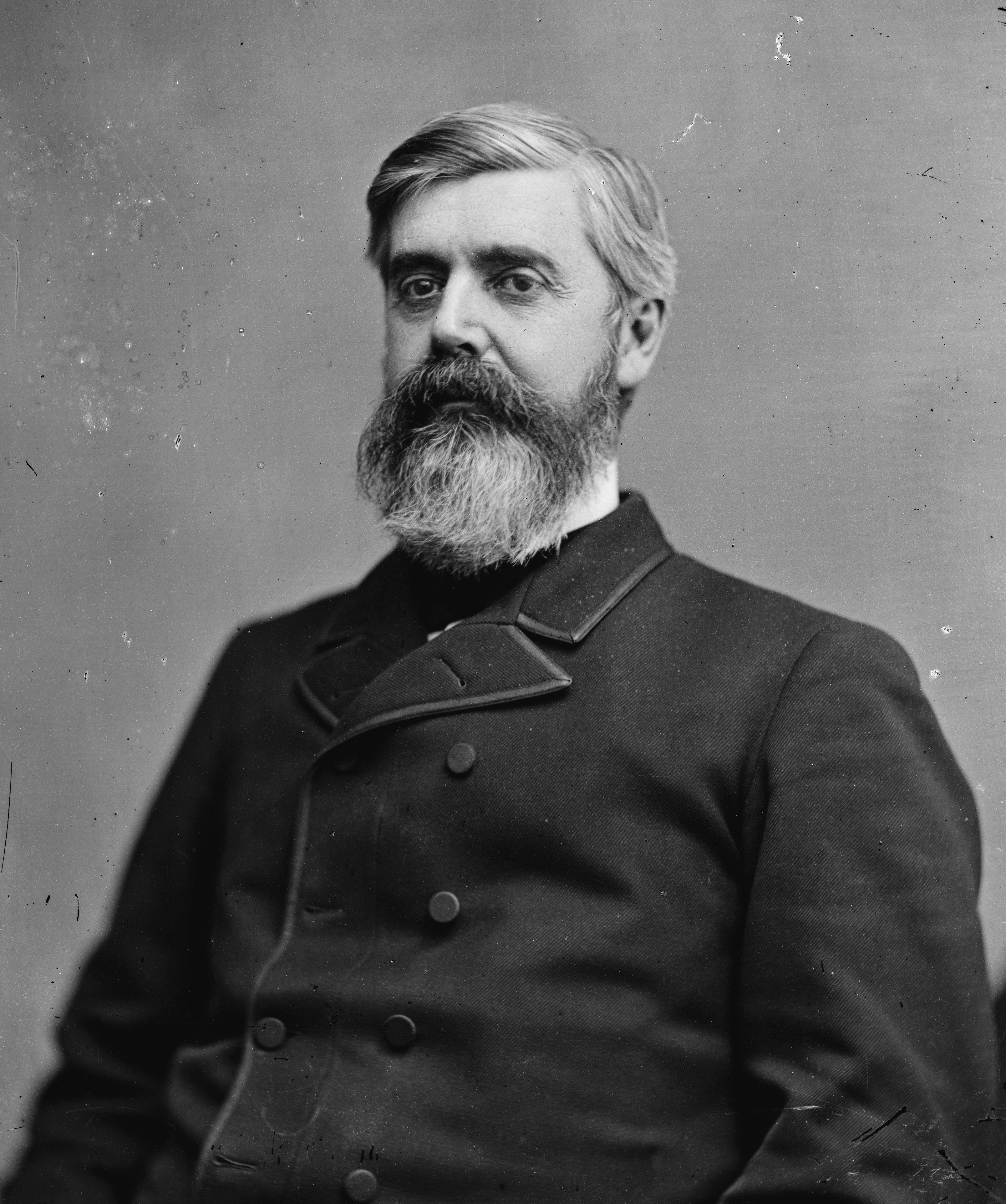
Historical · U.S. Court of Appeals for the Seventh Circuit
Walter Quintin Gresham
Former Circuit Judge · U.S. Court of Appeals for the Seventh Circuit · 1891–1893 · Appointed by None Assignment
Walter Quintin Gresham served as a circuit judge of the U.S. Court of Appeals for the Seventh Circuit (1891–1893). Gresham was appointed by None Assignment.
Key facts
- Full name
- Walter Quintin Gresham
- Court
- U.S. Court of Appeals for the Seventh Circuit
- Office
- Circuit Judge (U.S. Court of Appeals)
- Status
- Former circuit judge
- Duty status
- Not serving
- Appointment
- Recess appointment
- FJC seat
- CA70101
- Tenure
- 1891–1893
- Confirmed
- —
- Born
- 1832-03-17
- Died
- 1895-05-28
- First year on the bench
- 1891
- Dataset version
- 1.20260711
Appointment & service record
U.S. Court of Appeals for the Seventh Circuit · 1891–1893
- Seat
- CA70101
- Appointment
- Recess appointment
- Appointing president
- None Assignment
- Confirmed
- Recess appointment
- Commissioned
- 1891-06-16
- Senior status
- —
Court, FJC seat, appointment type (Senate-confirmed or recess), appointing president, confirmation and commission dates, and senior-status date are drawn from the Federal Judicial Center Biographical Directory and Wikidata.[1][2][3]
Sources
- [1]https://www.fjc.gov/node/1381516fjc · retrieved 2026-07-11
- [2]https://www.fjc.gov/history/judges/biographical-directory-article-iii-federal-judges-exportfjc-directory · retrieved 2026-07-11
- [3]https://www.wikidata.org/wiki/Q726198Wikidata · retrieved 2026-07-11
Biographical narrative
1,770 words · sourced from the Wikipedia REST extract
Walter Quintin Gresham was a federal appellate judge who served on the United States Court of Appeals for the Seventh Circuit from 1891 to 1893. Born in Indiana in 1832, he had a distinguished career that spanned military service during the Civil War, federal district court judgeships, cabinet positions in two presidential administrations, and ultimately service on the nation's second-highest court. His judicial career was interrupted by periods of executive branch service, and he died in 1895 while serving as United States Secretary of State.
Early life and legal career
Walter Quintin Gresham was born on March 17, 1832, in Lanesville, Indiana, to William Gresham and Sarah Davis. His father, William Gresham, had served as a colonel in the Indiana militia and worked as a cabinet maker while maintaining involvement in politics as a member of the Whig Party. William Gresham was elected to serve as sheriff of Harrison County, but his life was cut tragically short on January 26, 1834, when he was fatally stabbed while attempting to assist in the arrest of an individual described in contemporary accounts as a desperado. Following his father's death, Walter and his brothers were raised by their stepfather, Noah Remley. Another significant influence during his childhood was his grandmother's brother, Dennis Pennington, who helped secure young Walter a position working in the office of the Harrison County auditor.
Gresham received his early education at local schools in Harrison County before attending Corydon Seminary from 1849 to 1851. He continued his education at Indiana University Bloomington, where he studied for one year beginning in September 1851. After leaving the university, he returned to Corydon to study law through the traditional method of reading law under the supervision of an established attorney, in this case Judge William A. Porter. Gresham was admitted to the bar on April 1, 1854, and began his legal career by entering private practice in partnership with Thomas C. Slaughter.
Even as a young attorney, Gresham became actively engaged in the political debates of his era. He positioned himself as an opponent of slavery, though he advocated for gradual and peaceful abolition rather than more radical approaches. His first foray into electoral politics came in 1853 when he ran unsuccessfully for the position of Harrison County clerk. As the political landscape shifted during the 1850s, Gresham initially joined the nativist American Party in 1855, but he quickly transitioned to the newly formed Republican Party in 1856 and became an active campaigner for the party's candidates. His political efforts bore fruit in 1860 when he was elected to the Indiana House of Representatives as a Republican, a notable achievement given that he won in a strongly Democratic district. Despite Stephen A. Douglas carrying Harrison County in the presidential election that year, Gresham managed to secure victory by a margin of sixty votes.
During his service in the state legislature, Gresham demonstrated his political principles through his legislative actions. His first act in the House was to introduce a resolution that would have declared armed resistance to constitutional laws enacted by Congress as treason, though the specific word "treason" was ultimately removed from the final version that passed. He also established himself as a vocal critic of the spoils system of political patronage. As chair of the House Committee on Military Affairs, he authored legislation that transferred the power to commission militia officers to the governor, replacing the previous system in which such officers had been elected. Despite his legislative accomplishments, Gresham's relationship with Governor Oliver P. Morton became strained after he received a commission as a colonel on Morton's staff but was later refused a militia commission he had requested.
At the conclusion of his legislative term, Gresham turned his attention to military service as the Civil War began. He organized a military company at Corydon and initially enlisted as a private soldier. He was elected captain by his company, but following lobbying efforts by his friends directed at Governor Morton, he was commissioned as lieutenant colonel of the 38th Indiana Volunteer Infantry on September 18, 1861. His military career advanced rapidly; by December he had been promoted to colonel and placed in command of the 53rd Indiana Volunteer Infantry. This regiment participated in Ulysses S. Grant's Tennessee campaign of 1862, including engagements at the Sieges of Corinth and Vicksburg, during which Colonel Gresham commanded a brigade. His service was recognized with promotion to brigadier general of volunteers on August 11, 1863, and he was assigned to command Federal forces at Natchez, Mississippi. In 1864, he commanded a division of the XVII Corps during William Tecumseh Sherman's Atlanta campaign. However, his active military service came to an abrupt end on July 20, before the Battle of Atlanta, when he received a gunshot wound to his knee. This injury forced his retirement from active service and left him with a permanent limp. In recognition of his service, he was appointed a brevet major general of volunteers in 1865.
Following the war, Gresham returned to civilian life and resumed the practice of law. In November 1865, he established a law practice in New Albany, Indiana, initially in partnership with Judge John Butler before transitioning to solo practice. His political standing within the Republican Party became complicated due to his opposition to black suffrage, which caused his popularity to decline among party members. Nevertheless, he received the Republican nomination for the United States House of Representatives in 1866 but was defeated by Michael C. Kerr. Rather than continuing in private practice, the state legislature elected him to a position handling Indiana state finances in New York City. While serving in that capacity, he participated as a delegate to the 1868 Republican National Convention. He was nominated to run for the House against Kerr once more but suffered defeat by an even larger margin than in his previous attempt.
On September 1, 1869, Gresham's career took a significant turn when he received a recess appointment to serve as a judge on the United States District Court for the District of Indiana, filling a vacancy left by Judge David McDonald. This appointment came after he had declined other positions offered by President Ulysses S. Grant, including appointments as collector of the Port of New Orleans and United States attorney for the District of Indiana. President Grant formally nominated Gresham for the district court position on December 6, 1869, and the United States Senate confirmed him on December 21, 1869, the same day he received his commission. His tenure as a district judge was marked by significant events, including the Great Railroad Strike of 1877, during which he took the initiative to organize volunteer companies to maintain order and protect property. Throughout this period, he repeatedly declined opportunities to run for various public offices, including governor of Indiana and the United States Senate.
On April 9, 1883, Gresham resigned from the district court bench to accept appointment as United States Postmaster General in the cabinet of President Chester A. Arthur. In this role, he oversaw significant postal reforms, including the reduction of the postal rate from three cents to two cents and an increase in the weight allowance for mail.
Federal appellate service
Gresham's service on the United States Court of Appeals for the Seventh Circuit began in 1891 and continued until 1893. According to official records, he received a recess appointment to the position and occupied seat CA70101 on the court. The circumstances of his appointment indicate it was made through assignment, and records do not reflect a subsequent formal confirmation process. This appellate service represented a return to the federal judiciary after his tenure in executive branch positions.
The Seventh Circuit, which had jurisdiction over federal appeals from several Midwestern states, provided Gresham with a forum to address significant legal questions at the appellate level. His service on this court came during a period of significant development in federal appellate jurisdiction, as the circuit courts of appeals had been recently established by the Evarts Act to help manage the growing caseload of the federal judiciary and provide an intermediate level of review between the district courts and the Supreme Court.
Gresham's tenure on the Court of Appeals for the Seventh Circuit was relatively brief, lasting approximately two years. His service on the appellate bench ended in 1893, when he departed the judiciary to assume another position in the executive branch. This pattern of movement between judicial and executive service characterized much of Gresham's professional life during this period.
Jurisprudence and legacy
Gresham's judicial philosophy and approach to deciding cases developed over his years of service on both the district court and the court of appeals. His experience as a district judge from 1869 to 1883 provided him with extensive exposure to trial-level federal litigation, while his later service on the Seventh Circuit allowed him to engage with appellate review and the development of legal doctrine at a higher level. His background as a military officer, state legislator, and cabinet official brought practical experience in government operations to his judicial work.
The trajectory of Gresham's career reflected the fluid boundaries between judicial and political service that characterized the late nineteenth century. His willingness to move between the bench and executive positions demonstrated both his versatility and the different expectations of judicial independence that prevailed during that era. His service in multiple branches of government provided him with a broad perspective on federal law and policy.
Beyond his judicial service, Gresham remained engaged in national politics and policy debates. He was twice considered as a candidate for the Republican nomination for president in 1884 and 1888. His political allegiances shifted over time, and he eventually left the Republican Party to support Democrat Grover Cleveland in the 1892 presidential election. Following Cleveland's victory, Gresham joined Cleveland's second cabinet as United States Secretary of State in 1893, a position he held until his death. One contemporary observer later attributed aspects of Gresham's approach to foreign policy during his time as Secretary of State to his devout religiosity, suggesting that his personal convictions influenced his public service.
Walter Quintin Gresham died on May 28, 1895, while still serving as Secretary of State. His career encompassed military leadership during the Civil War, judicial service at both the trial and appellate levels of the federal court system, multiple cabinet positions under presidents of different parties, and active participation in the political debates of the Reconstruction and Gilded Age periods. His service on the United States Court of Appeals for the Seventh Circuit, though brief, formed part of a diverse career in public service that spanned more than three decades.
Sources & provenance
Every quantitative or attributable claim above carries a per-section [N] marker that resolves to the corresponding URL below. Each entry records the upstream provider, the canonical URL, and the timestamp at which the underlying source was retrieved.
Key facts
- https://www.fjc.gov/node/1381516fjc · retrieved 2026-07-11
- https://www.fjc.gov/history/judges/biographical-directory-article-iii-federal-judges-exportfjc-directory · retrieved 2026-07-11
- https://www.wikidata.org/wiki/Q726198Wikidata · retrieved 2026-07-11
Biographical narrative
- https://en.wikipedia.org/wiki/Walter_Q._GreshamWikipedia · retrieved 2026-07-11
Explore the federal judiciary
The U.S. Courts of Appeals are the intermediate appellate courts of the federal judiciary — thirteen circuits sitting between the district courts and the Supreme Court. Browse the full roster of judges on the U.S. Court of Appeals for the Seventh Circuit, or explore how the appointed federal judiciary fits into the federal government.