
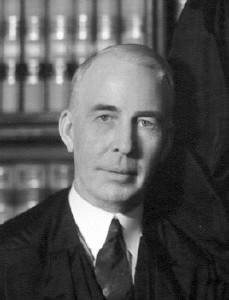
Historical · U.S. Court of Appeals for the Sixth Circuit
Charles Harwood Moorman
Former Circuit Judge · U.S. Court of Appeals for the Sixth Circuit · 1925–1938 · Appointed by Calvin Coolidge
Charles Harwood Moorman served as a circuit judge of the U.S. Court of Appeals for the Sixth Circuit (1925–1938). Moorman was appointed by Calvin Coolidge.
Key facts
- Full name
- Charles Harwood Moorman
- Court
- U.S. Court of Appeals for the Sixth Circuit
- Office
- Circuit Judge (U.S. Court of Appeals)
- Status
- Former circuit judge
- Duty status
- Not serving
- Appointment
- Senate-confirmed
- FJC seat
- CA60104
- Tenure
- 1925–1938
- Confirmed
- 1925-01-13
- Born
- 1876-04-24
- Died
- 1938-01-26
- First year on the bench
- 1925
- Dataset version
- 1.20260711
Appointment & service record
U.S. Court of Appeals for the Sixth Circuit · 1925–1938
- Seat
- CA60104
- Appointment
- Senate-confirmed
- Appointing president
- Calvin Coolidge
- Confirmed
- 1925-01-13
- Commissioned
- 1925-01-13
- Senior status
- —
Court, FJC seat, appointment type (Senate-confirmed or recess), appointing president, confirmation and commission dates, and senior-status date are drawn from the Federal Judicial Center Biographical Directory and Wikidata.[1][2][3]
Sources
- [1]https://www.fjc.gov/node/1385326fjc · retrieved 2026-07-11
- [2]https://www.fjc.gov/history/judges/biographical-directory-article-iii-federal-judges-exportfjc-directory · retrieved 2026-07-11
- [3]https://www.wikidata.org/wiki/Q5078830Wikidata · retrieved 2026-07-11
Biographical narrative
1,283 words · sourced from the Wikipedia REST extract
Charles Harwood Moorman was a United States circuit judge who served on the United States Court of Appeals for the Sixth Circuit from 1925 until his death in 1938. Born in Kentucky in 1876, he built a distinguished legal career that included private practice, military service during World War I, a position on Kentucky's highest state court, and ultimately more than a decade on the federal appellate bench. Appointed by President Calvin Coolidge, a Republican, Moorman contributed to the development of federal jurisprudence in the Sixth Circuit during a transformative period in American legal history that encompassed the later years of the Roaring Twenties, the Great Depression, and the early New Deal era.
Early life and legal career
Charles Harwood Moorman was born on April 24, 1876, in Big Spring, Kentucky, a small community in the central part of the state. Details about his family background and early education are not extensively documented in available records. Rather than attending a traditional law school, Moorman pursued the path of reading law, a common method of legal education in the late nineteenth century whereby aspiring attorneys studied under the supervision of practicing lawyers or judges. Through this apprenticeship model, he gained admission to the bar in 1900, positioning himself to begin his professional legal career at the turn of the twentieth century.
Moorman commenced private practice in Elizabethtown, Kentucky, in 1900, establishing himself in this county seat located south of Louisville. He maintained his practice in Elizabethtown for six years, during which time he would have handled the variety of legal matters typical of a small-city attorney in that era. In 1906, he relocated his practice to Louisville, Kentucky's largest city and a major commercial center on the Ohio River. He continued in private practice in Louisville for fifteen years, building a reputation that would eventually lead to judicial appointment.
The course of Moorman's career was interrupted by World War I. From 1917 to 1918, he volunteered with the American Red Cross in France, contributing to humanitarian relief efforts during the conflict. In 1918, he served as a Major in the Judge Advocate General's Corps of the United States Army, applying his legal expertise to military justice matters during the final year of the war. This military service reflected both his sense of civic duty and his professional standing in the legal community.
Following his return from military service, Moorman's career took a judicial turn. In 1921, he was appointed as a judge of the Kentucky Court of Appeals, which at that time served as the highest court in the Commonwealth of Kentucky. He served on this state appellate court for three years, from 1921 to 1924, gaining valuable experience in appellate decision-making and legal analysis that would prove foundational for his subsequent federal judicial service.
Federal appellate service
Moorman's transition to the federal judiciary began with an appointment to the trial bench. On January 3, 1924, President Calvin Coolidge nominated him to serve as a United States district judge for the United States District Court for the Western District of Kentucky. This seat had been vacated by Judge Walter Evans. The United States Senate confirmed the nomination on January 8, 1924, and Moorman received his commission the same day, allowing him to assume his duties promptly. His tenure as a federal district judge, however, proved brief, as he served in that capacity for just over one year.
The opportunity for elevation to the federal appellate bench came quickly. On January 2, 1925, President Coolidge nominated Moorman to a seat on the United States Court of Appeals for the Sixth Circuit. This vacancy had been created by the departure of Judge Loyal Edwin Knappen. The Senate confirmed Moorman's appointment on January 13, 1925, and he received his commission that same day. His service on the district court terminated on February 2, 1925, as he assumed his new responsibilities on the circuit court. The Sixth Circuit, which hears appeals from federal district courts in Kentucky, Michigan, Ohio, and Tennessee, provided Moorman with a significantly broader jurisdiction and the opportunity to shape federal law across multiple states.
Moorman served on the Sixth Circuit for nearly thirteen years, participating in the resolution of numerous appeals during a period of significant legal and social change. The late 1920s saw continued economic expansion followed by the stock market crash of 1929, while the 1930s brought the challenges of the Great Depression and the legal controversies surrounding President Franklin Roosevelt's New Deal programs. Federal appellate courts during this era confronted novel questions about the scope of federal regulatory authority, the interpretation of new social and economic legislation, and the balance between governmental power and individual rights.
In recognition of his standing within the federal judiciary, Moorman was selected to serve as a member of the Conference of Senior Circuit Judges from 1932 to 1937. This body, which later became known as the Judicial Conference of the United States, served as the principal policy-making body for the administration of the federal court system. Membership in this conference indicated that Moorman was regarded as a senior and respected voice among federal appellate judges, contributing to discussions about court administration, procedural rules, and the operation of the federal judiciary during a period of institutional development.
Moorman's service on the Sixth Circuit continued until his death on January 26, 1938, at the age of sixty-one. His tenure of nearly thirteen years on the circuit court represented a substantial contribution to the federal appellate judiciary during a formative period in twentieth-century American law.
Jurisprudence and legacy
The specific details of Moorman's judicial philosophy and his most significant opinions are not extensively documented in readily available historical records. As a federal appellate judge during the 1920s and 1930s, he would have participated in decisions addressing the legal issues characteristic of that era, including matters of federal jurisdiction, statutory interpretation, constitutional questions arising from state and federal legislation, and the full range of civil and criminal appeals that came before the Sixth Circuit.
The period of Moorman's service coincided with significant developments in American law. The 1920s saw the federal courts grappling with Prohibition enforcement, the expansion of federal criminal jurisdiction, and questions about the scope of federal regulatory authority over interstate commerce. The 1930s brought an avalanche of litigation related to the economic crisis and the New Deal, with federal courts called upon to interpret new statutes governing labor relations, securities regulation, agricultural policy, and social welfare programs. As a member of the Sixth Circuit panel, Moorman would have contributed to the development of legal precedent in these and many other areas affecting the four states within the circuit's jurisdiction.
Moorman's career trajectory—from private practice through state appellate service to the federal bench—reflected a traditional path of judicial advancement in the early twentieth century. His military service during World War I and his subsequent selection for the Conference of Senior Circuit Judges suggest that he was regarded as a person of integrity and sound judgment by his contemporaries. His thirteen years on the Sixth Circuit provided continuity and institutional knowledge during a period of rapid change in American society and law.
The legacy of any appellate judge rests primarily in the body of written opinions and the contribution to legal doctrine, though the specific contours of Moorman's jurisprudential impact remain a subject that would require detailed archival research to fully assess. His service spanned a critical period in the development of federal law, and his participation in the Conference of Senior Circuit Judges placed him among the leadership of the federal judiciary during the 1930s. He died in office, having served the federal courts for fourteen years across both the district and circuit levels.
Sources & provenance
Every quantitative or attributable claim above carries a per-section [N] marker that resolves to the corresponding URL below. Each entry records the upstream provider, the canonical URL, and the timestamp at which the underlying source was retrieved.
Key facts
- https://www.fjc.gov/node/1385326fjc · retrieved 2026-07-11
- https://www.fjc.gov/history/judges/biographical-directory-article-iii-federal-judges-exportfjc-directory · retrieved 2026-07-11
- https://www.wikidata.org/wiki/Q5078830Wikidata · retrieved 2026-07-11
Biographical narrative
- https://en.wikipedia.org/wiki/Charles_Harwood_MoormanWikipedia · retrieved 2026-07-11
Explore the federal judiciary
The U.S. Courts of Appeals are the intermediate appellate courts of the federal judiciary — thirteen circuits sitting between the district courts and the Supreme Court. Browse the full roster of judges on the U.S. Court of Appeals for the Sixth Circuit, or explore how the appointed federal judiciary fits into the federal government.