
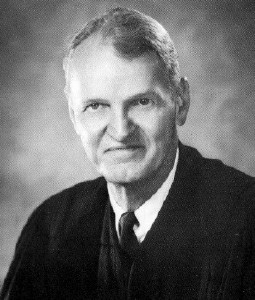
Historical · U.S. Court of Appeals for the Sixth Circuit
Henry Luesing Brooks
Former Circuit Judge · U.S. Court of Appeals for the Sixth Circuit · 1969–1971 · Appointed by Richard Nixon
Henry Luesing Brooks served as a circuit judge of the U.S. Court of Appeals for the Sixth Circuit (1969–1971). Brooks was appointed by Richard Nixon.
Key facts
- Full name
- Henry Luesing Brooks
- Court
- U.S. Court of Appeals for the Sixth Circuit
- Office
- Circuit Judge (U.S. Court of Appeals)
- Status
- Former circuit judge
- Duty status
- Not serving
- Appointment
- Senate-confirmed
- FJC seat
- CA61001
- Tenure
- 1969–1971
- Confirmed
- 1969-12-10
- Born
- 1905-12-09
- Died
- 1971-12-30
- First year on the bench
- 1969
- Dataset version
- 1.20260711
Appointment & service record
U.S. Court of Appeals for the Sixth Circuit · 1969–1971
- Seat
- CA61001
- Appointment
- Senate-confirmed
- Appointing president
- Richard Nixon
- Confirmed
- 1969-12-10
- Commissioned
- 1969-12-11
- Senior status
- —
Court, FJC seat, appointment type (Senate-confirmed or recess), appointing president, confirmation and commission dates, and senior-status date are drawn from the Federal Judicial Center Biographical Directory and Wikidata.[1][2][3]
Sources
- [1]https://www.fjc.gov/node/1378346fjc · retrieved 2026-07-11
- [2]https://www.fjc.gov/history/judges/biographical-directory-article-iii-federal-judges-exportfjc-directory · retrieved 2026-07-11
- [3]https://www.wikidata.org/wiki/Q5725153Wikidata · retrieved 2026-07-11
Biographical narrative
997 words · sourced from the Wikipedia REST extract
Henry Luesing Brooks was a United States circuit judge who served on the United States Court of Appeals for the Sixth Circuit from 1969 until his death in 1971. Before his elevation to the circuit court, he had a distinguished career that included fifteen years as a United States district judge for the Western District of Kentucky, where he served as chief judge for nearly a decade. His path to the federal bench followed extensive experience in private legal practice, state judicial service, and legal education in his native Kentucky.
Early life and legal career
Henry Luesing Brooks was born on December 9, 1905, in Louisville, Kentucky. He pursued his undergraduate education outside his home state, attending the University of Wisconsin, where he earned an Artium Baccalaureus degree in 1927. He then returned to Kentucky for his legal education, enrolling at the Jefferson School of Law, which would later become the University of Louisville School of Law. Brooks completed his legal studies and received his Bachelor of Laws degree from that institution in 1929.
Following his admission to the bar, Brooks established himself in private legal practice in Louisville, where he would work for a quarter century, from 1929 to 1954. His private practice years were interrupted by military service during World War II. From 1942 to 1945, Brooks served as a lieutenant in the United States Naval Reserve, contributing to the war effort during a period when many attorneys temporarily left civilian practice for military duty.
After returning from military service, Brooks transitioned into public service on the state level. In 1946, he was appointed or elected to serve as a judge on the Jefferson County Circuit Court, a position he held until 1948. This state court judgeship provided him with trial court experience that would prove valuable in his subsequent federal judicial career. Following his time on the county bench, Brooks joined the faculty of the Jefferson School of Law, his alma mater, where he taught from 1948 to 1952. This academic appointment allowed him to shape the education of future Kentucky lawyers while maintaining his connection to the legal profession during the years before his appointment to the federal judiciary.
Federal appellate service
Brooks's federal judicial career began at the district court level. On August 16, 1954, President Dwight D. Eisenhower, a Republican, nominated Brooks to fill a newly created seat on the United States District Court for the Western District of Kentucky. The seat had been authorized by Congress through legislation codified as 68 Stat. 8. The Senate moved swiftly on the nomination, confirming Brooks just two days later on August 18, 1954. He received his commission on August 21, 1954, and began his service on the federal trial court.
Brooks served on the district court for fifteen years, establishing a reputation that would lead to his eventual elevation. In 1960, he assumed additional administrative responsibilities when he became Chief Judge of the Western District of Kentucky, a position he held for nine years until 1969. As chief judge, Brooks would have been responsible for the administrative operations of the court in addition to his regular caseload, overseeing matters such as case assignments, court personnel, and coordination with other courts in the federal system.
The opportunity for elevation to the circuit court came in 1969. On August 13 of that year, President Richard M. Nixon, a Republican, nominated Brooks to a newly created seat on the United States Court of Appeals for the Sixth Circuit. This seat had been established by Congress through legislation codified as 82 Stat. 184, part of an expansion of the federal appellate judiciary. The Senate confirmed Brooks's nomination on December 10, 1969, and he received his commission the following day, December 11, 1969. His service on the district court formally terminated on December 12, 1969, as he assumed his new duties on the circuit court.
Brooks's tenure on the Sixth Circuit was cut short by his untimely death. He served as a circuit judge for just over two years, from December 1969 until December 30, 1971, when he died in Louisville at the age of sixty-six. His death came just three weeks after his sixty-sixth birthday, ending a federal judicial career that had spanned seventeen years across two levels of the federal court system.
Jurisprudence and legacy
Brooks's service on the Sixth Circuit, while brief, came during a period of significant change in American law. The late 1960s and early 1970s saw federal appellate courts grappling with the implementation of major civil rights legislation, criminal procedure reforms stemming from Warren Court decisions, and evolving questions of federal jurisdiction and administrative law. As a circuit judge, Brooks would have participated in three-judge panels reviewing appeals from the federal district courts in Kentucky, Michigan, Ohio, and Tennessee, the four states that comprise the Sixth Circuit.
His extensive experience on the district court bench, including nine years as chief judge, would have provided him with valuable perspective on the practical challenges facing trial courts. Judges elevated from district courts to circuit courts often bring particular insight into questions of trial procedure, evidence, and the management of complex litigation, having dealt with these matters firsthand in their previous service. Brooks's quarter century in private practice before joining the federal bench would have further informed his understanding of how legal rules operate in practice.
The brevity of Brooks's circuit court service, lasting only two years, means that his influence on Sixth Circuit jurisprudence was necessarily limited compared to judges who serve for decades. Nevertheless, his career reflected a traditional path to the federal appellate bench: legal education at a regional law school, extensive private practice, state court judicial experience, a substantial tenure on the federal trial bench including service as chief judge, and finally elevation to the circuit court. His death in 1971 created a vacancy that would be filled through the appointments process, continuing the evolution of the Sixth Circuit's composition during a dynamic period in American legal history.
Sources & provenance
Every quantitative or attributable claim above carries a per-section [N] marker that resolves to the corresponding URL below. Each entry records the upstream provider, the canonical URL, and the timestamp at which the underlying source was retrieved.
Key facts
- https://www.fjc.gov/node/1378346fjc · retrieved 2026-07-11
- https://www.fjc.gov/history/judges/biographical-directory-article-iii-federal-judges-exportfjc-directory · retrieved 2026-07-11
- https://www.wikidata.org/wiki/Q5725153Wikidata · retrieved 2026-07-11
Biographical narrative
- https://en.wikipedia.org/wiki/Henry_Luesing_BrooksWikipedia · retrieved 2026-07-11
Explore the federal judiciary
The U.S. Courts of Appeals are the intermediate appellate courts of the federal judiciary — thirteen circuits sitting between the district courts and the Supreme Court. Browse the full roster of judges on the U.S. Court of Appeals for the Sixth Circuit, or explore how the appointed federal judiciary fits into the federal government.