
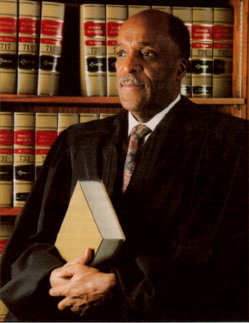
Historical · U.S. Court of Appeals for the Sixth Circuit
Nathaniel Raphael Jones
Former Circuit Judge · U.S. Court of Appeals for the Sixth Circuit · 1979–2002 · Appointed by Jimmy Carter
Nathaniel Raphael Jones served as a circuit judge of the U.S. Court of Appeals for the Sixth Circuit (1979–2002). Jones was appointed by Jimmy Carter.
Key facts
- Full name
- Nathaniel Raphael Jones
- Court
- U.S. Court of Appeals for the Sixth Circuit
- Office
- Circuit Judge (U.S. Court of Appeals)
- Status
- Former circuit judge
- Duty status
- Not serving
- Appointment
- Senate-confirmed
- FJC seat
- CA60802
- Tenure
- 1979–2002
- Confirmed
- 1979-10-04
- Born
- 1926-05-13
- Died
- 2020-01-26
- First year on the bench
- 1979
- Dataset version
- 1.20260711
Appointment & service record
U.S. Court of Appeals for the Sixth Circuit · 1979–1995
- Seat
- CA60802
- Appointment
- Senate-confirmed
- Appointing president
- Jimmy Carter
- Confirmed
- 1979-10-04
- Commissioned
- 1979-10-05
- Senior status
- 1995-05-13
Court, FJC seat, appointment type (Senate-confirmed or recess), appointing president, confirmation and commission dates, and senior-status date are drawn from the Federal Judicial Center Biographical Directory and Wikidata.[1][2][3]
Sources
- [1]https://www.fjc.gov/node/1382931fjc · retrieved 2026-07-11
- [2]https://www.fjc.gov/history/judges/biographical-directory-article-iii-federal-judges-exportfjc-directory · retrieved 2026-07-11
- [3]https://www.wikidata.org/wiki/Q6969814Wikidata · retrieved 2026-07-11
Biographical narrative
1,542 words · sourced from the Wikipedia REST extract
Nathaniel Raphael Jones was a United States circuit judge who served on the United States Court of Appeals for the Sixth Circuit from 1979 to 1995, before assuming senior status and later retiring in 2002. Born in Youngstown, Ohio, in 1926, Jones devoted his career to civil rights advocacy and the law, serving as general counsel of the NAACP during a critical period of desegregation litigation in the 1970s before his appointment to the federal bench by President Jimmy Carter, a Democrat. His work spanned multiple domains of public service, including roles as a federal prosecutor, presidential commission counsel, civil rights litigator, and legal educator. Jones passed away in January 2020, leaving behind a legacy of contributions to civil rights law and federal jurisprudence.
Early life and legal career
Jones was born on May 13, 1926, in the Smoky Hollow district of Youngstown, Ohio, located just blocks from what would later become a federal courthouse named in his honor. Though he grew up in an integrated neighborhood and attended integrated public schools, his mother ensured he was exposed to the realities of racial segregation and the civil rights movement from an early age. She brought him to the local segregated YMCA, where he encountered and heard from national civil rights leaders, experiences that would shape his future path. His mother also introduced him to J. Maynard Dickerson, an attorney who published a weekly black newspaper called The Buckeye Review, and who became an important mentor in Jones's life.
As a young person, Jones became active in the youth council of the local NAACP chapter. In one of his early civil rights actions, he successfully organized a boycott of a local roller skating rink that had previously restricted black patrons to skating only on Monday nights. After graduating from high school in 1945, Jones was inducted into the United States Army, as World War II had not yet concluded. He later recounted his profound shock at encountering the segregated training facilities at Camp Atterbury, Indiana, and observing that Italian prisoners of war received better treatment than black American soldiers. Despite these experiences, he served with the United States Army Air Corps.
Following his military service, Jones took advantage of the GI Bill to attend Youngstown College, which is now known as Youngstown State University. During his undergraduate years, he continued his involvement with the NAACP. When the nearby city of Warren, Ohio, attempted to bar black residents from using the local swimming pool, Jones witnessed future Supreme Court Justice Thurgood Marshall argue the case, an experience that left a lasting impression. Jones received his Bachelor of Arts degree in 1951. He then enrolled in law school, attending classes at night while simultaneously serving as director of Youngstown's Fair Employment Practices Commission. He completed his legal education in 1956, earning a Bachelor of Laws degree.
Jones was admitted to the bar in 1957 and established his own private law practice. His career in public service began in 1961 when Attorney General Robert Kennedy nominated him to serve as Assistant United States Attorney for the Northern District of Ohio in Cleveland. In 1962, Jones became the first African American to hold that position in the district, a role he maintained until 1967. That year, he was appointed as Assistant General Counsel to the National Advisory Commission on Civil Disorders, commonly known as the Kerner Commission, which had been established by President Lyndon B. Johnson. After completing his work with the commission, Jones returned to private practice in Youngstown, joining the firm of Goldberg & Jones, which became the first racially integrated law firm in the city.
In 1969, NAACP executive director Roy Wilkins asked Jones to serve as the organization's general counsel, a position of significant responsibility and influence. The following year, more than six hundred dignitaries attended an NAACP recognition banquet held in Youngstown to honor Jones. In his keynote address at that event, he characterized the situation of African Americans by stating that they still lived in the basement of the great society and must continue working until achieving their goals. For the next nine years, Jones directed all litigation efforts for the NAACP, a period of intense legal activity in civil rights law.
During his tenure as general counsel, Jones personally argued multiple cases before the United States Supreme Court and coordinated nationwide efforts to combat school segregation in northern states, defend affirmative action programs, and investigate discrimination against black servicemen in the United States military. Among his significant cases, he successfully coordinated the NAACP's defense on First Amendment grounds in what became known as the Mississippi Boycott case. He also won Reed v. Rhodes, a case that resulted in the desegregation of schools in the Cleveland area. Additionally, Jones argued on behalf of the NAACP in Milliken v. Bradley, a case that ultimately imposed significant limitations on desegregation remedies.
Federal appellate service
On August 28, 1979, President Jimmy Carter, a Democrat, nominated Jones to serve as a circuit judge on the United States Court of Appeals for the Sixth Circuit. The nomination was to fill a seat that had been vacated by Judge John Weld Peck II. The United States Senate confirmed Jones's nomination on October 4, 1979, and he received his commission the following day, on October 5, 1979. He took his judicial oath on October 15, 1979, officially beginning his service on the federal appellate bench.
Jones served as an active circuit judge for approximately sixteen years. During his time on the Sixth Circuit, he heard cases arising from federal district courts in Ohio, Michigan, Kentucky, and Tennessee, the states within the circuit's jurisdiction. The Sixth Circuit handles appeals in a wide range of federal matters, including constitutional questions, federal statutory interpretation, and review of administrative agency decisions. As a member of a three-judge panel system typical of federal appellate courts, Jones participated in the collegial decision-making process that characterizes circuit court work.
While serving on the federal bench, Jones also contributed to legal education, teaching at both Harvard Law School and the University of Cincinnati College of Law. His commitment to civil rights and constitutional principles extended beyond his judicial duties. He made numerous trips to South Africa during the apartheid era and its aftermath, speaking against the legal structures that supported apartheid. He served as one of the observers for South Africa's first democratic elections in 1993 and later provided consultation to those drafting the new South African constitution, sharing his expertise in constitutional law and civil rights.
Jones assumed senior status on May 13, 1995, his sixty-ninth birthday. Senior status is a form of semi-retirement that allows federal judges to continue hearing cases on a reduced schedule while creating a vacancy for a new active judge to be appointed. Jones continued to serve in senior status until March 30, 2002, when his federal judicial service formally terminated upon his retirement from the bench.
Jurisprudence and legacy
After retiring from the federal judiciary in 2002, Jones joined the Cincinnati office of Blank Rome LLP as Senior Counsel, where he also served as the firm's Chief Diversity and Inclusion Officer. This role allowed him to continue contributing to the legal profession while focusing on issues of equity and representation within the legal community. His post-judicial career demonstrated his ongoing commitment to the principles that had guided his work throughout his life.
In 2016, Jones published a memoir titled "Answering the Call: An Autobiography of the Modern Struggle to End Racial Discrimination in America," which featured a foreword by Harvard professor Evelyn Brooks Higgenbotham. The memoir provided his personal account of decades of civil rights work and legal service, offering insights into the major civil rights battles of the late twentieth century from the perspective of someone who had been directly involved in many of them.
Jones received numerous honors and recognitions throughout his career and in his later years. On May 6, 2003, the second federal courthouse established in his hometown of Youngstown, Ohio, was officially named in his honor. Former United States Representative Louis B. Stokes of Cleveland attended the naming ceremony and remarked that the building would serve as a permanent testament to outstanding public service by someone who had begun life as a local resident. In 2016, Jones received the NAACP's Spingarn Medal, the organization's highest honor, recognizing his lifetime of contributions to civil rights. He had previously received the Laurel Wreath, the highest honor bestowed by his fraternity, Kappa Alpha Psi, in 2009. In 2019, the University of Cincinnati named its Center for Race, Gender, and Social Justice in honor of Judge Jones. Over the course of his lifetime, he received nineteen honorary degrees from various institutions.
Jones was married to the late Jean Graham Jones, with whom he had a daughter, Stephanie J. Jones, and was also married to the late Lillian Hawthorne Jones. He had four stepchildren: Pamela L. Velez, William L. Hawthorne, Ricky B. Hawthorne, and Marc D. Hawthorne. He was a member of Kappa Alpha Psi fraternity and a Prince Hall Freemason. Nathaniel Raphael Jones died on January 26, 2020, bringing to a close a life that had spanned nearly a century and had been devoted to the pursuit of civil rights and equal justice under law.
Sources & provenance
Every quantitative or attributable claim above carries a per-section [N] marker that resolves to the corresponding URL below. Each entry records the upstream provider, the canonical URL, and the timestamp at which the underlying source was retrieved.
Key facts
- https://www.fjc.gov/node/1382931fjc · retrieved 2026-07-11
- https://www.fjc.gov/history/judges/biographical-directory-article-iii-federal-judges-exportfjc-directory · retrieved 2026-07-11
- https://www.wikidata.org/wiki/Q6969814Wikidata · retrieved 2026-07-11
Biographical narrative
- https://en.wikipedia.org/wiki/Nathaniel_R._JonesWikipedia · retrieved 2026-07-11
Explore the federal judiciary
The U.S. Courts of Appeals are the intermediate appellate courts of the federal judiciary — thirteen circuits sitting between the district courts and the Supreme Court. Browse the full roster of judges on the U.S. Court of Appeals for the Sixth Circuit, or explore how the appointed federal judiciary fits into the federal government.