
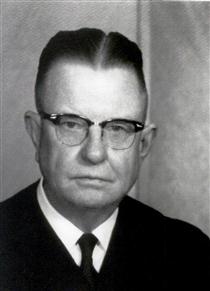
Historical · U.S. Court of Appeals for the Tenth Circuit
Delmas Carl Hill
Former Circuit Judge · U.S. Court of Appeals for the Tenth Circuit · 1961–1989 · Appointed by John F Kennedy
Delmas Carl Hill served as a circuit judge of the U.S. Court of Appeals for the Tenth Circuit (1961–1989). Hill was appointed by John F Kennedy.
Key facts
- Full name
- Delmas Carl Hill
- Court
- U.S. Court of Appeals for the Tenth Circuit
- Office
- Circuit Judge (U.S. Court of Appeals)
- Status
- Former circuit judge
- Duty status
- Not serving
- Appointment
- Senate-confirmed
- FJC seat
- CA100601
- Tenure
- 1961–1989
- Confirmed
- 1961-09-21
- Born
- 1906-10-09
- Died
- 1989-12-02
- First year on the bench
- 1961
- Dataset version
- 1.20260711
Appointment & service record
U.S. Court of Appeals for the Tenth Circuit · 1961–1977
- Seat
- CA100601
- Appointment
- Senate-confirmed
- Appointing president
- John F Kennedy
- Confirmed
- 1961-09-21
- Commissioned
- 1961-09-22
- Senior status
- 1977-04-01
Court, FJC seat, appointment type (Senate-confirmed or recess), appointing president, confirmation and commission dates, and senior-status date are drawn from the Federal Judicial Center Biographical Directory and Wikidata.[1][2][3]
Sources
- [1]https://www.fjc.gov/node/1382151fjc · retrieved 2026-07-11
- [2]https://www.fjc.gov/history/judges/biographical-directory-article-iii-federal-judges-exportfjc-directory · retrieved 2026-07-11
- [3]https://www.wikidata.org/wiki/Q5254273Wikidata · retrieved 2026-07-11
Biographical narrative
1,252 words · sourced from the Wikipedia REST extract
Delmas Carl Hill was a United States circuit judge who served on the United States Court of Appeals for the Tenth Circuit from 1961 to 1989. Born in Kansas in 1906, he spent nearly four decades in federal judicial service, first as a district judge and later as a circuit judge. Appointed to the Tenth Circuit by President John F. Kennedy, a Democrat, Hill served as an active judge until 1977 and continued in senior status until his death in 1989. His career spanned multiple facets of legal practice, including private law, municipal and county prosecution, federal prosecution, military legal service during World War II, and ultimately the federal judiciary.
Early life and legal career
Delmas Carl Hill was born on October 9, 1906, in Wamego, Kansas, a small community in Pottawatomie County in the northeastern part of the state. He pursued his legal education at Washburn University School of Law, where he earned a Bachelor of Laws degree in 1929. Following his admission to the bar, Hill established himself in private legal practice in his hometown of Wamego, where he would maintain a connection throughout much of his pre-judicial career.
Hill's early professional life was characterized by a combination of private practice and public service in various prosecutorial and legal advisory roles. Beginning in 1929, the same year he completed his law degree, he assumed the position of city attorney for Wamego, a role he held until 1934. He also served as county attorney of Pottawatomie County from 1931 to 1934, gaining experience in local criminal prosecution and legal matters affecting county government. His work in these positions provided him with a foundation in both municipal law and the practical aspects of legal administration at the local level.
In 1934, Hill's career took a significant step forward when he was appointed United States Attorney for the District of Kansas, a position he held until 1936. This role placed him at the forefront of federal law enforcement in Kansas during the mid-1930s, a period marked by significant federal activity in response to the Great Depression and organized crime. After completing his service as United States Attorney, Hill returned to Kansas state government, serving as general counsel to the Kansas State Tax Commission from 1937 to 1939. During this period and continuing until 1943, he also resumed his role as city attorney of Wamego and maintained his private law practice.
Hill's legal career was interrupted by World War II. In 1943, he entered military service in the Judge Advocate General's Corps of the United States Army. He attended the Army Judge Advocate Training Center and was commissioned as a first lieutenant upon graduation. During his military service, which lasted from 1943 to 1946, Hill served on military commissions responsible for prosecuting violations of the Laws of War, work that would have involved the adjudication of serious offenses under military and international law during the global conflict. Following his discharge from military service in 1946, Hill returned to Wamego and resumed his private law practice, which he continued until 1949.
Federal appellate service
Hill's transition to the federal judiciary began with his appointment to the trial bench. On October 21, 1949, President Harry S. Truman, a Democrat, gave Hill a recess appointment to the United States District Court for the District of Kansas, filling a newly created judgeship authorized by federal statute. The recess appointment allowed Hill to begin serving immediately while Congress was not in session. President Truman formally nominated Hill to the same position on January 5, 1950, and the United States Senate confirmed the nomination on March 8, 1950. Hill received his commission the following day, on March 9, 1950, officially beginning what would become a long tenure in the federal judiciary.
As a district judge, Hill presided over federal cases in Kansas for more than a decade. His responsibilities would have included both civil and criminal matters arising under federal law, as well as diversity jurisdiction cases. In 1957, Hill was elevated to the position of Chief Judge of the District of Kansas, an administrative role in which he would have overseen the operations of the court and managed case assignments among the judges of the district. He served as Chief Judge until 1961, when his district court service came to an end due to his elevation to the appellate bench.
Hill's appointment to the United States Court of Appeals for the Tenth Circuit came during the early months of the Kennedy administration. President John F. Kennedy, a Democrat, nominated Hill on September 14, 1961, to fill a newly authorized seat on the Tenth Circuit, which had been created by federal legislation. The Senate moved quickly on the nomination, confirming Hill on September 21, 1961, just one week after the nomination was submitted. Hill received his commission on September 22, 1961, and his service on the district court formally terminated on September 28, 1961.
As a circuit judge on the Tenth Circuit, Hill joined a court with appellate jurisdiction over federal cases arising in Colorado, Kansas, New Mexico, Oklahoma, Utah, and Wyoming. The Tenth Circuit hears appeals from the federal district courts in those states, as well as from certain administrative agencies. Hill served as an active circuit judge for sixteen years, participating in the review of district court decisions and contributing to the development of federal law within the circuit's jurisdiction. On April 1, 1977, Hill assumed senior status, a form of semi-retirement that allowed him to continue hearing cases on a reduced schedule while creating a vacancy for a new active judge. Hill remained in senior status for more than twelve years, continuing to contribute to the work of the court until his death on December 2, 1989, at the age of 83.
Jurisprudence and legacy
Hill's nearly three decades on the Tenth Circuit, including both his active service and senior status, represented a substantial contribution to the federal appellate judiciary during a period of significant legal and social change in the United States. His tenure on the court spanned from the early 1960s through the late 1980s, a period that saw major developments in civil rights law, criminal procedure, administrative law, and many other areas of federal jurisprudence. As a circuit judge, Hill would have participated in three-judge panels reviewing appeals and would have had the opportunity to author opinions, join in the opinions of colleagues, and occasionally dissent from panel decisions.
The breadth of Hill's pre-judicial experience likely informed his work on the bench. His background included local government law, federal prosecution, military justice, and more than a decade of trial court experience. This diverse foundation would have provided him with practical insights into the operation of legal systems at multiple levels and the real-world implications of appellate decisions. His service as a district judge before joining the circuit court would have given him particular familiarity with the challenges facing trial judges and the importance of clear appellate guidance.
Hill's long period of service, extending across multiple presidential administrations and significant shifts in American society, allowed him to contribute to the Tenth Circuit's jurisprudence over an extended period. His willingness to continue serving in senior status for more than a decade after assuming that status in 1977 demonstrated a continued commitment to the work of the federal courts. The Tenth Circuit during Hill's tenure addressed appeals from a geographically large and diverse region, requiring sensitivity to the particular legal issues affecting both urban and rural communities across the Mountain West and Great Plains.
Sources & provenance
Every quantitative or attributable claim above carries a per-section [N] marker that resolves to the corresponding URL below. Each entry records the upstream provider, the canonical URL, and the timestamp at which the underlying source was retrieved.
Key facts
- https://www.fjc.gov/node/1382151fjc · retrieved 2026-07-11
- https://www.fjc.gov/history/judges/biographical-directory-article-iii-federal-judges-exportfjc-directory · retrieved 2026-07-11
- https://www.wikidata.org/wiki/Q5254273Wikidata · retrieved 2026-07-11
Biographical narrative
- https://en.wikipedia.org/wiki/Delmas_Carl_HillWikipedia · retrieved 2026-07-11
Explore the federal judiciary
The U.S. Courts of Appeals are the intermediate appellate courts of the federal judiciary — thirteen circuits sitting between the district courts and the Supreme Court. Browse the full roster of judges on the U.S. Court of Appeals for the Tenth Circuit, or explore how the appointed federal judiciary fits into the federal government.