
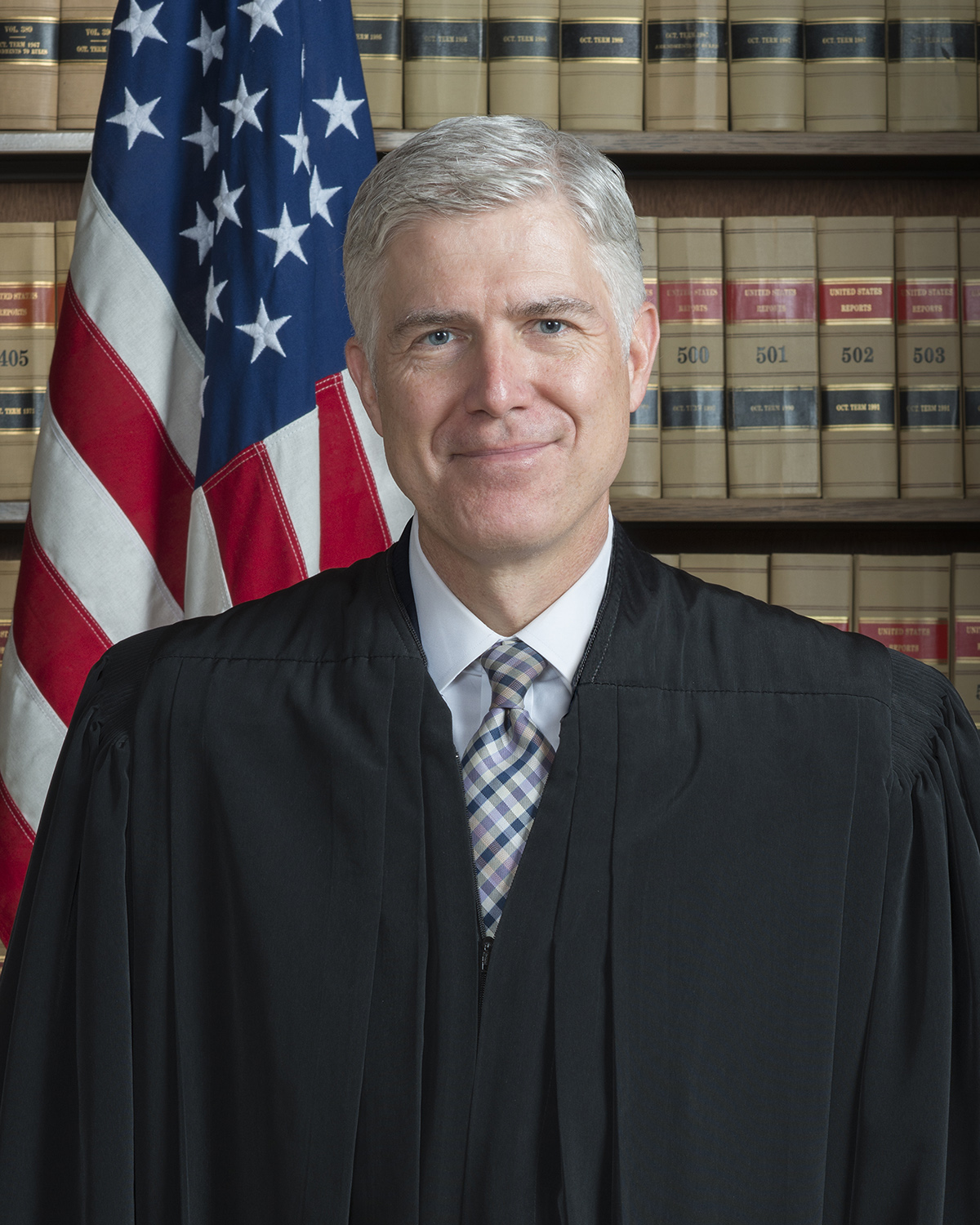
Historical · U.S. Court of Appeals for the Tenth Circuit
Neil M. Gorsuch
Former Circuit Judge · U.S. Court of Appeals for the Tenth Circuit · 2006–2017 · Appointed by George W Bush
Neil M. Gorsuch served as a circuit judge of the U.S. Court of Appeals for the Tenth Circuit (2006–2017). Gorsuch was appointed by George W Bush.
Key facts
- Full name
- Neil M. Gorsuch
- Court
- U.S. Court of Appeals for the Tenth Circuit
- Office
- Circuit Judge (U.S. Court of Appeals)
- Status
- Former circuit judge
- Duty status
- Not serving
- Appointment
- Senate-confirmed
- FJC seat
- CA100105
- Tenure
- 2006–2017
- Confirmed
- 2006-07-20
- Born
- 1967
- Died
- —
- First year on the bench
- 2006
- Dataset version
- 1.20260711
Appointment & service record
U.S. Court of Appeals for the Tenth Circuit · 2006–2017
- Seat
- CA100105
- Appointment
- Senate-confirmed
- Appointing president
- George W Bush
- Confirmed
- 2006-07-20
- Commissioned
- 2006-08-08
- Senior status
- —
Court, FJC seat, appointment type (Senate-confirmed or recess), appointing president, confirmation and commission dates, and senior-status date are drawn from the Federal Judicial Center Biographical Directory and Wikidata.[1][2][3]
Sources
- [1]https://www.fjc.gov/node/1392461fjc · retrieved 2026-07-11
- [2]https://www.fjc.gov/history/judges/biographical-directory-article-iii-federal-judges-exportfjc-directory · retrieved 2026-07-11
- [3]https://www.wikidata.org/wiki/Q15488345Wikidata · retrieved 2026-07-11
Biographical narrative
1,634 words · sourced from the Wikipedia REST extract
Neil M. Gorsuch is a former judge of the United States Court of Appeals for the Tenth Circuit who served on that court from 2006 to 2017. Appointed by President George W. Bush, a Republican, and confirmed in July 2006, he brought to the federal appellate bench a background that included Supreme Court clerkships, private practice at a prominent Washington law firm, and service in the U.S. Department of Justice. His tenure on the Tenth Circuit preceded his elevation to the Supreme Court of the United States in 2017. During his years as a circuit judge, he developed a judicial philosophy grounded in textualism and originalism, approaches that would come to define his work on the federal bench.
Early life and legal career
Neil McGill Gorsuch was born on August 29, 1967, in Denver, Colorado, into a family with deep roots in the state. He was the eldest of three children born to Anne Gorsuch Burford and David Ronald Gorsuch, both attorneys. His family's Colorado heritage extended back four generations, with ancestors of Irish and English descent. On his paternal side, his lineage traced to pre-Revolutionary America; an ancestor named Charles Gorsuch emigrated from England to Maryland in the seventeenth century, working as a planter until his death in 1716. His great-grandfather Joseph M. McGill relocated the family from New York City to Colorado during the 1890s, establishing the family's long connection to the region.
Gorsuch's upbringing was shaped by parents who valued intellectual engagement and debate. His mother served in the Colorado House of Representatives from 1976 to 1980 and was later appointed by President Ronald Reagan as the first woman to lead the United States Environmental Protection Agency. His father held more liberal political views, creating a household where differing perspectives were part of daily life. The family encouraged their children to participate in spontaneous debates, fostering skills that would serve Gorsuch throughout his legal career. As a young child, he assisted his mother's campaign for the Colorado legislature at age nine.
His early education took place at Christ the King Roman Catholic School in Denver, a private institution whose moral instruction left a lasting impression on him. Classmates remembered him for taking strong positions on issues even at a young age. When his mother received her federal appointment, the family relocated to Bethesda, Maryland, and Gorsuch enrolled at Georgetown Preparatory School, a selective Jesuit college-preparatory institution, beginning in 1981 as a freshman. At Georgetown Prep, he participated in debate, forensics, and international relations clubs, and served as a United States Senate page in the early 1980s. He graduated in 1985 as student body president and was described by those who knew him as outgoing and extroverted. Among his classmates was Brett Kavanaugh, who was two years his senior and with whom he would later work.
Gorsuch attended Columbia University, where he completed his undergraduate studies in an accelerated timeframe, graduating in 1988 with a Bachelor of Arts degree, cum laude, in history and politics. He took on a heavier courseload to finish in three years. During his time at Columbia, he wrote for the Columbia Daily Spectator and co-founded a satirical student publication called The Fed in 1986, which he helped establish as a conservative alternative to what he viewed as liberal-leaning campus newspapers. He distinguished himself as an active debater and outspoken conservative, publishing pieces critical of left-wing politics. He was a member of the Phi Gamma Delta fraternity and earned induction into the Phi Beta Kappa honor society.
Following Columbia, Gorsuch attended Harvard Law School on a Harry S. Truman Scholarship. At Harvard, he served as an editor of the Harvard Journal of Law and Public Policy and participated in the Lincoln's Inn Society, the Harvard Prison Legal Assistance Project, and the Harvard Defenders program. On a campus characterized by many as predominantly liberal, he maintained his conservative views, supporting positions such as the Gulf War and congressional term limits. Despite these political differences, classmates generally regarded him warmly. One close friend from law school recalled him as sensitive and non-confrontational, noting an instance when Gorsuch provided support during a difficult personal disclosure. Gorsuch graduated from Harvard Law School in 1991 with a Juris Doctor degree, cum laude. Among his classmates was Barack Obama, who would later serve as President of the United States.
After law school, Gorsuch began his legal career with a clerkship for Judge David B. Sentelle of the United States Court of Appeals for the District of Columbia Circuit, serving from 1991 to 1992. He then pursued graduate studies at the University of Oxford as a Marshall Scholar, ultimately earning a doctorate in jurisprudence in 2004. His doctoral thesis examined the morality of assisted suicide and was completed under the supervision of legal philosopher John Finnis. Between his time at Oxford and completing his doctorate, Gorsuch clerked for two Supreme Court justices. He worked for Justice Byron White from 1993 to 1994, assisting White after the justice's retirement from the Supreme Court; during this period, White sat by designation on the Tenth Circuit, and Gorsuch helped with that work. He also clerked for Justice Anthony Kennedy during the same term, working alongside a group of five law clerks that included Brett Kavanaugh.
From 1995 to 2005, Gorsuch practiced law with the Washington, D.C., firm of Kellogg, Hansen, Todd, Figel & Frederick, where he worked for a decade in private practice. In 2005, he entered government service as the principal deputy associate attorney general at the United States Department of Justice, a position he held until his appointment to the federal appellate bench.
Federal appellate service
President George W. Bush, a Republican, nominated Gorsuch to the United States Court of Appeals for the Tenth Circuit on May 10, 2006. The nomination was made to fill the seat being vacated by Judge David M. Ebel, who took senior status that same year. Gorsuch was confirmed by the United States Senate on July 20, 2006, and began his service on the court, which has jurisdiction over appeals from federal district courts in Colorado, Kansas, New Mexico, Oklahoma, Utah, and Wyoming, as well as certain administrative agencies.
During his tenure on the Tenth Circuit, Gorsuch participated in the court's work reviewing a wide range of federal legal questions, including matters of constitutional law, statutory interpretation, administrative law, and criminal procedure. As a circuit judge, he authored numerous opinions that reflected his developing judicial philosophy. His approach to legal interpretation emphasized textualism in reading statutes—focusing on the ordinary meaning of the text as written—and originalism in constitutional matters, seeking to understand constitutional provisions according to their meaning at the time of adoption.
Gorsuch served on the Tenth Circuit for more than a decade, from 2006 until 2017. His work on the court established his reputation within the federal judiciary and the broader legal community. The Tenth Circuit, like other federal courts of appeals, operates primarily through three-judge panels that hear cases and issue decisions, with occasional en banc proceedings involving the full court for matters of particular importance. Throughout his service, Gorsuch participated in this collegial process of appellate decision-making.
His time on the Tenth Circuit came to an end when he was nominated to the Supreme Court of the United States by President Donald Trump in January 2017. He was confirmed by the Senate and took his seat on the nation's highest court in April 2017, concluding his service as a circuit judge.
Jurisprudence and legacy
Gorsuch's judicial philosophy, developed and refined during his years on the Tenth Circuit, centered on textualism and originalism. These interpretive methods shaped his approach to both statutory and constitutional questions. Textualism, as applied to statutes, focuses on the plain meaning of the words enacted by the legislature, rather than attempting to discern broader legislative intent or purpose beyond the text itself. Originalism, in constitutional interpretation, seeks to understand the Constitution's provisions according to their original public meaning—how they would have been understood at the time of ratification.
These methodologies reflected a broader judicial philosophy that emphasized the role of judges as interpreters rather than makers of law. This approach suggested that courts should apply legal texts as written, leaving policy choices to the elected branches of government. Such a philosophy has implications across many areas of law, from questions of individual rights to matters of federal regulatory authority and the separation of powers between branches of government.
In addition to his textualist and originalist commitments, Gorsuch has been identified as an advocate of natural law jurisprudence, a philosophical tradition that posits the existence of moral principles inherent in human nature and reason that can inform legal interpretation. This aspect of his judicial thinking connected to his academic work, including his doctoral thesis on the morality of assisted suicide, which engaged with fundamental questions about human dignity, autonomy, and the proper role of law in matters of life and death.
Gorsuch's tenure on the Tenth Circuit represented an important chapter in the court's history and contributed to the development of federal law within the circuit's jurisdiction. His service on that court provided him with extensive experience in the federal appellate system before his elevation to the Supreme Court. The transition from circuit judge to Supreme Court justice made him the first person to serve on the nation's highest court alongside a justice—Anthony Kennedy—for whom he had previously clerked, an unusual circumstance in the Court's history.
His legacy as a Tenth Circuit judge is intertwined with his subsequent service on the Supreme Court, where the judicial philosophy he developed during his circuit court years has continued to influence his work on cases of national significance. His time on the Tenth Circuit from 2006 to 2017 thus represents a formative period in a judicial career that has had substantial impact on American law.
Sources & provenance
Every quantitative or attributable claim above carries a per-section [N] marker that resolves to the corresponding URL below. Each entry records the upstream provider, the canonical URL, and the timestamp at which the underlying source was retrieved.
Key facts
- https://www.fjc.gov/node/1392461fjc · retrieved 2026-07-11
- https://www.fjc.gov/history/judges/biographical-directory-article-iii-federal-judges-exportfjc-directory · retrieved 2026-07-11
- https://www.wikidata.org/wiki/Q15488345Wikidata · retrieved 2026-07-11
Biographical narrative
- https://en.wikipedia.org/wiki/Neil_GorsuchWikipedia · retrieved 2026-07-11
Explore the federal judiciary
The U.S. Courts of Appeals are the intermediate appellate courts of the federal judiciary — thirteen circuits sitting between the district courts and the Supreme Court. Browse the full roster of judges on the U.S. Court of Appeals for the Tenth Circuit, or explore how the appointed federal judiciary fits into the federal government.