
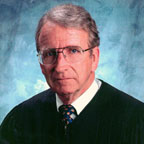
Currently serving · U.S. Court of Appeals for the Tenth Circuit
Paul Joseph Kelly Jr.
Currently servingSenior status
Senior Circuit Judge · U.S. Court of Appeals for the Tenth Circuit · 1992–present · Appointed by George H W Bush
Paul Joseph Kelly Jr. serves as a senior circuit judge of the U.S. Court of Appeals for the Tenth Circuit (1992–present). Jr. was appointed by George H W Bush. Jr. assumed senior status in 2017 and continues to hear cases.
Key facts
- Full name
- Paul Joseph Kelly Jr.
- Court
- U.S. Court of Appeals for the Tenth Circuit
- Office
- Circuit Judge (U.S. Court of Appeals)
- Status
- Senior circuit judge (still serving)
- Duty status
- Senior
- Appointment
- Senate-confirmed
- FJC seat
- CA101101
- Tenure
- 1992–present
- Confirmed
- 1992-04-08
- Born
- 1940
- Died
- —
- First year on the bench
- 1992
- Dataset version
- 1.20260705
Appointment & service record
U.S. Court of Appeals for the Tenth Circuit · 1992–present
- Seat
- CA101101
- Appointment
- Senate-confirmed
- Appointing president
- George H W Bush
- Confirmed
- 1992-04-08
- Commissioned
- 1992-04-13
- Senior status
- 2017-12-31 (still serving)
Court, FJC seat, appointment type (Senate-confirmed or recess), appointing president, confirmation and commission dates, and senior-status date are drawn from the Federal Judicial Center Biographical Directory and Wikidata.[1][2][3]
Sources
- [1]https://www.fjc.gov/node/1383186fjc · retrieved 2026-07-05
- [2]https://www.fjc.gov/history/judges/biographical-directory-article-iii-federal-judges-exportfjc-directory · retrieved 2026-07-05
- [3]https://www.wikidata.org/wiki/Q16105382Wikidata · retrieved 2026-07-05
Biographical narrative
931 words · sourced from the Wikipedia REST extract
Paul Joseph Kelly Jr. is a senior United States circuit judge on the Court of Appeals for the Tenth Circuit. Appointed by President George H. W. Bush and confirmed in 1992, he has served on the federal appellate bench for more than three decades, assuming senior status at the end of 2017 while continuing to hear cases from his chambers in Santa Fe, New Mexico.
Early life and legal career
Born on December 6, 1940, in Freeport, New York, Paul Kelly pursued higher education in both business and law. He earned a Bachelor of Business Administration from the University of Notre Dame in 1963, followed by a Juris Doctor degree from Fordham University School of Law in 1967. After completing his legal studies, Kelly began his professional career at the prominent New York City firm Cravath, Swaine & Moore, where he gained experience in a large‑firm environment.
Later that same year, Kelly relocated to New Mexico and entered private practice with Hinkle, Bondurant, Cox & Eaton, a firm with offices in Roswell and Santa Fe. Over the next twenty‑five years, he built a reputation as a highly successful jury trial attorney. Colleagues noted his relentless investigative approach to case preparation; after each favorable verdict, his staff would ask about the outcome, and Kelly habitually responded with the rhetorical question, “Does a cat have a tail?” This anecdote illustrates both his confidence in results and his insistence on thoroughness. In addition to litigation, he was known for mentoring younger lawyers, sharing practical insights drawn from his courtroom experience.
Kelly’s public service began at the state level when he was elected to the New Mexico House of Representatives, serving from 1977 until 1981. During this period, he contributed to legislative deliberations while maintaining his legal practice, blending statutory work with his advocacy background.
Federal appellate service
The federal judicial career of Paul Kelly commenced when President George H. W. Bush nominated him on November 19, 1991, to a newly created seat on the United States Court of Appeals for the Tenth Circuit, authorized by statute (104 Stat. 5089). The United States Senate confirmed his appointment on April 8, 1992, and he received his commission five days later, on April 13, 1992. His official seat is identified as CA101101.
Judge Kelly served as an active circuit judge for a span of twenty‑five years, hearing appeals that covered the six states within the Tenth Circuit’s jurisdiction—Colorado, Kansas, New Mexico, Oklahoma, Utah, and Wyoming. Throughout his tenure, he contributed to the development of federal jurisprudence across a broad array of legal issues, ranging from civil rights to commercial disputes.
On December 31, 2017, Judge Kelly elected to take senior status, a form of semi‑retirement that permits continued participation in casework while creating a vacancy for a new full‑time judge. Despite this transition, he remains an active member of the court, regularly sitting on panels and issuing opinions from his Santa Fe chambers.
Recognition of Judge Kelly’s professionalism extended beyond the courtroom. In October 2008, the American Inns of Court honored him with its Professionalism Award for the Tenth Circuit, a distinction presented in the Great Hall of the United States Supreme Court Building. This award highlighted his commitment to ethical conduct and collegiality within the legal community.
Beyond his judicial responsibilities, Judge Kelly has maintained involvement in civic activities. He volunteers with fire and emergency services, contributing time and expertise to local public‑safety efforts. His personal interests include golf and skiing, pursuits he enjoys during periods away from the bench.
Jurisprudence and legacy
Judge Kelly’s influence on appellate jurisprudence is reflected in both scholarly assessments and citation metrics. A law review article titled “Who Would Win a Tournament of Judges” identified him as one of the most frequently cited appellate judges currently serving, ranking him just behind two well‑known scholars—Judges Posner and Easterbrook. This placement underscores the practical relevance of his opinions to litigants and fellow jurists.
When asked about an overarching judicial philosophy, Judge Kelly has indicated that he does not adhere to a fixed doctrinal framework. In a public commentary, he noted that his decisions have landed on various sides of legal debates, suggesting a case‑by‑case approach guided by the specifics of each matter rather than a predetermined ideological stance.
His body of work includes opinions that address complex statutory interpretation, constitutional questions, and procedural matters. While specific cases are not enumerated here, the breadth of topics covered in his docket demonstrates an adaptability to evolving legal challenges across the circuit’s diverse jurisdiction.
The combination of his extensive trial experience, legislative background, and long service on the appellate bench contributes to a legacy characterized by thorough analysis and practical insight. His mentorship of younger attorneys, both in private practice and within the federal judiciary, has helped shape subsequent generations of lawyers who value diligent preparation and ethical conduct.
Judge Kelly’s continued engagement as a senior judge allows him to influence ongoing legal developments while also providing institutional memory for newer members of the court. The recognition he received from professional organizations, along with his volunteer commitments, reflects a career that balances judicial responsibilities with broader community service.
In sum, Paul Joseph Kelly Jr.’s career spans private advocacy, state legislation, and federal appellate adjudication. His tenure on the Tenth Circuit has been marked by frequent citation in legal scholarship, an absence of rigid doctrinal allegiance, and a reputation for professionalism both on and off the bench. As he remains active in hearing cases, his contributions to American jurisprudence continue to evolve, reinforcing his standing as a notable figure within the federal judiciary.
Sources & provenance
Every quantitative or attributable claim above carries a per-section [N] marker that resolves to the corresponding URL below. Each entry records the upstream provider, the canonical URL, and the timestamp at which the underlying source was retrieved.
Key facts
- https://www.fjc.gov/node/1383186fjc · retrieved 2026-07-05
- https://www.fjc.gov/history/judges/biographical-directory-article-iii-federal-judges-exportfjc-directory · retrieved 2026-07-05
- https://www.wikidata.org/wiki/Q16105382Wikidata · retrieved 2026-07-05
Biographical narrative
- https://en.wikipedia.org/wiki/Paul_Joseph_Kelly_Jr.Wikipedia · retrieved 2026-07-05
Explore the federal judiciary
The U.S. Courts of Appeals are the intermediate appellate courts of the federal judiciary — thirteen circuits sitting between the district courts and the Supreme Court. Browse the full roster of judges on the U.S. Court of Appeals for the Tenth Circuit, or explore how the appointed federal judiciary fits into the federal government.