
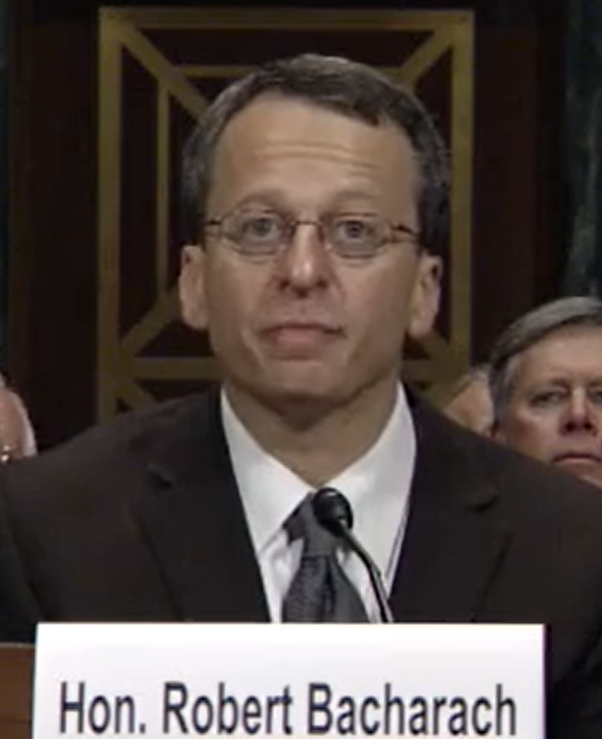
Currently serving · U.S. Court of Appeals for the Tenth Circuit
Robert Edwin Bacharach
Currently serving
Circuit Judge · U.S. Court of Appeals for the Tenth Circuit · 2013–present · Appointed by Barack Obama
Robert Edwin Bacharach serves as a circuit judge of the U.S. Court of Appeals for the Tenth Circuit (2013–present). Bacharach was appointed by Barack Obama.
Key facts
- Full name
- Robert Edwin Bacharach
- Court
- U.S. Court of Appeals for the Tenth Circuit
- Office
- Circuit Judge (U.S. Court of Appeals)
- Status
- Active circuit judge
- Duty status
- Active
- Appointment
- Senate-confirmed
- FJC seat
- CA100703
- Tenure
- 2013–present
- Confirmed
- 2013-02-25
- Born
- 1959
- Died
- —
- First year on the bench
- 2013
- Dataset version
- 1.20260705
Appointment & service record
U.S. Court of Appeals for the Tenth Circuit · 2013–present
- Seat
- CA100703
- Appointment
- Senate-confirmed
- Appointing president
- Barack Obama
- Confirmed
- 2013-02-25
- Commissioned
- 2013-02-28
- Senior status
- —
Court, FJC seat, appointment type (Senate-confirmed or recess), appointing president, confirmation and commission dates, and senior-status date are drawn from the Federal Judicial Center Biographical Directory and Wikidata.[1][2][3]
Sources
- [1]https://www.fjc.gov/node/1394126fjc · retrieved 2026-07-05
- [2]https://www.fjc.gov/history/judges/biographical-directory-article-iii-federal-judges-exportfjc-directory · retrieved 2026-07-05
- [3]https://www.wikidata.org/wiki/Q7343729Wikidata · retrieved 2026-07-05
Biographical narrative
1,058 words · sourced from the Wikipedia REST extract
Robert Edwin Bacharach (born May 20, 1959) is a United States circuit judge serving on the U.S. Court of Appeals for the Tenth Circuit. Appointed by President Barack Obama and confirmed by the Senate in February 2013, Judge Bacharach has been an active member of the federal judiciary since his earlier service as a United States magistrate judge in Oklahoma. His career encompasses private practice, academic instruction, and extensive experience handling civil and criminal matters at both the district‑court and appellate levels.
Early life and legal career
Robert Edwin Bacharach was born in Clarksdale, Mississippi, in 1959. He began his undergraduate studies at Washington University in St. Louis before transferring to the University of Oklahoma, where he earned a Bachelor of Arts degree magna cum laude in 1981. Pursuing a legal education, he returned to Washington University and received his Juris Doctor from its School of Law in 1985. While in law school, Bacharach distinguished himself academically as a member of the Order of the Coif and contributed to scholarly publishing as an editor of the Washington University Law Quarterly.
Following graduation, Bacharach entered the federal judiciary as a law clerk for Judge William Judson Holloway Jr., a judge on the United States Court of Appeals for the Tenth Circuit. He served in this capacity for two years, gaining insight into appellate practice and jurisprudence. In 1987, he joined the Oklahoma City firm Crowe & Dunlevy, P.C. as an associate attorney. Over the ensuing years, his practice concentrated on commercial litigation, a focus that led to his elevation to shareholder status within the firm in 1994.
In addition to his private‑practice work, Bacharach contributed to legal education as an adjunct professor at the University of Oklahoma College of Law. In this role he taught courses on civil pretrial litigation, sharing practical courtroom experience with law students and reinforcing his commitment to the development of future attorneys.
Bacharach’s transition from private practice to the federal bench occurred in 1999 when he was appointed a United States magistrate judge for the Western District of Oklahoma. He held that position until his elevation to the appellate court in 2013. During his twelve‑year tenure as a magistrate, he managed an extensive docket that included nearly three thousand civil and criminal cases. He also presided over more than four hundred judicial settlement conferences, facilitating dispute resolution outside of trial. In the course of these duties, Judge Bacharach issued over one thousand six hundred reports and recommendations covering a wide array of procedural and substantive matters.
His service on the district court extended beyond case adjudication. He chaired several key committees, notably the Civil Rules Committee and the Criminal Justice Act Committee, where he helped shape local procedural policies and ensure effective administration of justice. Moreover, Bacharach has been an active participant in professional organizations; he is a member of the Federal Bar Association and has served as the Tenth Circuit’s Vice President since 2007, reflecting his ongoing engagement with the broader legal community.
Federal appellate service
President Barack Obama nominated Robert E. Bacharach to serve as a United States circuit judge for the Tenth Circuit on January 23, 2012. The nomination targeted the seat identified by the commission number CA100703. During the Senate’s consideration of his appointment, Senate Majority Leader Harry Reid filed a cloture motion on July 26, 2012. The subsequent cloture vote held on July 30, 2012 did not achieve the required threshold; it failed with a tally of 56 in favor, 34 opposed, and three senators voting present, including both Oklahoma Senators at the time.
Because the Senate adjourned sine die at the end of that session, Bacharach’s nomination was returned to the President on January 2, 2013. The following day, President Obama renominated him to the same position. The Senate Judiciary Committee reviewed the renewed nomination and reported it to the full Senate by voice vote on February 7, 2013.
The confirmation vote took place on February 25, 2013, where the Senate unanimously approved Bacharach’s appointment with a 93‑0 vote. He received his judicial commission three days later, on February 28, 2013, and has served as an active circuit judge on the Tenth Circuit ever since.
Since joining the appellate bench, Judge Bacharach has participated in the court’s collective work of reviewing district‑court decisions, interpreting federal statutes, and applying constitutional principles across a jurisdiction that includes six states. While specific opinions authored by him are not detailed here, his background in commercial litigation, extensive experience as a magistrate handling both civil and criminal matters, and involvement in procedural rulemaking inform his contributions to the appellate process.
Jurisprudence and legacy
Judge Robert E. Bacharach’s professional trajectory reflects a blend of practical courtroom experience, academic instruction, and judicial administration. His early work in commercial litigation provided a foundation for understanding complex civil disputes, while his twelve years as a United States magistrate judge afforded him direct exposure to the mechanics of trial practice, case management, and settlement facilitation. Handling nearly three thousand cases and issuing more than one and a half thousand reports and recommendations, he developed a reputation for thoroughness in pre‑trial and post‑trial matters.
His leadership roles on district‑court committees—particularly those overseeing civil procedural rules and the administration of criminal legal aid—demonstrate an ongoing commitment to improving judicial efficiency and fairness. As Vice President of the Federal Bar Association’s Tenth Circuit chapter since 2007, he has contributed to professional development initiatives and fostered dialogue among practitioners and judges within the circuit.
Transitioning to the appellate level, Judge Bacharach brings this extensive procedural expertise to the review of lower‑court rulings. Although specific case holdings are not enumerated in the available sources, his participation in the Tenth Circuit’s collective jurisprudence contributes to the development of federal law across a broad geographic region. His background as an adjunct professor further underscores a dedication to legal education, suggesting that he values both the theoretical underpinnings and practical applications of the law.
Overall, Judge Bacharach’s career illustrates a sustained engagement with multiple facets of the federal judicial system: from litigating and adjudicating cases at the district level, to shaping procedural policies, to interpreting appellate precedent. His continued service on the Tenth Circuit reflects an ongoing role in the administration of justice, while his involvement in professional organizations and legal education signals a broader influence on the legal community within his jurisdiction.
Sources & provenance
Every quantitative or attributable claim above carries a per-section [N] marker that resolves to the corresponding URL below. Each entry records the upstream provider, the canonical URL, and the timestamp at which the underlying source was retrieved.
Key facts
- https://www.fjc.gov/node/1394126fjc · retrieved 2026-07-05
- https://www.fjc.gov/history/judges/biographical-directory-article-iii-federal-judges-exportfjc-directory · retrieved 2026-07-05
- https://www.wikidata.org/wiki/Q7343729Wikidata · retrieved 2026-07-05
Biographical narrative
- https://en.wikipedia.org/wiki/Robert_E._BacharachWikipedia · retrieved 2026-07-05
Explore the federal judiciary
The U.S. Courts of Appeals are the intermediate appellate courts of the federal judiciary — thirteen circuits sitting between the district courts and the Supreme Court. Browse the full roster of judges on the U.S. Court of Appeals for the Tenth Circuit, or explore how the appointed federal judiciary fits into the federal government.