
Historical · U.S. Court of Appeals for the Third Circuit
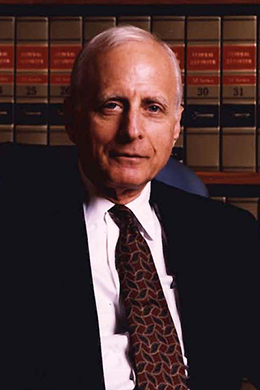
Edward Roy Becker
Former Circuit Judge · U.S. Court of Appeals for the Third Circuit · 1981–2006 · Appointed by Ronald Reagan
Edward Roy Becker served as a circuit judge of the U.S. Court of Appeals for the Third Circuit (1981–2006). Becker was appointed by Ronald Reagan.
Key facts
- Full name
- Edward Roy Becker
- Court
- U.S. Court of Appeals for the Third Circuit
- Office
- Circuit Judge (U.S. Court of Appeals)
- Status
- Former circuit judge
- Duty status
- Not serving
- Appointment
- Senate-confirmed
- FJC seat
- CA31003
- Tenure
- 1981–2006
- Confirmed
- 1981-12-03
- Born
- 1933-05-04
- Died
- 2006-05-19
- First year on the bench
- 1981
- Dataset version
- 1.20260711
Appointment & service record
U.S. Court of Appeals for the Third Circuit · 1981–2003
- Seat
- CA31003
- Appointment
- Senate-confirmed
- Appointing president
- Ronald Reagan
- Confirmed
- 1981-12-03
- Commissioned
- 1981-12-03
- Senior status
- 2003-05-04
- Chief Judge
- 1998–2003
Court, FJC seat, appointment type (Senate-confirmed or recess), appointing president, confirmation and commission dates, and senior-status date are drawn from the Federal Judicial Center Biographical Directory and Wikidata.[1][2][3]
Sources
- [1]https://www.fjc.gov/node/1377646fjc · retrieved 2026-07-11
- [2]https://www.fjc.gov/history/judges/biographical-directory-article-iii-federal-judges-exportfjc-directory · retrieved 2026-07-11
- [3]https://www.wikidata.org/wiki/Q5345128Wikidata · retrieved 2026-07-11
Biographical narrative
1,602 words · sourced from the Wikipedia REST extract
Edward Roy Becker was a United States circuit judge who served on the United States Court of Appeals for the Third Circuit from 1981 to 2003, including five years as Chief Judge from 1998 to 2003. Appointed by President Ronald Reagan, a Republican, Judge Becker presided over significant litigation during his more than two decades on the federal appellate bench. Prior to his elevation to the circuit court, he served as a United States district judge for the Eastern District of Pennsylvania for over a decade. Known for his intellectual rigor, occasional use of humor in judicial opinions, and deep commitment to civic engagement in Philadelphia, Becker remained active in the federal judiciary until assuming senior status in 2003. He passed away in 2006, leaving a legacy that continues to be honored in the Philadelphia legal community.
Early life and legal career
Edward Roy Becker was born on May 4, 1933, in Philadelphia, Pennsylvania, where he would spend virtually his entire life. He came from a legal family; his father practiced law, establishing an early connection to the profession that Becker would eventually join. He pursued his undergraduate education at the University of Pennsylvania, earning a Bachelor of Arts degree in 1954. Following his undergraduate studies, Becker attended Yale Law School, one of the nation's most prestigious legal institutions, where he received his Bachelor of Laws degree in 1957.
After completing his legal education, Becker returned to Philadelphia and entered private practice. For thirteen years, from 1957 to 1970, he practiced law in the city, building experience and a professional reputation that would eventually lead to his appointment to the federal bench. During this period, he established himself within Philadelphia's legal community, developing the expertise and connections that would characterize his later career. His time in private practice provided him with practical experience in legal advocacy and client representation that would inform his later work as a jurist.
Becker's transition from private practice to the federal judiciary came in 1970, when President Richard M. Nixon nominated him to serve as a United States district judge for the Eastern District of Pennsylvania. The nomination, submitted on September 24, 1970, was for a newly created seat authorized by federal statute. The United States Senate confirmed the nomination on October 8, 1970, and Becker received his commission on October 14, 1970. This appointment marked the beginning of what would become more than three decades of service on the federal bench, establishing Becker as a significant figure in the administration of federal justice in Pennsylvania and the broader Third Circuit.
Federal appellate service
Becker's service as a district judge lasted just over eleven years. During this time, he presided over complex litigation, including his assignment in 1977 to the massive Japanese Electronic Products Antitrust Litigation. This case, which had been pending since 1970 and had passed through the hands of multiple federal judges, involved claims by Zenith Radio Corporation and National Union Electric seeking billions of dollars in damages against numerous Japanese television manufacturers as well as American companies Sears, Roebuck and Company and Motorola. The litigation had languished for years, and Becker worked to move the case toward resolution. In 1981, he entered summary judgment in favor of all defendants on the antitrust and antidumping claims, dismissing the lawsuits. The plaintiffs appealed, and the appellate court reversed his rulings regarding the Japanese manufacturers on the antitrust claims while affirming the summary judgment for Sears, Motorola, and Sony. The matter eventually reached the Supreme Court of the United States, which in March 1986 affirmed Becker's original ruling in favor of the defendants on the antitrust claims brought by Zenith, vindicating his analysis of the legal issues.
His service on the district court ended on January 22, 1982, when he was elevated to the United States Court of Appeals for the Third Circuit. President Ronald Reagan, a Republican, had nominated Becker on November 16, 1981, to fill the seat vacated by Max Rosenn. The Senate confirmed the nomination on December 3, 1981, and Becker received his commission the same day. This elevation marked the beginning of his service on one of the thirteen federal courts of appeals, tribunals that occupy a critical position in the federal judicial hierarchy between the district courts and the Supreme Court.
During his tenure on the Third Circuit, Becker served with distinction for more than two decades. In 1998, he became Chief Judge of the Third Circuit, the administrative head of the court responsible for managing its operations and representing it in the broader federal judiciary. He served in this leadership capacity for five years, until 2003. His time as Chief Judge coincided with significant developments in federal law and the administration of justice in the circuit, which encompasses Pennsylvania, New Jersey, Delaware, and the Virgin Islands.
Becker assumed senior status on May 4, 2003, his seventieth birthday. Senior status is a form of semi-retirement that allows federal judges to continue hearing cases on a reduced schedule while creating a vacancy for a new active judge to be appointed. He continued to participate in the work of the court until his death in 2006.
Jurisprudence and legacy
Judge Becker developed a reputation for a distinctive judicial style that combined rigorous legal analysis with occasional flashes of creativity and humor. He became known for the case Mackensworth v. American Trading Transportation Company, in which he wrote a decision in verse, demonstrating an unconventional approach to judicial opinion-writing. He was also recognized for occasionally inserting humor into his judicial rulings, a practice that distinguished him from many of his more traditionally austere colleagues on the federal bench.
In 2003, Becker authored an important decision addressing the intersection of religious expression and constitutional law in Freethought Society of Greater Philadelphia v. Chester County. In that case, he ruled that the display of the Ten Commandments outside a courthouse in Chester County did not violate the Establishment Clause of the First Amendment. This decision addressed ongoing debates about the permissible scope of religious symbols on government property, an issue that has generated considerable litigation in federal courts.
Beyond his formal judicial work, Becker was known for his approach to the role of judge and his relationships with his law clerks. He was recognized for his humility and humanity in chambers, instructing his clerks to develop strong arguments against his positions rather than simply deferring to his authority. This approach fostered rigorous legal analysis and created an environment where ideas could be tested and refined. He maintained the practice of commuting by train for nearly his entire judicial career, often reading cases during his commute. His law clerks would accompany him on afternoon walks to visit his elderly mother in center city Philadelphia, discussing cases during these walks. These practices reflected his integration of professional responsibilities with personal commitments and his accessibility to those who worked with him.
Becker was actively involved in civic affairs in Philadelphia beyond his judicial duties. He participated in efforts related to the relocation of the Liberty Bell, one of the city's most important historical symbols. Following the September 11, 2001 terrorist attacks, he played a leadership role in the campaign to prevent the National Park Service from closing a block of Chestnut Street to public access, advocating for maintaining public engagement with historic sites even in an era of heightened security concerns.
His personal life was deeply rooted in Philadelphia and intertwined with the law. His wife, Flora, was also a judge, and two of their three children entered the legal profession. His son Jonathan became a teacher, while another son, Charles (known as Chip), became a lawyer in private practice, and his daughter Susan worked for the United States Attorney's Office for the Eastern District of Pennsylvania. Friends and family knew him as Eddie. He was an accomplished pianist, and a former law clerk recruited him to serve as pianist for Chief Justice William Rehnquist's annual all-court sing-along, reflecting the respect and affection he commanded across the federal judiciary. He was also a fan of the Philadelphia 76ers basketball team.
Judge Becker died of prostate cancer on May 19, 2006. His funeral drew attendance from prominent figures in the legal and political worlds, including United States Supreme Court Justices Antonin Scalia, David Souter, and Samuel Alito, the latter a former colleague on the Third Circuit who had recently been confirmed to the Supreme Court. Pennsylvania Governor Ed Rendell also attended. Eulogies were delivered by Senator Arlen Specter, Justice Alito, Third Circuit colleagues Chief Judge Anthony Scirica and Judge Marjorie Rendell, and Stephen J. Harmelin, managing director of Dilworth Paxson law firm.
Following his death, the Philadelphia legal community established several memorials to honor his service and legacy. The lobby of the James A. Byrne United States Courthouse in Philadelphia was named in his honor. Additionally, the block of Chestnut Street running from Fifth Street to Sixth Street, between the Liberty Bell and Independence Hall, was designated as Judge Edward R. Becker Way, recognizing his advocacy for keeping that block open to public access. The Fox Rothschild Center for Law and Society at the Community College of Philadelphia created the Judge Edward R. Becker Citizenship Award, which has been presented annually to distinguished public servants and advocates. Recipients have included Senator Arlen Specter, civil rights attorney and former Transportation Secretary William T. Coleman Jr., homeless advocate Sister Mary Scullion, Judge Marjorie Rendell, former Pennsylvania Governor Edward Rendell, Senator Robert Casey Jr., and Justice Samuel Alito. The award is typically presented by Judge Becker's son Chip, continuing the family's connection to his legacy of public service and civic engagement.
Sources & provenance
Every quantitative or attributable claim above carries a per-section [N] marker that resolves to the corresponding URL below. Each entry records the upstream provider, the canonical URL, and the timestamp at which the underlying source was retrieved.
Key facts
- https://www.fjc.gov/node/1377646fjc · retrieved 2026-07-11
- https://www.fjc.gov/history/judges/biographical-directory-article-iii-federal-judges-exportfjc-directory · retrieved 2026-07-11
- https://www.wikidata.org/wiki/Q5345128Wikidata · retrieved 2026-07-11
Biographical narrative
- https://en.wikipedia.org/wiki/Edward_R._BeckerWikipedia · retrieved 2026-07-11
Explore the federal judiciary
The U.S. Courts of Appeals are the intermediate appellate courts of the federal judiciary — thirteen circuits sitting between the district courts and the Supreme Court. Browse the full roster of judges on the U.S. Court of Appeals for the Third Circuit, or explore how the appointed federal judiciary fits into the federal government.