
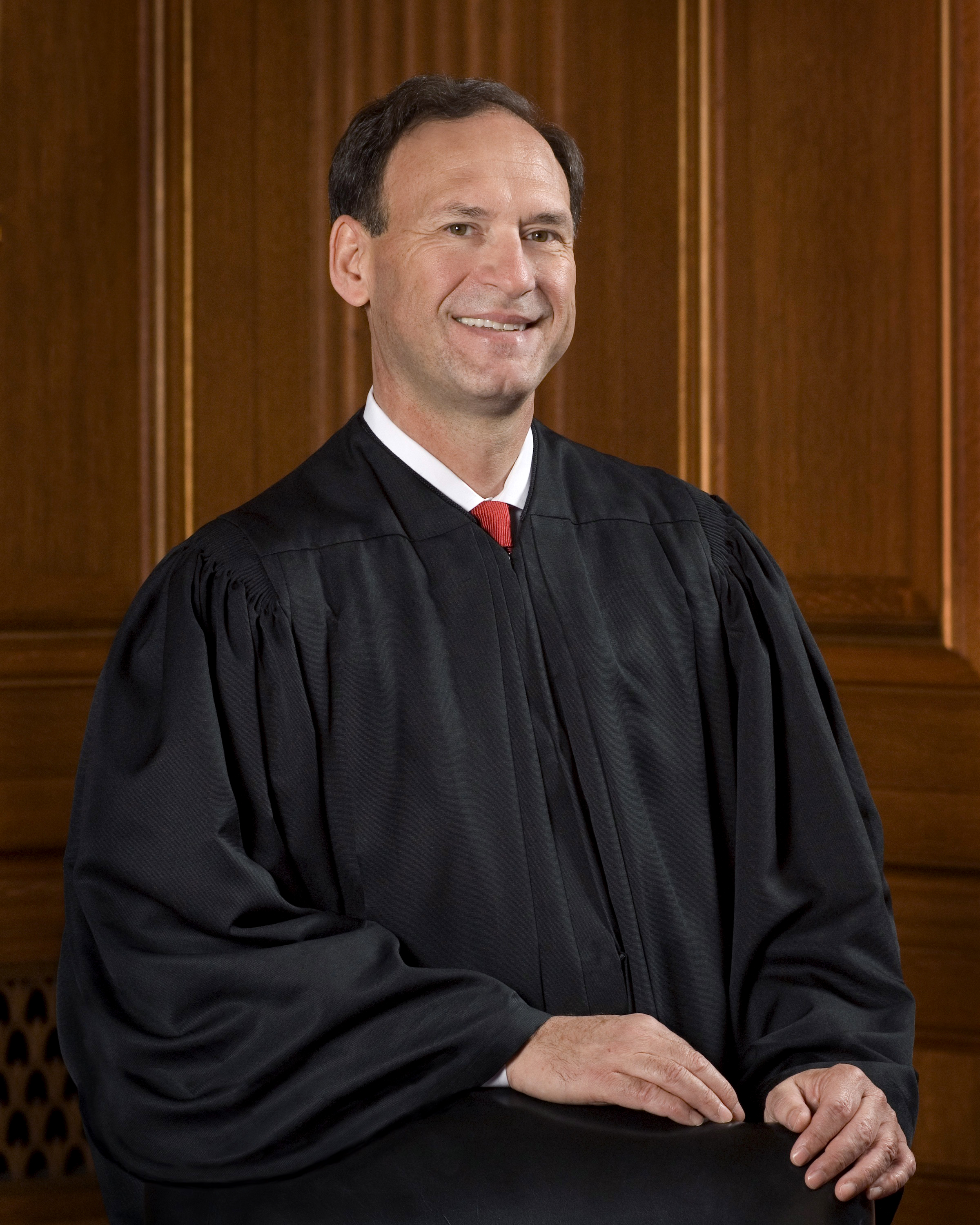
Historical · U.S. Court of Appeals for the Third Circuit
Samuel A. Alito Jr.
Former Circuit Judge · U.S. Court of Appeals for the Third Circuit · 1990–2006 · Appointed by George H W Bush
Samuel A. Alito Jr. served as a circuit judge of the U.S. Court of Appeals for the Third Circuit (1990–2006). Jr. was appointed by George H W Bush.
Key facts
- Full name
- Samuel A. Alito Jr.
- Court
- U.S. Court of Appeals for the Third Circuit
- Office
- Circuit Judge (U.S. Court of Appeals)
- Status
- Former circuit judge
- Duty status
- Not serving
- Appointment
- Senate-confirmed
- FJC seat
- CA30505
- Tenure
- 1990–2006
- Confirmed
- 1990-04-27
- Born
- 1950
- Died
- —
- First year on the bench
- 1990
- Dataset version
- 1.20260711
Appointment & service record
U.S. Court of Appeals for the Third Circuit · 1990–2006
- Seat
- CA30505
- Appointment
- Senate-confirmed
- Appointing president
- George H W Bush
- Confirmed
- 1990-04-27
- Commissioned
- 1990-04-30
- Senior status
- —
Court, FJC seat, appointment type (Senate-confirmed or recess), appointing president, confirmation and commission dates, and senior-status date are drawn from the Federal Judicial Center Biographical Directory and Wikidata.[1][2][3]
Sources
- [1]https://www.fjc.gov/node/1377101fjc · retrieved 2026-07-11
- [2]https://www.fjc.gov/history/judges/biographical-directory-article-iii-federal-judges-exportfjc-directory · retrieved 2026-07-11
- [3]https://www.wikidata.org/wiki/Q11138Wikidata · retrieved 2026-07-11
Biographical narrative
1,670 words · sourced from the Wikipedia REST extract
Samuel A. Alito Jr. is a former United States Circuit Judge who served on the U.S. Court of Appeals for the Third Circuit from 1990 to 2006. Born in 1950, he was appointed to the federal appellate bench by President George H.W. Bush, a Republican, and confirmed in April 1990. His tenure on the Third Circuit spanned sixteen years before his elevation to the Supreme Court of the United States in 2006, where he became the second Italian American justice to serve on the nation's highest court. Prior to his judicial service, Alito built an extensive career in federal legal practice, including positions as an Assistant United States Attorney, an assistant to the Solicitor General, and a Deputy Assistant Attorney General.
Early life and legal career
Samuel Anthony Alito Jr. was born on April 1, 1950, in Trenton, New Jersey, into a family of Italian heritage. His father, Samuel A. Alito Sr., was born Salvatore Alati and immigrated to the United States from Saline Joniche, a town in the municipality of Montebello Jonico in the province of Reggio Calabria in the Calabria region of Italy. His mother, Rose Fradusco, was an Italian American whose parents emigrated from Palazzo San Gervasio in the Basilicata region. Alito's paternal grandfather, Antonino Alati, who anglicized his surname to Alito, arrived in Philadelphia in 1913 aboard the SS Ancona. Both of Alito's parents were educators: his father earned a master's degree from Rutgers University and worked as a high school teacher before becoming the first director of the New Jersey Office of Legislative Services, a position he held from 1952 to 1984, while his mother was a schoolteacher.
Alito was raised in Hamilton Township, New Jersey, a suburban community near Trenton. He attended Steinert High School, where he excelled academically and graduated as class valedictorian in 1968. He then enrolled at Princeton University, where he pursued his undergraduate studies at the Woodrow Wilson School of Public and International Affairs. During his time at Princeton, Alito demonstrated leadership and intellectual engagement in various capacities. In 1971, he chaired a student conference titled "The Boundaries of Privacy in American Society," which examined issues related to domestic intelligence gathering and advocated for statutory oversight of national security surveillance. He also led the Debate Panel of the American Whig-Cliosophic Society, one of Princeton's oldest student organizations. Rather than joining one of Princeton's traditional eating clubs, Alito became a member of Stevenson Hall.
As a sophomore in December 1969, Alito received lottery number 32 in the Selective Service drawing and subsequently joined the Army ROTC program at Princeton. He was commissioned as a second lieutenant in the United States Army Reserve in 1972. During his senior year, Alito studied in Italy, where he researched and wrote his senior thesis on the Italian Constitutional Court under the supervision of political scientist Walter F. Murphy, who also served as his faculty adviser and taught a course on constitutional interpretation that significantly influenced Alito's thinking. Among his peers in the American Whig-Cliosophic Society, Alito was noted for his familiarity with the writings of Supreme Court Justice John Marshall Harlan II. He graduated from Princeton in 1972 with a Bachelor of Arts degree, summa cum laude. His yearbook entry from that year expressed his aspiration to eventually serve on the Supreme Court. During his Princeton years, Alito also joined Concerned Alumni of Princeton, a conservative alumni organization that opposed coeducation and expressed concerns about the admission of women and minorities to the university.
Following his undergraduate education, Alito attended Yale Law School, where he served as an editor of the Yale Law Journal and earned his Juris Doctor degree in 1975. After completing law school, he fulfilled his military service obligation, serving on active duty from September to December 1975 while attending the Signal Officer Basic Course at Fort Gordon, Georgia. He was promoted through the ranks to first lieutenant and captain, completing his service as a member of the inactive reserve before receiving an honorable discharge in 1980.
Alito began his legal career in 1976 as a law clerk to Judge Leonard I. Garth of the U.S. Court of Appeals for the Third Circuit in Newark, New Jersey, serving through 1977. He had interviewed for a clerkship with Supreme Court Justice Byron White but was not selected. From 1977 to 1981, Alito worked as an Assistant United States Attorney in the District of New Jersey, where he served under Maryanne Trump Barry, who was then chief of the appeals division and later became a federal judge. In this role, Alito prosecuted numerous cases involving drug trafficking and organized crime, gaining substantial trial and appellate experience in federal criminal law.
In 1981, Alito transitioned to the Office of the Solicitor General, serving as an assistant to Solicitor General Rex E. Lee until 1985. During this period, he argued twelve cases before the Supreme Court on behalf of the federal government, prevailing in all but two of them. His work in the Solicitor General's office included involvement in significant constitutional litigation. From 1985 to 1987, Alito served as Deputy Assistant Attorney General in the Office of Legal Counsel under Charles J. Cooper, further deepening his expertise in constitutional law and federal legal policy. Following this position, he was appointed United States Attorney for the District of New Jersey, where he served as the chief federal prosecutor for the state until his appointment to the federal appellate bench.
Federal appellate service
In 1990, President George H.W. Bush, a Republican, nominated Alito to serve as a judge on the U.S. Court of Appeals for the Third Circuit. He was confirmed by the United States Senate on April 27, 1990, and took his seat on the court, filling seat CA30505. The Third Circuit has jurisdiction over federal appeals from the district courts of Pennsylvania, New Jersey, Delaware, and the Virgin Islands, and Alito's appointment placed him on one of the nation's thirteen federal courts of appeals, which occupy an intermediate position in the federal judicial hierarchy between the district trial courts and the Supreme Court.
During his sixteen years on the Third Circuit, Alito participated in the consideration of thousands of cases spanning the full range of federal law, including constitutional questions, criminal appeals, civil rights matters, administrative law, and commercial disputes. As a circuit judge, he authored numerous opinions that addressed complex legal issues and contributed to the development of federal jurisprudence within the Third Circuit's jurisdiction. His work on the appellate court provided him with extensive experience in appellate decision-making and legal reasoning across diverse areas of federal law.
Alito's service on the Third Circuit established his reputation within the federal judiciary and the broader legal community. His opinions and judicial approach during this period were studied by legal scholars, practitioners, and other judges. The experience he gained during his years on the court of appeals would later inform his work after his elevation to the Supreme Court, as circuit court service traditionally provides federal judges with a comprehensive understanding of the federal judicial system and the practical application of legal principles in appellate review.
His tenure on the Third Circuit came to an end in 2006 when he was nominated to the Supreme Court by President George W. Bush, a Republican, following the retirement of Justice Sandra Day O'Connor. After Senate confirmation, Alito was sworn in as an Associate Justice of the Supreme Court on January 31, 2006, becoming the second Italian American to serve on the nation's highest court, following Justice Antonin Scalia.
Jurisprudence and legacy
Alito's years of service on the U.S. Court of Appeals for the Third Circuit from 1990 to 2006 represented a significant chapter in his judicial career and contributed to the body of federal appellate law during a period of important legal developments. His work as a circuit judge provided the foundation for his subsequent service on the Supreme Court, where he has described himself as a "practical originalist" in his approach to constitutional interpretation. This methodological orientation, which emphasizes the original public meaning of constitutional text while acknowledging practical considerations in its application, reflects a judicial philosophy that was developed and refined during his years in the federal judiciary.
On the Supreme Court, Alito has been identified as a member of the conservative bloc and has authored majority opinions in several landmark cases that have significantly shaped American constitutional law. These include decisions addressing the Second Amendment and firearm rights, the Religious Freedom Restoration Act and insurance coverage mandates, public-sector labor relations and union security agreements, and the constitutional status of abortion rights. His opinion writing has demonstrated the analytical skills and legal reasoning developed during his extensive experience in federal appellate practice and his sixteen years as a circuit judge.
The trajectory of Alito's career from Assistant United States Attorney through various positions in the Department of Justice, to his appointment as United States Attorney for New Jersey, and then to the federal appellate bench, represents a traditional path of advancement within the federal legal system. His service on the Third Circuit provided him with the opportunity to work alongside other federal judges, to engage with the full spectrum of federal legal questions, and to develop expertise in appellate decision-making that would prove valuable in his later role on the Supreme Court.
As a former circuit judge who ascended to the Supreme Court, Alito joined a long tradition of justices who previously served on the federal courts of appeals. This career progression has historically been viewed as valuable preparation for Supreme Court service, as it provides judges with direct experience in the federal appellate system and familiarity with the types of legal questions that ultimately reach the nation's highest court. His sixteen years on the Third Circuit represented a substantial period of judicial service during which he contributed to the resolution of numerous legal disputes and the interpretation of federal law within the circuit's jurisdiction, leaving a record of appellate opinions that continues to be cited and analyzed by courts, legal scholars, and practitioners.
Sources & provenance
Every quantitative or attributable claim above carries a per-section [N] marker that resolves to the corresponding URL below. Each entry records the upstream provider, the canonical URL, and the timestamp at which the underlying source was retrieved.
Key facts
- https://www.fjc.gov/node/1377101fjc · retrieved 2026-07-11
- https://www.fjc.gov/history/judges/biographical-directory-article-iii-federal-judges-exportfjc-directory · retrieved 2026-07-11
- https://www.wikidata.org/wiki/Q11138Wikidata · retrieved 2026-07-11
Biographical narrative
- https://en.wikipedia.org/wiki/Samuel_AlitoWikipedia · retrieved 2026-07-11
Explore the federal judiciary
The U.S. Courts of Appeals are the intermediate appellate courts of the federal judiciary — thirteen circuits sitting between the district courts and the Supreme Court. Browse the full roster of judges on the U.S. Court of Appeals for the Third Circuit, or explore how the appointed federal judiciary fits into the federal government.