
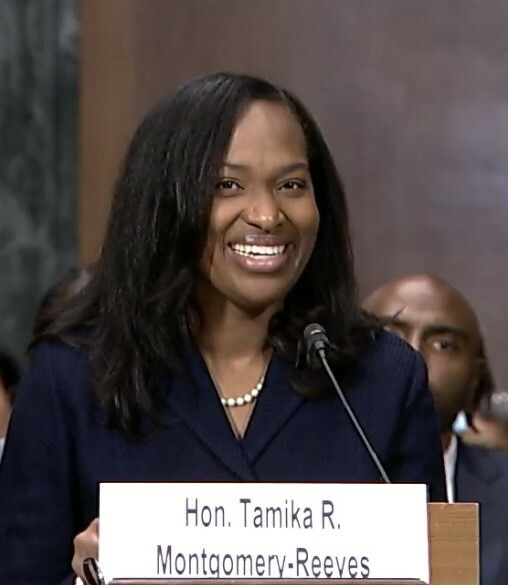
Currently serving · U.S. Court of Appeals for the Third Circuit
Tamika Renee Montgomery-Reeves
Currently serving
Circuit Judge · U.S. Court of Appeals for the Third Circuit · 2023–present · Appointed by Joe Biden
Tamika Renee Montgomery-Reeves serves as a circuit judge of the U.S. Court of Appeals for the Third Circuit (2023–present). Montgomery-Reeves was appointed by Joe Biden.
Key facts
- Full name
- Tamika Renee Montgomery-Reeves
- Court
- U.S. Court of Appeals for the Third Circuit
- Office
- Circuit Judge (U.S. Court of Appeals)
- Status
- Active circuit judge
- Duty status
- Active
- Appointment
- Senate-confirmed
- FJC seat
- CA31303
- Tenure
- 2023–present
- Confirmed
- 2022-12-12
- Born
- 1981
- Died
- —
- First year on the bench
- 2023
- Dataset version
- 1.20260705
Appointment & service record
U.S. Court of Appeals for the Third Circuit · 2023–present
- Seat
- CA31303
- Appointment
- Senate-confirmed
- Appointing president
- Joe Biden
- Confirmed
- 2022-12-12
- Commissioned
- 2023-02-07
- Senior status
- —
Court, FJC seat, appointment type (Senate-confirmed or recess), appointing president, confirmation and commission dates, and senior-status date are drawn from the Federal Judicial Center Biographical Directory and Wikidata.[1][2][3]
Sources
- [1]https://www.fjc.gov/node/12941021fjc · retrieved 2026-07-05
- [2]https://www.fjc.gov/history/judges/biographical-directory-article-iii-federal-judges-exportfjc-directory · retrieved 2026-07-05
- [3]https://www.wikidata.org/wiki/Q74604225Wikidata · retrieved 2026-07-05
Biographical narrative
1,109 words · sourced from the Wikipedia REST extract
Tamika Renee Montgomery‑Reeves (born 1981) is an American jurist who serves as a United States circuit judge on the Court of Appeals for the Third Circuit. Prior to her federal appointment, she held positions on both the Delaware Court of Chancery and the Delaware Supreme Court, becoming the first African‑American justice on the latter bench. Her career has combined private practice in corporate law with public service focused on judicial administration, diversity initiatives, and pro bono advocacy.
Early life and legal career
Tamika Montgomery‑Reeves was born in Jackson, Mississippi, to Dewrey and Bettye Montgomery (née Cribbs). She pursued her undergraduate studies at the University of Mississippi, graduating magna cum laude with a Bachelor of Arts degree in 2003. Continuing her education in law, she earned a Juris Doctor from the University of Georgia School of Law in 2006.
Following admission to the bar, Montgomery‑Reeves entered private practice, first joining the Wilmington office of Wilson Sonsini Goodrich & Rosati. In that role she concentrated on corporate governance matters and commercial litigation, representing businesses in a range of transactional and dispute contexts. She later moved to New York City, where she worked at Weil Gotshal & Manges. At Weil, her practice similarly emphasized corporate governance, with an added focus on securities litigation, allowing her to develop expertise in the regulatory dimensions of corporate finance.
In addition to her work for private clients, Montgomery‑Reeves has engaged in pro bono service. Notably, she contributed to the Prisoners’ Rights Project, providing legal assistance aimed at protecting the constitutional rights of incarcerated individuals. Her commitment to improving the legal profession extended beyond casework; she participated on a steering committee led by Chief Justice Collins J. Seitz Jr., which produced a strategic plan intended to increase diversity within Delaware’s judiciary and broader legal community.
Montgomery‑Reeves’ early judicial experience began with her appointment as Vice Chancellor of the Delaware Court of Chancery in 2015. Governor Jack Markell nominated her on October 13, 2015 to fill the vacancy left by Vice Chancellor Donald F. Parsons. The chancery court, renowned for its jurisdiction over corporate disputes, provided a platform for Montgomery‑Reeves to apply her corporate law background within a judicial setting.
Federal appellate service
After serving on Delaware’s highest courts, Montgomery‑Reeves was nominated to the federal judiciary by President Joe Biden. On June 29, 2022 the president announced his intent to nominate her as a United States circuit judge for the Third Circuit, designating her to succeed Judge Thomas L. Ambro, who had indicated plans to assume senior status upon confirmation of a successor. The formal nomination was transmitted to the Senate on July 11, 2022.
The Senate Judiciary Committee held a hearing on Montgomery‑Reeves’ nomination on September 7, 2022. During the proceedings, Republican members raised questions concerning a diversity strategic plan that she had co‑chaired while serving on Delaware’s Supreme Court steering committee. The plan included recommendations such as allowing prospective lawyers to rely on clerkship experience and judicial endorsements in lieu of passing the bar exam, and suggested removing portraits of white judges from courthouses to mitigate implicit bias. Montgomery‑Reeves clarified that she had not authored or edited those specific proposals, emphasizing her limited involvement as co‑chair.
The American Bar Association’s Standing Committee on the Federal Judiciary evaluated her qualifications and unanimously rated her “well qualified” for the appellate position. Following committee deliberations, her nomination was reported out of the Judiciary Committee on September 28, 2022 by a vote of 13–9. The full Senate subsequently invoked cloture on December 8, 2022 with a 57–39 vote, limiting further debate on the nomination. On December 12, 2022, the Senate confirmed Montgomery‑Reeves by a 53–35 margin. She received her judicial commission on February 7, 2023 and entered active service as an appellate judge for the Third Circuit.
Since joining the federal bench, Montgomery‑Reeves has been listed as an active circuit judge, contributing to the adjudication of appeals arising from district courts within Pennsylvania, New Jersey, Delaware, and the Virgin Islands. While specific opinions authored on the Third Circuit are not detailed in the available sources, her presence adds to the demographic diversity of the federal judiciary and reflects a trajectory that spans state‑level equity initiatives and high‑profile corporate jurisprudence.
Jurisprudence and legacy
Tamika Montgomery‑Reeves’ judicial career is marked by several pioneering milestones and thematic contributions. Her appointment to the Delaware Supreme Court in 2019 made her the first African‑American justice to serve on that court, a historic development for a state with a long tradition of corporate law adjudication. During her tenure on the supreme court, she authored a majority opinion in 2021 addressing the applicability of the Delaware Freedom of Information Act to Senate records submitted to the University of Delaware archives by President Biden; the decision held that such records were not subject to FOIA demands, underscoring her engagement with issues at the intersection of governmental transparency and privacy.
Beyond case decisions, Montgomery‑Reeves has been active in efforts to broaden representation within the legal profession. Her participation on the Diversity Strategic Planning Steering Committee demonstrated a commitment to identifying structural barriers that may impede minority participation in law, such as traditional bar admission requirements and symbolic representations within courthouses. Although some of the committee’s recommendations generated debate during her federal confirmation hearing, her involvement reflects an ongoing concern for equity in judicial institutions.
Montgomery‑Reeves’ professional background blends extensive corporate litigation experience with a record of public service. Her work at prominent law firms equipped her with practical insight into complex commercial disputes, which she later applied as Vice Chancellor of the Delaware Court of Chancery—a court that frequently resolves high‑stakes corporate matters. This combination of private‑sector expertise and judicial stewardship has positioned her to contribute meaningfully to appellate review of both commercial and constitutional issues.
The confirmation process itself highlighted the political dimensions often accompanying federal judicial appointments, yet the Senate’s ultimate vote confirmed a broad consensus on her qualifications, as reflected in the ABA’s “well qualified” rating and the bipartisan support evident in the cloture and confirmation votes. Her elevation to the Third Circuit adds to the growing representation of African‑American jurists within the federal appellate system, aligning with broader trends toward greater diversity on the bench.
In sum, Tamika Renee Montgomery‑Reeves’ career trajectory—from her early education in Mississippi and Georgia, through private practice in Delaware and New York, to state judicial service and ultimately a federal appellate appointment—illustrates a blend of legal acumen, commitment to public interest, and pioneering representation. Her contributions continue to shape the jurisprudential landscape of both Delaware’s courts and the Third Circuit, while her involvement in diversity initiatives signals an enduring focus on fostering inclusivity within the legal profession.
Sources & provenance
Every quantitative or attributable claim above carries a per-section [N] marker that resolves to the corresponding URL below. Each entry records the upstream provider, the canonical URL, and the timestamp at which the underlying source was retrieved.
Key facts
- https://www.fjc.gov/node/12941021fjc · retrieved 2026-07-05
- https://www.fjc.gov/history/judges/biographical-directory-article-iii-federal-judges-exportfjc-directory · retrieved 2026-07-05
- https://www.wikidata.org/wiki/Q74604225Wikidata · retrieved 2026-07-05
Biographical narrative
- https://en.wikipedia.org/wiki/Tamika_Montgomery-ReevesWikipedia · retrieved 2026-07-05
Explore the federal judiciary
The U.S. Courts of Appeals are the intermediate appellate courts of the federal judiciary — thirteen circuits sitting between the district courts and the Supreme Court. Browse the full roster of judges on the U.S. Court of Appeals for the Third Circuit, or explore how the appointed federal judiciary fits into the federal government.