
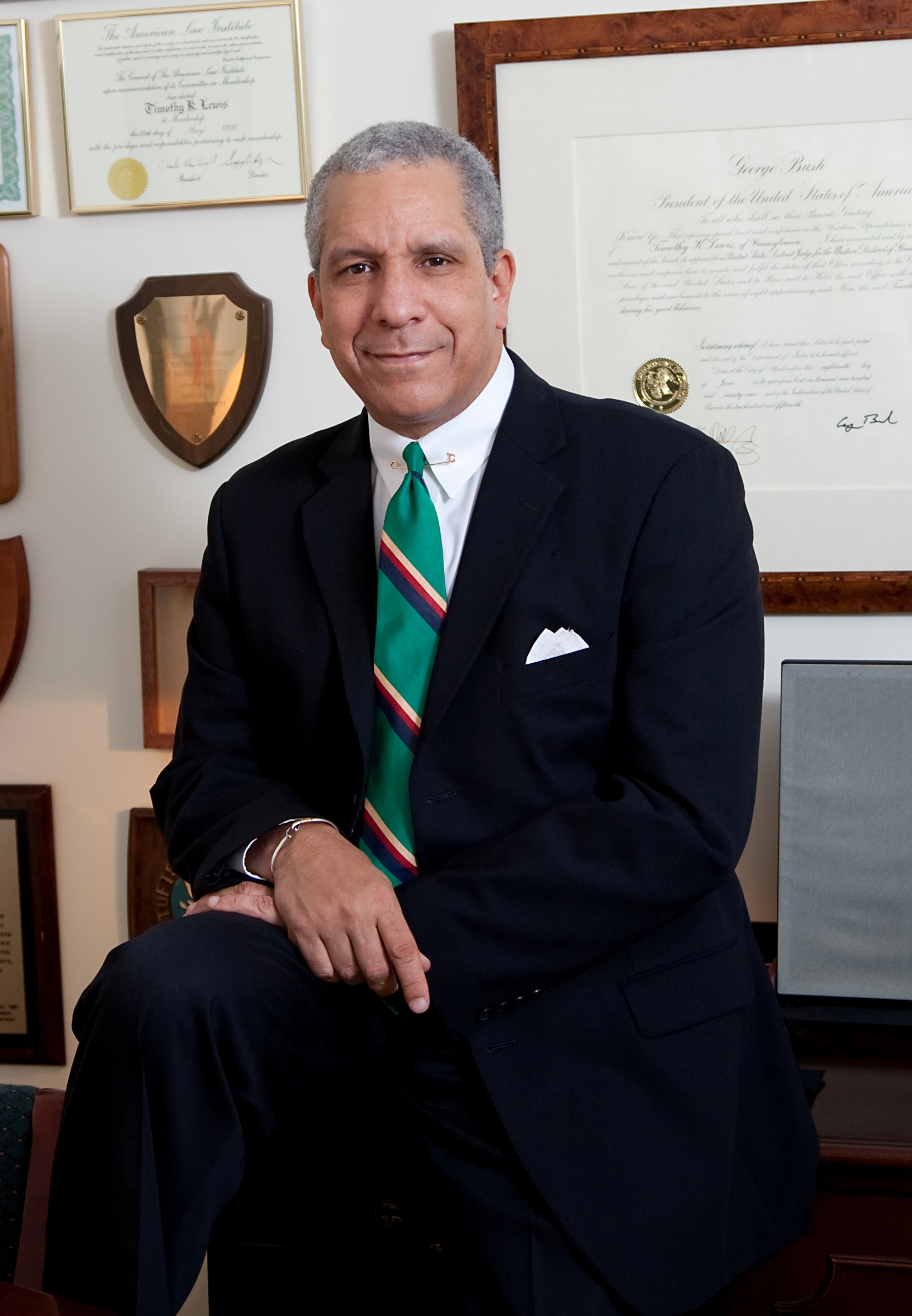
Historical · U.S. Court of Appeals for the Third Circuit
Timothy K. Lewis
Former Circuit Judge · U.S. Court of Appeals for the Third Circuit · 1992–1999 · Appointed by George H W Bush
Timothy K. Lewis served as a circuit judge of the U.S. Court of Appeals for the Third Circuit (1992–1999). Lewis was appointed by George H W Bush.
Key facts
- Full name
- Timothy K. Lewis
- Court
- U.S. Court of Appeals for the Third Circuit
- Office
- Circuit Judge (U.S. Court of Appeals)
- Status
- Former circuit judge
- Duty status
- Not serving
- Appointment
- Senate-confirmed
- FJC seat
- CA31401
- Tenure
- 1992–1999
- Confirmed
- 1992-10-08
- Born
- 1954
- Died
- —
- First year on the bench
- 1992
- Dataset version
- 1.20260711
Appointment & service record
U.S. Court of Appeals for the Third Circuit · 1992–1999
- Seat
- CA31401
- Appointment
- Senate-confirmed
- Appointing president
- George H W Bush
- Confirmed
- 1992-10-08
- Commissioned
- 1992-10-09
- Senior status
- —
Court, FJC seat, appointment type (Senate-confirmed or recess), appointing president, confirmation and commission dates, and senior-status date are drawn from the Federal Judicial Center Biographical Directory and Wikidata.[1][2][3]
Sources
- [1]https://www.fjc.gov/node/1383891fjc · retrieved 2026-07-11
- [2]https://www.fjc.gov/history/judges/biographical-directory-article-iii-federal-judges-exportfjc-directory · retrieved 2026-07-11
- [3]https://www.wikidata.org/wiki/Q7807321Wikidata · retrieved 2026-07-11
Biographical narrative
1,152 words · sourced from the Wikipedia REST extract
Timothy K. Lewis is a former United States circuit judge who served on the United States Court of Appeals for the Third Circuit from 1992 to 1999. Born in 1954, he was appointed to the federal appellate bench by President George H.W. Bush, a Republican, and confirmed by the Senate in October 1992. Lewis had a distinguished career in federal prosecution before his judicial service and has since become a prominent figure in alternative dispute resolution and commercial litigation in private practice.
Early life and legal career
Timothy Kimbrue Lewis was born on November 2, 1954, in Pittsburgh, Pennsylvania. He pursued his undergraduate education at Tufts University, where he earned a Bachelor of Arts degree in 1976. Following his undergraduate studies, Lewis attended Duquesne University School of Law in Pittsburgh, obtaining his Juris Doctor in 1980.
Upon graduating from law school, Lewis began his legal career in public service as a prosecutor. From 1980 to 1983, he worked as an assistant district attorney for Allegheny County, Pennsylvania, gaining experience in state-level criminal prosecution. In 1983, he transitioned to federal prosecution, joining the office of the United States Attorney for the Western District of Pennsylvania as an Assistant United States Attorney. He served in this capacity for eight years, from 1983 to 1991, handling federal criminal matters and developing expertise in trial advocacy and federal criminal law.
Lewis comes from a historically significant family background. He is the great-great-great-grandson of Lewis Woodson, who is believed to have been a descendant of Thomas Jefferson and Sally Hemings. DNA evidence that emerged in 1998 provided support for the historical account of Jefferson's relationship with Hemings, who was enslaved at Jefferson's Monticello estate. This ancestry connects Lewis to an important and complex chapter of American history regarding race, slavery, and the founding generation.
Federal appellate service
Lewis's federal judicial career began when President George H.W. Bush nominated him to serve as a United States District Judge for the Western District of Pennsylvania on April 25, 1991. This nomination was to fill a vacancy that had been created by the departure of Judge Paul A. Simmons. The Senate confirmed Lewis on June 14, 1991, and he received his commission four days later, on June 18, 1991. At the time of this appointment, Lewis was noted as being the youngest federal judge then serving in the United States, a distinction that reflected both his professional accomplishments at a relatively early age and the confidence placed in him by the appointing authorities.
Lewis's service on the district court was brief but significant. After just over a year on the trial bench, President Bush nominated him for elevation to the United States Court of Appeals for the Third Circuit. This nomination, made on September 17, 1992, was for a newly created seat on the appellate court. The Senate moved quickly to confirm the nomination, doing so on October 8, 1992, and Lewis received his commission the following day, on October 9, 1992. His confirmation made him the final appeals court nominee of President Bush to be confirmed by the Senate before the end of Bush's presidency. Lewis's district court service officially terminated on October 23, 1992, due to his elevation to the circuit court.
As a circuit judge on the Third Circuit, Lewis was once again noted as the youngest federal judge in the United States at the time of his appointment to the appellate bench. The Third Circuit has jurisdiction over appeals from the federal district courts in Pennsylvania, New Jersey, Delaware, and the Virgin Islands, giving Lewis a broad range of cases to consider during his tenure. He served on the court for nearly seven years, participating in the resolution of numerous appeals across the full spectrum of federal law.
On June 30, 1999, Lewis resigned from his position on the Third Circuit to return to private practice. His departure from the bench came while he was still relatively young and at a point when he could pursue other professional opportunities. The decision to leave lifetime-tenured judicial service for private practice is relatively uncommon among federal appellate judges, but Lewis chose to redirect his career toward alternative dispute resolution and litigation practice.
Jurisprudence and legacy
Following his resignation from the federal bench, Lewis has maintained a prominent position in the legal profession, particularly in the fields of alternative dispute resolution and complex litigation. He joined the law firm then known as Schnader, Harrison, Segal & Lewis LLP, where he served as co-chair of the firm's alternative dispute resolution group. In this role, he worked extensively as a mediator, arbitrator, and settlement counselor, helping parties resolve disputes outside of traditional litigation. He also served as counsel on both trial and appellate matters and was a past co-chair of the firm's appellate practice group, drawing on his experience as a federal appellate judge.
As of recent years, Lewis has been affiliated with Blank Rome LLP, where he serves as senior counsel in the Business Litigation practice group. His work continues to focus on mediation, arbitration, settlement counseling, and both trial and appellate advocacy. This combination of roles allows him to leverage both his judicial experience and his skills in facilitating dispute resolution.
Lewis has been extensively involved in professional organizations related to dispute resolution and the legal profession more broadly. He has held multiple positions with the American Arbitration Association, including service on the Judicial Settlement Conference Service Panel and membership on the National Task Force on Issues Related to the Arbitration of Consumer Debt Issues. He has also served on the organization's board and executive committee. At the International Institute for Conflict Prevention and Resolution, he contributed to the Task Force that developed the Employment-Related Mass Claims Protocol, which provides guidance for arbitrators and mediators handling such matters. He has served as co-chair of the organization's Diversity in ADR Task Force and as a former member of its board of directors.
His professional affiliations reflect his standing in the legal community. Lewis is a member of the American Law Institute, an organization of judges, lawyers, and legal scholars dedicated to clarifying and improving the law. He is an honorary fellow of the American Academy of Appellate Lawyers and a fellow of the College of Commercial Arbitrators. He maintains active involvement with the Pennsylvania Interbranch Commission for Gender, Racial, and Ethnic Fairness and serves on the Board of Advisors of the Georgetown Supreme Court Institute. Beyond the legal field, he has served as a former member of the board of directors of the National Jazz Museum in Harlem, demonstrating engagement with cultural institutions.
As an African American jurist who served on a federal court of appeals, Lewis is part of the history of increasing diversity on the federal bench, and his career trajectory from prosecutor to district judge to circuit judge to prominent practitioner in alternative dispute resolution represents a distinctive path in the American legal profession.
Sources & provenance
Every quantitative or attributable claim above carries a per-section [N] marker that resolves to the corresponding URL below. Each entry records the upstream provider, the canonical URL, and the timestamp at which the underlying source was retrieved.
Key facts
- https://www.fjc.gov/node/1383891fjc · retrieved 2026-07-11
- https://www.fjc.gov/history/judges/biographical-directory-article-iii-federal-judges-exportfjc-directory · retrieved 2026-07-11
- https://www.wikidata.org/wiki/Q7807321Wikidata · retrieved 2026-07-11
Biographical narrative
- https://en.wikipedia.org/wiki/Timothy_K._LewisWikipedia · retrieved 2026-07-11
Explore the federal judiciary
The U.S. Courts of Appeals are the intermediate appellate courts of the federal judiciary — thirteen circuits sitting between the district courts and the Supreme Court. Browse the full roster of judges on the U.S. Court of Appeals for the Third Circuit, or explore how the appointed federal judiciary fits into the federal government.