
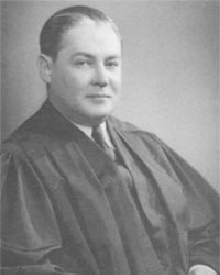
Historical · U.S. Court of Appeals for the Third Circuit
William Francis Smith
Former Circuit Judge · U.S. Court of Appeals for the Third Circuit · 1961–1968 · Appointed by John F Kennedy
William Francis Smith served as a circuit judge of the U.S. Court of Appeals for the Third Circuit (1961–1968). Smith was appointed by John F Kennedy.
Key facts
- Full name
- William Francis Smith
- Court
- U.S. Court of Appeals for the Third Circuit
- Office
- Circuit Judge (U.S. Court of Appeals)
- Status
- Former circuit judge
- Duty status
- Not serving
- Appointment
- Senate-confirmed
- FJC seat
- CA30305
- Tenure
- 1961–1968
- Confirmed
- 1961-08-30
- Born
- 1903-02-24
- Died
- 1968-02-26
- First year on the bench
- 1961
- Dataset version
- 1.20260711
Appointment & service record
U.S. Court of Appeals for the Third Circuit · 1961–1968
- Seat
- CA30305
- Appointment
- Senate-confirmed
- Appointing president
- John F Kennedy
- Confirmed
- 1961-08-30
- Commissioned
- 1961-08-30
- Senior status
- —
Court, FJC seat, appointment type (Senate-confirmed or recess), appointing president, confirmation and commission dates, and senior-status date are drawn from the Federal Judicial Center Biographical Directory and Wikidata.[1][2][3]
Sources
- [1]https://www.fjc.gov/node/1388031fjc · retrieved 2026-07-11
- [2]https://www.fjc.gov/history/judges/biographical-directory-article-iii-federal-judges-exportfjc-directory · retrieved 2026-07-11
- [3]https://www.wikidata.org/wiki/Q8009325Wikidata · retrieved 2026-07-11
Biographical narrative
1,084 words · sourced from the Wikipedia REST extract
William Francis Smith (1903–1968) was a United States circuit judge who served on the United States Court of Appeals for the Third Circuit from 1961 until his death in 1968. Prior to his elevation to the appellate bench, he had a distinguished career in federal service that included two decades as a United States district judge for the District of New Jersey, as well as earlier service as both United States Attorney and Assistant United States Attorney for that district. His judicial career spanned nearly three decades of federal service, during which he developed a reputation for efficiency and dedication to clearing court backlogs.
Early life and legal career
William Francis Smith was born on February 24, 1903, in Perth Amboy, New Jersey, to John Stephan Smith and Ann Elizabeth Owens. His educational path was somewhat unconventional for someone who would eventually serve on the federal bench. He first pursued pharmaceutical studies, earning a Graduate of Pharmacy degree from Columbia University in 1922. He then turned to the law, receiving his Bachelor of Laws from New Jersey Law School in 1929. The institution from which he graduated would later become known as Rutgers Law School.
Smith's involvement in public service began even before he completed his legal education. In 1926, while still pursuing his law degree, he served as deputy mayor of Perth Amboy, his hometown. This early experience in municipal government provided him with practical knowledge of public administration that would serve him throughout his career.
After obtaining his law degree, Smith entered private practice in New Jersey, where he worked from 1930 to 1931. During this same period and continuing until 1935, he served as an instructor at New Jersey Law School, the institution where he had received his own legal training. This teaching role allowed him to contribute to the education of future lawyers while establishing his own legal career.
Smith's career took a decisive turn toward federal service in 1934 when he was appointed as an Assistant United States Attorney for the District of New Jersey. He served in this prosecutorial role for six years, gaining extensive experience in federal criminal and civil litigation. His performance in this position led to his promotion to United States Attorney for the District of New Jersey in 1940, the chief federal law enforcement position in the district. He held this office until 1941, when he transitioned to the federal judiciary.
On August 29, 1935, during his time as a law school instructor and assistant federal prosecutor, Smith married Marie Cathers.
Federal appellate service
Smith's judicial career began at the district court level. President Franklin D. Roosevelt, a Democrat, nominated him to the United States District Court for the District of New Jersey on January 23, 1941. The nomination was for a newly created judgeship authorized by federal statute. The Senate confirmed his appointment on February 13, 1941, and he received his commission two days later, on February 15, 1941. At the time of his appointment to the federal bench, Smith was believed to have been the youngest federal court judge then serving, though his exact age at appointment—thirty-seven years old—demonstrated that he had already accumulated substantial legal experience despite his youth.
Smith served as a district judge for two decades, eventually rising to the position of Chief Judge of the District of New Jersey, a role he held from 1959 to 1961. During his tenure on the district court, he developed a reputation for judicial efficiency and effectiveness in managing heavy caseloads. In 1959, Chief Justice Earl Warren called upon him to address a significant backlog that had accumulated at the federal court in Brooklyn, part of the Eastern District of New York. Smith accepted this assignment and succeeded in bringing that court's docket current within six months, a notable achievement that demonstrated his administrative capabilities and work ethic.
Smith's effective service on the district court led to his elevation to the appellate bench. President John F. Kennedy, a Democrat, nominated him on August 15, 1961, to a seat on the United States Court of Appeals for the Third Circuit. The vacancy had been created by the departure of Judge Phillip Forman. The Senate moved quickly on the nomination, confirming Smith on August 30, 1961. He received his commission the same day, and his service on the district court was terminated on September 12, 1961, when he formally assumed his new appellate duties.
Smith served on the Third Circuit for approximately six and a half years. His tenure on the appellate court was cut short by his death on February 26, 1968, at Saint Peter's University Hospital in New Brunswick, New Jersey. He died just two days after his sixty-fifth birthday, bringing to an end a federal judicial career that had spanned nearly twenty-seven years.
Jurisprudence and legacy
The Third Circuit, on which Smith served during the final years of his life, holds appellate jurisdiction over federal cases arising from Delaware, New Jersey, Pennsylvania, and the Virgin Islands. During Smith's tenure from 1961 to 1968, the federal courts were addressing significant legal questions arising from the civil rights movement, criminal procedure reforms, and evolving interpretations of constitutional rights. While specific details of Smith's individual opinions and judicial philosophy are not extensively documented in available records, his service during this period placed him at the center of important developments in federal law.
Smith's career trajectory—from local government service through federal prosecution to two decades on the trial bench before his appellate appointment—provided him with a comprehensive understanding of the federal judicial system from multiple perspectives. His experience as United States Attorney gave him insight into federal law enforcement priorities and prosecutorial decision-making. His twenty years as a district judge, including his time as chief judge, afforded him extensive experience with trial-level proceedings, evidence, and the practical administration of justice. This background would have informed his work reviewing lower court decisions during his years on the Third Circuit.
His demonstrated ability to manage judicial workload efficiently, as evidenced by his successful resolution of the Eastern District of New York backlog, reflected a commitment to the timely administration of justice. This practical approach to judicial administration complemented his substantive legal work and contributed to the effective functioning of the federal courts during his tenure.
Smith's nearly three decades of federal service, spanning appointments by two Democratic presidents and encompassing both trial and appellate work, represented a significant contribution to the federal judiciary in New Jersey and the Third Circuit during the mid-twentieth century.
Sources & provenance
Every quantitative or attributable claim above carries a per-section [N] marker that resolves to the corresponding URL below. Each entry records the upstream provider, the canonical URL, and the timestamp at which the underlying source was retrieved.
Key facts
- https://www.fjc.gov/node/1388031fjc · retrieved 2026-07-11
- https://www.fjc.gov/history/judges/biographical-directory-article-iii-federal-judges-exportfjc-directory · retrieved 2026-07-11
- https://www.wikidata.org/wiki/Q8009325Wikidata · retrieved 2026-07-11
Biographical narrative
- https://en.wikipedia.org/wiki/William_Francis_SmithWikipedia · retrieved 2026-07-11
Explore the federal judiciary
The U.S. Courts of Appeals are the intermediate appellate courts of the federal judiciary — thirteen circuits sitting between the district courts and the Supreme Court. Browse the full roster of judges on the U.S. Court of Appeals for the Third Circuit, or explore how the appointed federal judiciary fits into the federal government.