
1864 presidential election (term 1)
Won election[1]
| Candidate | Party | Popular vote | Electoral vote |
|---|---|---|---|
| Andrew Johnson | — | — | — |
| Opponent-level tallies pending operator curation. | |||
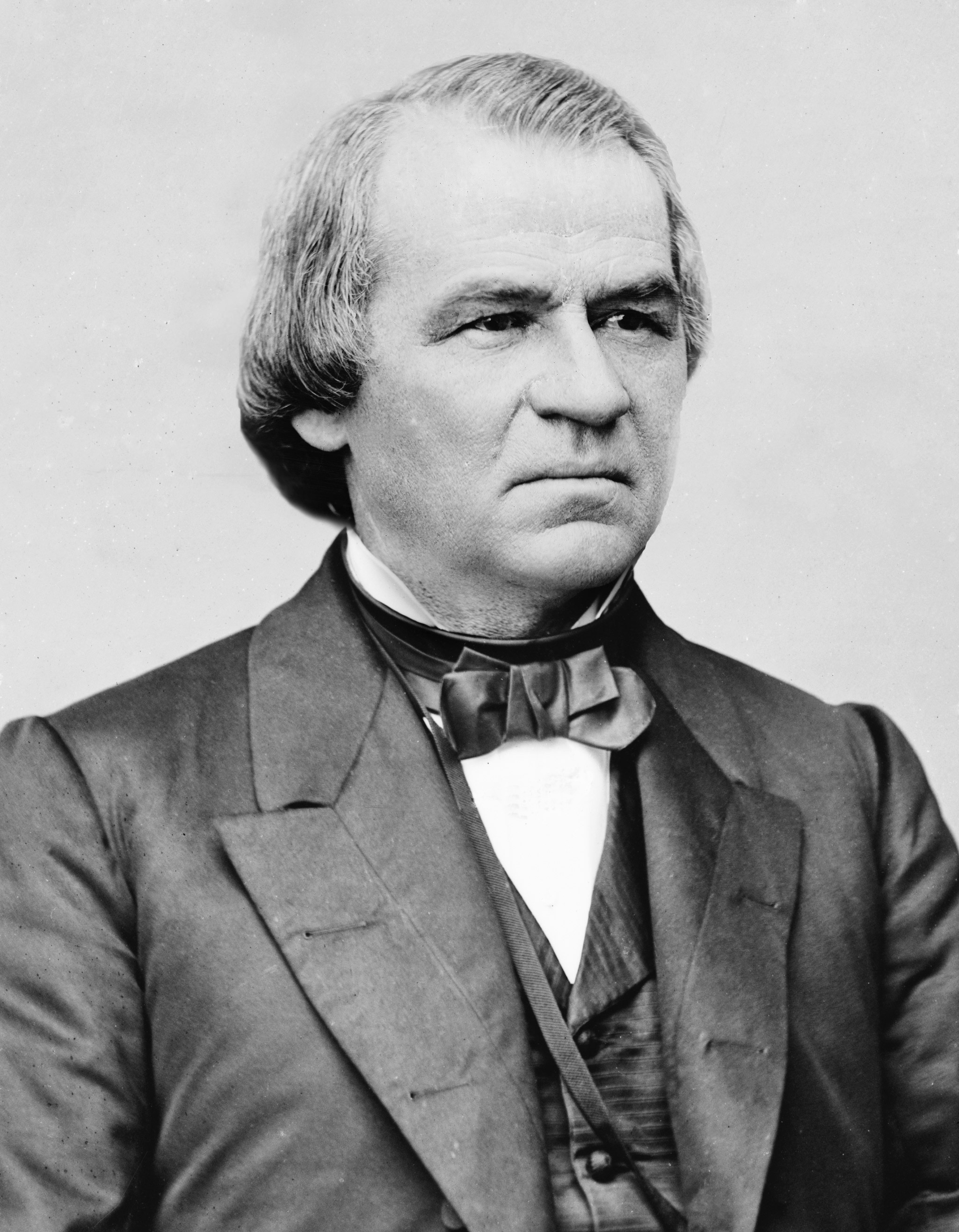
Historical · U.S. President · 17th
17th President of the United States · 1865–1869 · Democratic / National Union
Andrew Johnson served as 17th President of the United States (1865–1869) — one term for the Democratic / National Union. The page below collects sourced biographical facts, the consequential decisions of the presidency, and the elections that put Johnson in office.
Sources
Quotes for Andrew Johnson are pending operator curation. The Task 16 admin queue will surface this row for review; ingest sources for narrative-scope provenance remain attached below.
Sources
Curated policy positions for Andrew Johnson are pending operator review. The biographical narrative below carries the same provenance trail and remains the canonical surface until per-topic positions are written.
Sources
Won election[1]
| Candidate | Party | Popular vote | Electoral vote |
|---|---|---|---|
| Andrew Johnson | — | — | — |
| Opponent-level tallies pending operator curation. | |||
Sources
Per-bill legislation entries for Andrew Johnson are pending operator curation. Era-level legislative impact appears inline in the biographical narrative below; per-bill rows will land in a follow-up sprint.
Sources
1,500 words · sourced from the Wikipedia REST extract
Andrew Johnson (December 29, 1808 – July 31, 1875) was the 17th president of the United States, serving from 1865 to 1869. The 16th vice president, he assumed the presidency following the assassination of Abraham Lincoln. Johnson was a War Democrat who ran with Lincoln on the National Union Party ticket in the 1864 presidential election, coming to office as the American Civil War concluded. Johnson favored quick restoration of the seceded states to the Union without protection for the newly freed people who were formerly enslaved, as well as pardoning ex-Confederates. This led to conflict with the Republican Party-dominated U.S. Congress, culminating in his impeachment by the House of Representatives in 1868. He was acquitted in the Senate by one vote. Johnson was born into poverty and never attended school. He was apprenticed as a tailor and worked in several frontier towns before settling in Greeneville, Tennessee, serving as an alderman and mayor before being elected to the Tennessee House of Representatives in 1835. After briefly serving in the Tennessee Senate, Johnson was elected to the U.S. House of Representatives in 1843, where he served five two-year terms. He was the governor of Tennessee for four years, and was elected by the legislature to the U.S. Senate in 1857. During his congressional service, he sought passage of the Homestead Bill, which was enacted soon after he left his Senate seat. In February 1861, Slave states in the Southern U.S., including Tennessee, seceded to form the Confederate States of America, but Johnson remained firmly with the Union. He was the only senator from a Confederate state who did not promptly resign his seat upon learning of his state's secession. In 1862, Lincoln appointed him as Military Governor of Tennessee after most of it had been retaken. Johnson was a logical choice as Lincoln's running mate in 1864 because Lincoln wanted to send a message of national unity in his re-election campaign. Following their victory, Johnson became vice president. Johnson implemented his own form of Presidential Reconstruction, a series of proclamations directing the seceded states to hold conventions and elections to reform their civil governments. Southern states returned many of their old leaders and passed Black Codes to deprive the freedmen of many civil liberties, but Congressional Republicans refused to seat legislators from those states and advanced legislation to overrule the Southern actions. Johnson vetoed their bills, and Congressional Republicans overrode him, setting a pattern for the remainder of his presidency. Johnson opposed the Fourteenth Amendment to the U.S. Constitution, which gave citizenship to former slaves. In 1866, he went on an unprecedented national tour promoting his executive policies, seeking to break Republican opposition. As the conflict grew between the branches of government, Congress passed the Tenure of Office Act (1867), restricting Johnson's ability to fire Cabinet officials. He persisted in trying to dismiss the Secretary of War, Edwin Stanton, but ended up being impeached by the House of Representatives and narrowly avoided conviction in the Senate. He did not win the 1868 Democratic presidential nomination and left office the following year. Johnson returned to Tennessee after his presidency and gained some vindication when he was elected to the Senate in 1875, making him the only former president to serve in the Senate. He died five months into his term. Johnson's strong opposition to federally guaranteed rights for African Americans is widely criticized, and historians have consistently ranked him as one of the worst U.S. presidents. ### Early life === Childhood === Andrew Johnson was born in Raleigh, North Carolina, on December 29, 1808, to Jacob Johnson and Mary ("Polly") McDonough, a laundress. He was of English, Scots-Irish, and Scottish ancestry. He had a brother, William, four years his senior, and an older sister Elizabeth, who died in childhood. Johnson's birth in a two-room shack was a political asset in the mid-19th century, and he frequently reminded voters of his humble origins. Jacob Johnson was a poor man, as had been his father, William Johnson, but he became town constable of Raleigh before marrying and starting a family. Jacob Johnson had been a porter for the State Bank of North Carolina, appointed by William Polk, a relative of President James K. Polk. Both Jacob and Mary were illiterate, and had worked as tavern servants, while Johnson never attended school and grew up in poverty. Jacob died of an apparent heart attack while ringing the town bell, shortly after rescuing three drowning men, when his son Andrew was three. Polly Johnson worked as a washerwoman and became the sole support of her family. Her occupation was then looked down on, as it often took her into other homes unaccompanied. Since Andrew did not resemble either of his siblings, there are rumors that he may have been fathered by another man. Polly Johnson eventually remarried to a man named Turner Doughtry, who was as poor as she was. Johnson's mother apprenticed her son William to a tailor, James Selby. Andrew also became an apprentice in Selby's shop at age ten and was legally bound to serve until his 21st birthday. Johnson lived with his mother for part of his service, and one of Selby's employees taught him rudimentary literacy skills. His education was augmented by citizens who would come to Selby's shop to read to the tailors as they worked. Even before he became an apprentice, Johnson came to listen. The readings instilled in him a lifelong love of learning, and his biographer Annette Gordon-Reed suggests that Johnson, later a gifted public speaker, learned the art as he threaded needles and cut cloth. Johnson was unhappy at James Selby's, and after about five years, he and his brother ran away. Selby responded by placing a reward for their return: "Ten Dollars Reward. Ran away from the subscriber, two apprentice boys, legally bound, named William and Andrew Johnson ... [payment] to any person who will deliver said apprentices to me in Raleigh, or I will give the above reward for Andrew Johnson alone." The brothers went to Carthage, North Carolina, where Johnson worked as a tailor for several months. Fearing he would be arrested and returned to Raleigh, Johnson moved to Laurens, South Carolina. He found work quickly, met his first love, Mary Wood, and made her a quilt as a gift. However, she rejected his marriage proposal. He returned to Raleigh, hoping to buy out his apprenticeship, but could not come to terms with Selby. Unable to stay in Raleigh, where he risked being apprehended for abandoning Selby, he decided to move west. === Move to Tennessee === Johnson left North Carolina for Tennessee, traveling mostly on foot. After a brief period in Knoxville, he moved to Mooresville, Alabama. He then worked as a tailor in Columbia, Tennessee, but was called back to Raleigh by his mother and stepfather, who saw limited opportunities there and who wished to emigrate west. Johnson and his party traveled through the Blue Ridge Mountains to Greeneville, Tennessee. Andrew Johnson fell in love with the town at first sight, and when he became prosperous purchased the land where he had first camped and planted a tree in commemoration. In Greeneville, Johnson established a successful tailoring business in the front of his home. In 1827, at the age of 18, he married 16-year-old Eliza McCardle, the daughter of a local shoemaker. The pair were married by Justice of the Peace Mordecai Lincoln, first cousin of Thomas Lincoln, whose son would become president. The Johnsons were married for almost 50 years and had five children: Martha (1828), Charles (1830), Mary (1832), Robert (1834), and Andrew Jr. (1852). Though she had tuberculosis, Eliza supported her husband's endeavors. She taught him mathematics skills and tutored him to improve his writing. Shy and retiring by nature, Eliza Johnson usually remained in Greeneville during Johnson's political rise. She was not often seen during her husband's presidency; their daughter Martha usually served as official hostess. Johnson's tailoring business prospered during the early years of the marriage, enabling him to hire help and giving him the funds to invest profitably in real estate. He later boasted of his talents as a tailor, "my work never ripped or gave way". He was a voracious reader. Books about famous orators aroused his interest in political dialogue, and he had private debates on the issues of the day with customers who held opposing views. He also took part in debates at Greeneville College. === Slaves === In 1843, Johnson purchased his first slave, Dolly, who was 14 years old at the time. Dolly had three children—Liz, Florence and William. Soon after his purchase of Dolly, he purchased Dolly's half-brother Sam. Sam Johnson and his wife Margaret had nine children. Sam became a commissioner of the Freedmen's Bureau and was known for being a proud man who negotiated the nature of his work with the Johnson family. Notably, he received some monetary compensation for his labors and negotiated with Andrew Johnson to receive a tract of land which Johnson gave…
https://en.wikipedia.org/wiki/1864_United_States_presidential_election
https://en.wikipedia.org/wiki/Andrew_Johnson
https://www.whitehouse.gov/about-the-white-house/presidents/andrew-johnson/
Every quantitative or attributable claim above carries a per-section [N] marker that resolves to the corresponding URL below. Each entry records the upstream provider, the canonical URL, and the timestamp at which the underlying source was retrieved by the ingest pipeline.
Key accomplishments
Election results
Biographical narrative