
1884 presidential election (term 1)
Won election[1]
| Candidate | Party | Popular vote | Electoral vote |
|---|---|---|---|
| Grover Cleveland | — | — | — |
| Opponent-level tallies pending operator curation. | |||
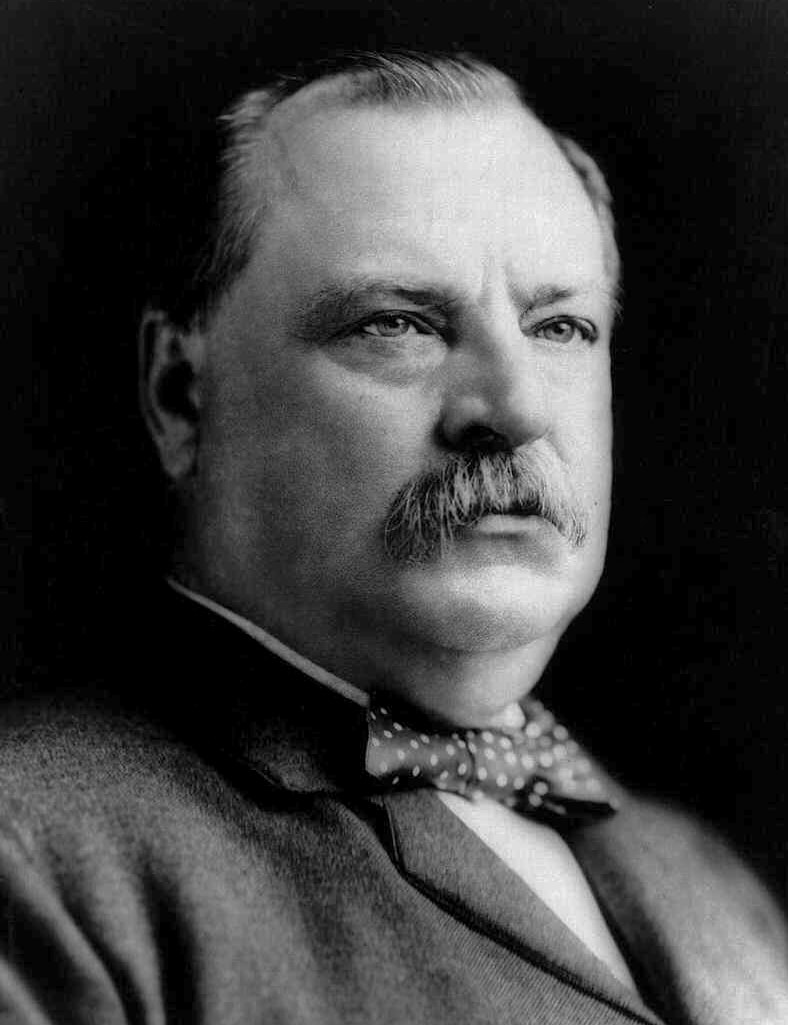
Historical · U.S. President · 22nd and 24th
22nd and 24th President of the United States · 1885–1897 · Democratic
Grover Cleveland served as 22nd and 24th President of the United States (1885–1897) — 2 terms for the Democratic. The page below collects sourced biographical facts, the consequential decisions of the presidency, and the elections that put Cleveland in office.
Sources
Quotes for Grover Cleveland are pending operator curation. The Task 16 admin queue will surface this row for review; ingest sources for narrative-scope provenance remain attached below.
Sources
Curated policy positions for Grover Cleveland are pending operator review. The biographical narrative below carries the same provenance trail and remains the canonical surface until per-topic positions are written.
Sources
Won election[1]
| Candidate | Party | Popular vote | Electoral vote |
|---|---|---|---|
| Grover Cleveland | — | — | — |
| Opponent-level tallies pending operator curation. | |||
Won re-election (term 2)[1]
| Candidate | Party | Popular vote | Electoral vote |
|---|---|---|---|
| Grover Cleveland | — | — | — |
| Opponent-level tallies pending operator curation. | |||
Sources
Per-bill legislation entries for Grover Cleveland are pending operator curation. Era-level legislative impact appears inline in the biographical narrative below; per-bill rows will land in a follow-up sprint.
Sources
1,179 words · sourced from the Wikipedia REST extract
Stephen Grover Cleveland (March 18, 1837 – June 24, 1908) was the 22nd and 24th president of the United States, serving from 1885 to 1889 and from 1893 to 1897. He was the first Democrat elected president after the American Civil War and the first U.S. president to serve nonconsecutive terms. Born in Caldwell, New Jersey, Cleveland was elected mayor of Buffalo in 1881 and governor of New York in 1882. While governor, he closely cooperated with state assembly minority leader Theodore Roosevelt to pass reform measures, winning national attention. He led the Bourbon Democrats, a pro-business movement opposed to high tariffs, free silver, inflation, imperialism, and subsidies to businesses, farmers, or veterans. His crusade for political reform and fiscal conservatism made him an icon for American conservatives of the time. Cleveland also won praise for honesty, self-reliance, integrity, and commitment to classical liberalism. His fight against political corruption, patronage, and bossism convinced many like-minded Republicans, called "Mugwumps", to cross party lines and support him in the 1884 presidential election, which he narrowly won against Republican James G. Blaine. During his first presidency, Cleveland signed the Interstate Commerce Act of 1887, which made the railroad industry the first industry subject to federal regulation by a regulatory body, and the Dawes Act, which subdivided Native American tribal communal landholdings into individual allotments. This policy led to Native Americans ceding control of about two-thirds of their land between 1887 and 1934. In the 1888 election, Cleveland won the popular vote but lost the electoral college and therefore the election to Benjamin Harrison. He returned to New York City and joined a law firm. In a rematch against Harrison for the 1892 election, Cleveland won both the popular vote and electoral college, returning him to the White House. One month before his second presidency began, the Panic of 1893 sparked a severe national depression. An anti-imperialist, Cleveland opposed the push to annex Hawaii, launched an investigation into the 1893 coup against Queen Liliʻuokalani, and called for her restoration. Cleveland intervened in the 1894 Pullman Strike to keep the railroads moving, angering Illinois Democrats and labor unions nationwide; his support of the gold standard and opposition to free silver alienated the agrarian wing of the Democrats. Critics complained that Cleveland had little imagination and seemed overwhelmed by the nation's economic disasters—depressions and strikes—in his second term. Many voters blamed the Democrats, opening the way for a Republican landslide in 1894 and for the agrarian and free silver (silverite) seizure of the Democratic Party at the 1896 Democratic convention. By the end of his second term, he was highly unpopular, even among Democrats. After leaving the White House, Cleveland served as a trustee of Princeton University. He joined the American Anti-Imperialist League in protest of the 1898 Spanish–American War. He died in 1908.
Childhood and family history
Stephen Grover Cleveland was born on March 18, 1837, in Caldwell, New Jersey, to Ann (née Neal) and Richard Falley Cleveland. Cleveland's father, originally from Connecticut, was a Congregational and Presbyterian minister. His mother was from Baltimore and was the daughter of a bookseller. On his father's side, Cleveland was descended from English ancestors who first emigrated to Massachusetts from Ipswich, England, in 1635. On his mother's side, Cleveland was descended from Anglo-Irish Protestants and German Quakers. Cleveland was distantly related to General Moses Cleaveland, after whom the city of Cleveland, Ohio, was named. Cleveland, the fifth of nine children, was named Stephen Grover in honor of the first pastor of the First Presbyterian Church of Caldwell, where his father was pastor at the time. He became known as Grover in his adult life. In 1841, the Cleveland family moved to Fayetteville, New York, where Grover spent much of his childhood. Neighbors later described him as "full of fun and inclined to play pranks", and fond of outdoor sports. In 1850, Cleveland's father Richard moved his family to Clinton, New York, accepting a job there as district secretary for the American Home Missionary Society. Despite his father's dedication to his missionary work, his income was insufficient for the large family. Financial conditions forced him to remove Grover from school and place him in a two-year mercantile apprenticeship in Fayetteville. The experience was valuable, though brief. Grover returned to Clinton and his schooling at the completion of the apprentice contract. In 1853, missionary work began to take a toll on Richard's health. He took a new work assignment in Holland Patent, New York, and moved his family once again. Shortly after, Richard Cleveland died from a gastric ulcer. Grover was said to have learned about his father's death from a boy selling newspapers.
Education and moving west
Cleveland received his elementary education at the Fayetteville Academy and the Clinton Grammar School (not to be confused with the Clinton Liberal Institute). After his father died in 1853, he again left school to help support his family. Later that year, Cleveland's brother William was hired as a teacher at the New York Institute for the Blind in New York City, and William obtained a place for Cleveland as an assistant teacher. Cleveland returned home to Holland Patent at the end of 1854, where an elder in his church offered to pay for his college education if he promised to become a minister. Cleveland declined, and in 1855 he decided to move west. He stopped first in Buffalo, New York, where his cousin Lewis F. Allen gave him a clerical job. Allen was an important man in Buffalo, and he introduced Cleveland to influential men there, including the partners in the law firm of Rogers, Bowen, and Rogers. Cleveland later took a clerkship with the firm, began to read the law with them, and was admitted to the New York bar in 1859.
Early career and the American Civil War Cleveland worked for the Rogers firm for three years before leaving in 1862 to start his own practice. In January 1863, he was appointed assistant district attorney of Erie County, New York. With the American Civil War raging, Congress passed the Conscription Act of 1863, requiring able-bodied men to serve in the army if called upon, or else to hire a substitute. Cleveland chose the latter, paying $150, equivalent to $3,922 in 2025, to George Brinski, a Polish immigrant, to serve in his place. As a lawyer, Cleveland became known for his single-minded concentration and dedication to hard work. In 1866, he successfully defended some participants in the Fenian raid, working pro bono (free of charge). In 1868, Cleveland attracted professional attention for his winning defense of a libel suit against the editor of Buffalo's Commercial Advertiser. During this time, Cleveland assumed a lifestyle of simplicity, taking residence in a plain boarding house. He devoted his growing income to the support of his mother and younger sisters. While his personal quarters were austere, Cleveland enjoyed an active social life and "the easy-going sociability of hotel-lobbies and saloons". He shunned the circles of higher society of Buffalo in which his uncle-in-law's family traveled.
https://en.wikipedia.org/wiki/1884_United_States_presidential_election
https://en.wikipedia.org/wiki/1892_United_States_presidential_election
https://en.wikipedia.org/wiki/Grover_Cleveland
https://www.whitehouse.gov/about-the-white-house/presidents/grover-cleveland/
Every quantitative or attributable claim above carries a per-section [N] marker that resolves to the corresponding URL below. Each entry records the upstream provider, the canonical URL, and the timestamp at which the underlying source was retrieved by the ingest pipeline.
Key accomplishments
Election results
Key facts
Biographical narrative