
1928 presidential election (term 1)
Won election[1]
| Candidate | Party | Popular vote | Electoral vote |
|---|---|---|---|
| Herbert Hoover | — | — | — |
| Opponent-level tallies pending operator curation. | |||
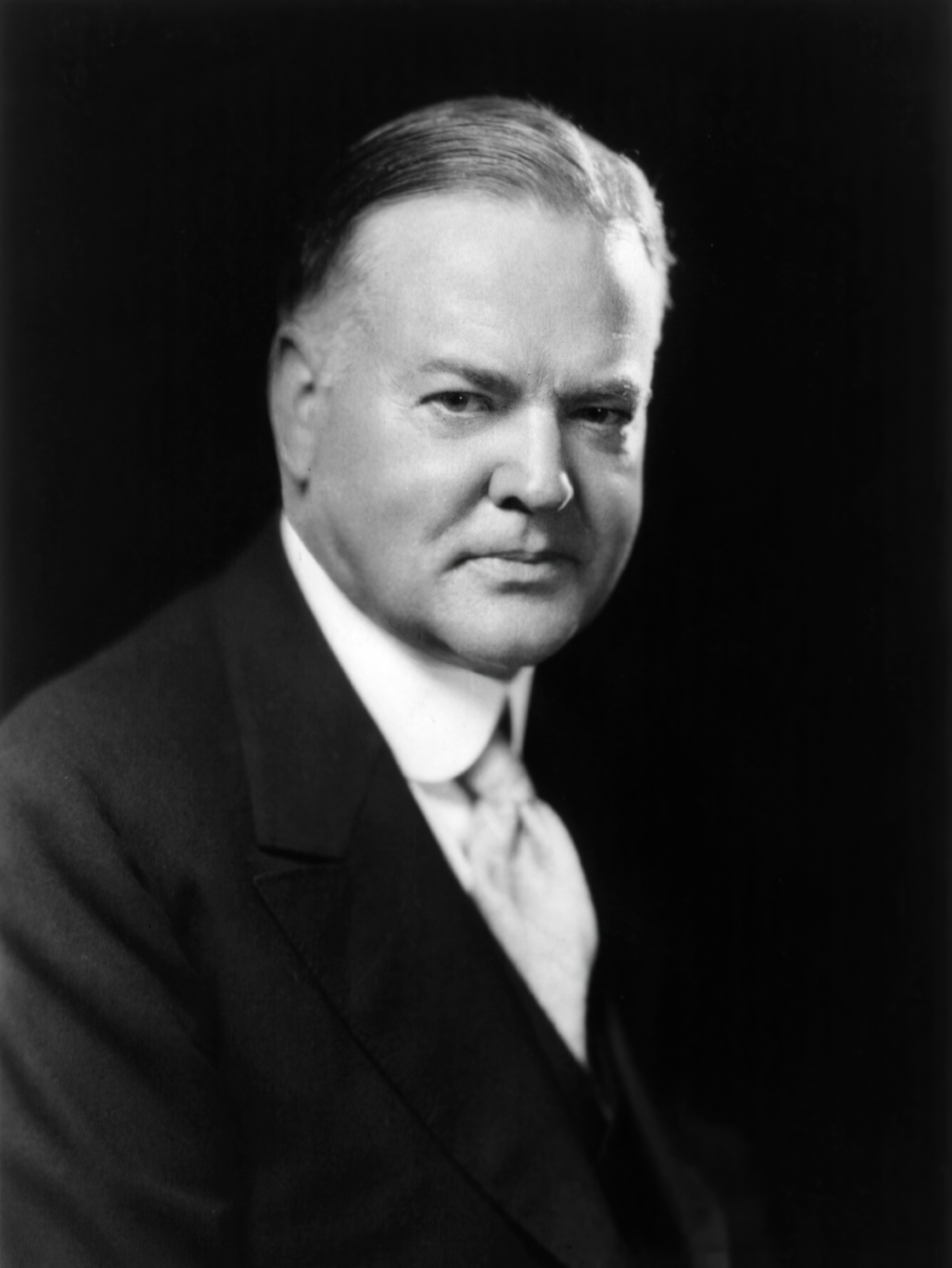
Historical · U.S. President · 31st
31st President of the United States · 1929–1933 · Republican
Herbert Hoover served as 31st President of the United States (1929–1933) — one term for the Republican. The page below collects sourced biographical facts, the consequential decisions of the presidency, and the elections that put Hoover in office.
Sources
Quotes for Herbert Hoover are pending operator curation. The Task 16 admin queue will surface this row for review; ingest sources for narrative-scope provenance remain attached below.
Sources
Curated policy positions for Herbert Hoover are pending operator review. The biographical narrative below carries the same provenance trail and remains the canonical surface until per-topic positions are written.
Sources
Won election[1]
| Candidate | Party | Popular vote | Electoral vote |
|---|---|---|---|
| Herbert Hoover | — | — | — |
| Opponent-level tallies pending operator curation. | |||
Sources
Per-bill legislation entries for Herbert Hoover are pending operator curation. Era-level legislative impact appears inline in the biographical narrative below; per-bill rows will land in a follow-up sprint.
Sources
1,500 words · sourced from the Wikipedia REST extract
Herbert Clark Hoover (August 10, 1874 – October 20, 1964) was the 31st president of the United States, serving from 1929 to 1933. As a member of the Republican Party, he served as the third United States secretary of commerce from 1921 to 1928 before being elected president in 1928. His presidency was dominated by the Great Depression, and his policies and methods to combat it were seen as inadequate and overly conservative. Amid his unpopularity, he decisively lost re-election to Franklin D. Roosevelt in 1932. Born to a Quaker family in West Branch, Iowa, Hoover grew up in Oregon. He was one of the first graduates of the new Stanford University in 1895. Hoover took a position with a London-based mining company working in Australia and China. He rapidly became a wealthy mining engineer and businessman. In 1914, the outbreak of World War I, he organized and headed the Commission for Relief in Belgium, an international relief organization that provided food to occupied Belgium. When the U.S. entered the war in 1917, President Woodrow Wilson appointed Hoover to lead the U.S. Food Administration. He became famous as his country's "food dictator". After the war, Hoover led the American Relief Administration, which provided food to the starving millions in Central and Eastern Europe, especially Russia. His wartime service made him a favorite of many progressives, and he unsuccessfully sought the Republican nomination in the 1920 United States presidential election. Hoover served as Secretary of Commerce under presidents Warren G. Harding and Calvin Coolidge. Hoover was an unusually active and visible Cabinet member, becoming known as "Secretary of Commerce and Under-Secretary of all other departments." He was influential in the development of air travel and radio. Hoover led the federal response to the Great Mississippi Flood of 1927. He won the Republican nomination in the 1928 presidential election and defeated Democratic candidate Al Smith in a landslide. In 1929, Hoover assumed the presidency. However, during his first year in office, the stock market crashed, signaling the onset of the Great Depression. Hoover supported the Mexican Repatriation and his response to the Great Depression was widely seen as lackluster. In the midst of the Great Depression, he lost in a landslide to Democratic nominee Franklin D. Roosevelt in the 1932 presidential election. Hoover's retirement was over 31 years long, one of the longest presidential retirements. He authored numerous works and became increasingly conservative in retirement. He strongly criticized Roosevelt's foreign policy and the New Deal. In the 1940s and 1950s, public opinion of Hoover improved, largely due to his service in various assignments for presidents Harry S. Truman and Dwight D. Eisenhower, including chairing the influential Hoover Commission. Critical assessments of his presidency by historians and political scientists generally rank him as amongst the worst presidents in American history, although Hoover has received praise for his actions as a humanitarian and public official. ### Early life Herbert Clark Hoover was born on August 10, 1874, in West Branch, Iowa. His father, Jesse Hoover, was a blacksmith and farm implement store owner of German, Swiss, and English ancestry. Hoover's mother, Hulda Randall Minthorn, was raised in Norwich, Ontario, Canada, before moving to Iowa in 1859. Like most other citizens of West Branch, Jesse and Hulda were Quakers. Around age two "Bertie", as he was called during that time, contracted a serious bout of croup, and was momentarily thought to have died until resuscitated by his uncle, John Minthorn. As a young child he was often referred to by his father as "my little stick in the mud" when he repeatedly got trapped in the mud crossing the unpaved street. Herbert's family figured prominently in the town's public prayer life, due almost entirely to mother Hulda's role in the church. As a child, Hoover consistently attended schools, but he did little reading on his own aside from the Bible. Hoover's father, noted by the local paper for his "pleasant, sunshiny disposition", died in 1880 at the age of 34 of a sudden heart attack. Hoover's mother died in 1884 of typhoid, leaving Hoover, his older brother, Theodore, and his younger sister, May, as orphans. Hoover lived the next 18 months with his uncle Allen Hoover at a nearby farm. In November 1885, Hoover was sent to Newberg, Oregon, to live with his uncle John Minthorn, a Quaker physician and businessman whose own son had died the year before. The Minthorn household was considered cultured and educational, and imparted a strong work ethic. Much like West Branch, Newberg was a frontier town settled largely by Midwestern Quakers. Minthorn ensured that Hoover received an education, but Hoover disliked the many chores assigned to him and often resented Minthorn. One observer described Hoover as "an orphan [who] seemed to be neglected in many ways". Hoover attended Friends Pacific Academy (now George Fox University), but dropped out at the age of thirteen to become an office assistant for his uncle's real estate office (Oregon Land Company) in Salem, Oregon. Though he did not attend high school, Hoover learned bookkeeping, typing, and mathematics at a night school. Hoover was a member of the inaugural "Pioneer Class" of Stanford University, entering in 1891 despite failing all the entrance exams except mathematics. During his freshman year, he switched his major from mechanical engineering to geology after working for John Casper Branner, the chairman of Stanford's geology department. During his sophomore year, Sam Collins proposed founding, Romero Hall Boarding Club, the first student cooperative boarding house at Romero Hall, for "sociability and economy", which Hoover and William Foster Hidden co-founded. Hoover was a mediocre student, and he spent much of his time working in various part-time jobs or participating in campus activities. Though he was initially shy among fellow students, Hoover won election as student treasurer and became known for his distaste for fraternities and sororities. He served as student manager of both the baseball and football teams, and helped organize the inaugural Big Game versus the University of California. During the summers before and after his senior year, Hoover interned under economic geologist Waldemar Lindgren of the United States Geological Survey; these experiences convinced Hoover to pursue a career as a mining geologist. ### Presidency Hoover saw the presidency as a vehicle for improving the conditions of all Americans by encouraging public-private cooperation—what he termed "volunteerism". He tended to oppose governmental coercion or intervention, as he thought they infringed on American ideals of individualism and self-reliance. Hoover did, however, advocate government-funded pensions for those over the age of 65, although this proposal was not acted on during his presidency. The first major bill that he signed, the Agricultural Marketing Act of 1929, established the Federal Farm Board in order to stabilize farm prices. Hoover made extensive use of commissions to study issues and propose solutions, and many of those commissions were sponsored by private donors rather than by the government. One of the commissions started by Hoover, the Research Committee on Social Trends, was tasked with surveying the entirety of American society. He appointed a Cabinet consisting largely of wealthy, business-oriented conservatives, including Secretary of the Treasury Andrew Mellon. Lou Henry Hoover was an activist First Lady. She typified the new woman of the post–World War I era: intelligent, robust, and aware of multiple female possibilities. === Domestic policy === ==== Great Depression ==== On taking office, Hoover said that "given the chance to go forward with the policies of the last eight years, we shall soon with the help of God, be in sight of the day when poverty will be banished from this nation". Having seen the fruits of prosperity brought by technological progress, many shared Hoover's optimism, and the already bullish stock market climbed even higher on Hoover's accession. This optimism concealed several threats to sustained U.S. economic growth, including a persistent farm crisis, a saturation of consumer goods like automobiles, and growing income inequality. Most dangerous of all to the economy was excessive speculation that had raised stock prices far beyond their value. Some regulators and bankers had warned Coolidge and Hoover that a failure to curb speculation would lead to "one of the greatest financial catastrophes that this country has ever seen," but both presidents were reluctant to become involved with the workings of the Federal Reserve System, which regulated banks. In late October 1929, the stock market crashed, and the worldwide economy began to spiral downward into the Great Depression. The causes of the Great Depression remain a matter of debate, but Hoover viewed a lack of confidence in the financial system as the fundamental economic problem facing the nation. He sought to avoid federal intervention, believing that the best way to bolster the economy was through the strengthening of businesses such as banks and railroads. He also feared that allowing individuals on the "dole" would permanently weaken the country, and believed that "relief to individuals from the federal government would bring an inevitable train of corruption and waste such as our nation had never…
https://en.wikipedia.org/wiki/1928_United_States_presidential_election
https://en.wikipedia.org/wiki/Herbert_Hoover
https://www.whitehouse.gov/about-the-white-house/presidents/herbert-hoover/
Every quantitative or attributable claim above carries a per-section [N] marker that resolves to the corresponding URL below. Each entry records the upstream provider, the canonical URL, and the timestamp at which the underlying source was retrieved by the ingest pipeline.
Key accomplishments
Election results
Biographical narrative