
1808 presidential election (term 1)
Won election[1]
| Candidate | Party | Popular vote | Electoral vote |
|---|---|---|---|
| James Madison | — | — | — |
| Opponent-level tallies pending operator curation. | |||
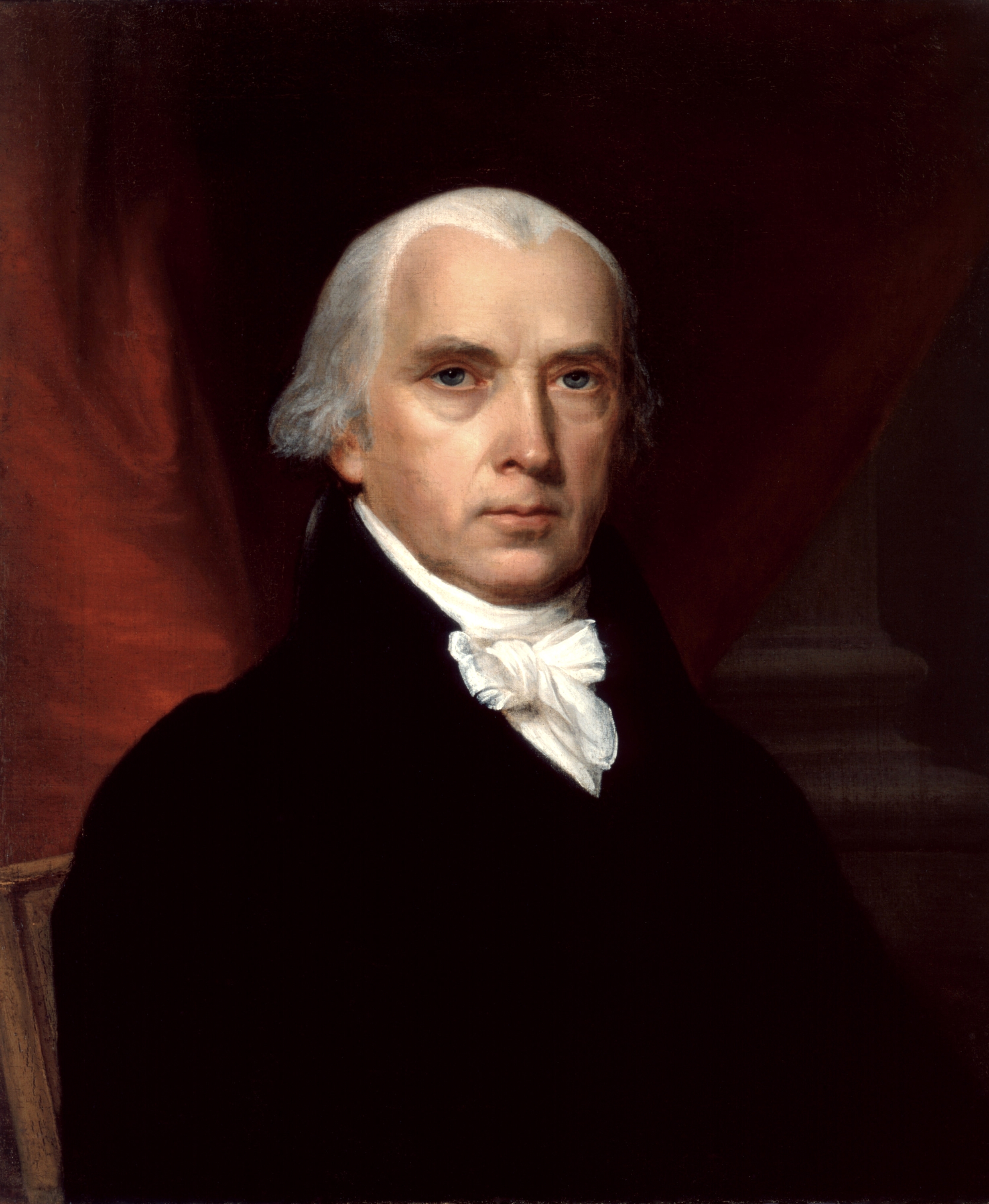
Historical · U.S. President · 4th
4th President of the United States · 1809–1817 · Democratic-Republican
James Madison served as 4th President of the United States (1809–1817) — 2 terms for the Democratic-Republican. The page below collects sourced biographical facts, the consequential decisions of the presidency, and the elections that put Madison in office.
Sources
Quotes for James Madison are pending operator curation. The Task 16 admin queue will surface this row for review; ingest sources for narrative-scope provenance remain attached below.
Sources
Curated policy positions for James Madison are pending operator review. The biographical narrative below carries the same provenance trail and remains the canonical surface until per-topic positions are written.
Sources
Won election[1]
| Candidate | Party | Popular vote | Electoral vote |
|---|---|---|---|
| James Madison | — | — | — |
| Opponent-level tallies pending operator curation. | |||
Won re-election (term 2)[1]
| Candidate | Party | Popular vote | Electoral vote |
|---|---|---|---|
| James Madison | — | — | — |
| Opponent-level tallies pending operator curation. | |||
Sources
Per-bill legislation entries for James Madison are pending operator curation. Era-level legislative impact appears inline in the biographical narrative below; per-bill rows will land in a follow-up sprint.
Sources
1,500 words · sourced from the Wikipedia REST extract
James Madison (March 16, 1751 [O.S. March 5, 1750] – June 28, 1836) was an American statesman, diplomat, and Founding Father who served as the fourth president of the United States from 1809 to 1817. Madison was popularly acclaimed as the "Father of the Constitution" for his pivotal role in drafting and promoting the Constitution of the United States and the Bill of Rights. Madison was born into a prominent slave-owning planter family in Virginia. In 1774, strongly opposed to British taxation, Madison joined with the Patriots. He was a member of both the Virginia House of Delegates and the Continental Congress during and after the American Revolutionary War. Dissatisfied with the weak national government established by the Articles of Confederation, he helped organize the Constitutional Convention, which produced a new constitution designed to strengthen republican government against democratic assembly. Madison's Virginia Plan was the basis for the convention's deliberations. He became one of the leaders in the movement to ratify the Constitution and joined Alexander Hamilton and John Jay in writing The Federalist Papers, a series of pro-ratification essays that remain prominent among works of political science in American history. Madison emerged as an important leader in the House of Representatives and was a close adviser to President George Washington. During the early 1790s, Madison opposed the economic program and the accompanying centralization of power favored by Secretary of the Treasury Hamilton. Alongside Thomas Jefferson, he organized the Democratic–Republican Party in opposition to Hamilton's Federalist Party. Madison served as Jefferson's Secretary of State from 1801 to 1809, during which time he helped convince Jefferson to submit the Louisiana Purchase Treaty for approval by the Senate. Madison was elected president in 1808. Motivated by a desire to acquire land held by Britain, Spain, and Native Americans, and after diplomatic protests with a trade embargo failed to end British seizures of American-shipped goods, Madison led the United States into the War of 1812. Madison was re-elected in the 1812 election, which was held during wartime. The war convinced Madison of the necessity of a stronger federal government. Although the war ended inconclusively in 1815, many Americans viewed it as a successful "second war of independence" against Britain which bolstered Madison's popularity. He presided over the creation of the Second Bank of the United States and the enactment of the protective Tariff of 1816. The United States acquired 26,000,000 acres (110,000 km2) of land through treaties or war from Native American tribes during Madison's presidency. Retiring from public office at the end of his presidency in 1817, Madison returned to his plantation, Montpelier, where he died in 1836. Madison was a slave owner; he freed one slave in 1783 to prevent a slave rebellion at Montpelier but did not free any in his will. Historians regard Madison as one of the most significant Founding Fathers of the United States, and have generally ranked him as an above-average president, although they are critical of his endorsement of slavery and his leadership during the War of 1812. Madison's name is commemorated in many landmarks across the nation, with prominent examples including Madison Square Garden, James Madison University, the James Madison Memorial Building, the capital city of Wisconsin, and the USS James Madison. ### Early life James Madison Jr. was born on March 16, 1751 (March 5, 1750, Old Style), at the Belle Grove plantation near Port Conway in the Colony of Virginia, to James Madison Sr. and Eleanor Madison. His family had lived in Virginia since the mid-17th century. Madison's maternal grandfather, Francis Conway, was a prominent planter and tobacco merchant. His paternal great-grandfather, James Taylor, was a member of the House of Burgesses. His father was a tobacco planter who grew up on a plantation, then called Mount Pleasant, which he inherited upon reaching adulthood. With an estimated 100 slaves and a 5,000-acre (2,000 ha) plantation, Madison's father was among the largest landowners in Virginia's Piedmont. In the early 1760s, the Madison family moved into a newly built house that they named Montpelier. Madison was the oldest of twelve children, with seven brothers and four sisters, though only six lived to adulthood: brothers Francis, Ambrose, and William, and sisters Nelly, Sarah, and Frances. Ambrose helped to manage Montpelier for his father and older brother until he died in 1793. From ages 11 to 16, Madison studied under Donald Robertson, a tutor for several prominent Southern families. Madison learned mathematics, geography, and modern and classical languages, becoming exceptionally proficient in Latin. At age 16, Madison returned to Montpelier, where he studied under the Reverend Thomas Martin to prepare for college. Unlike most college-bound Virginians of his day, Madison did not attend the College of William and Mary, as the lowland Williamsburg climate—thought to be more likely to harbor infectious disease—might have impacted his health. Instead, in 1769, he enrolled at the College of New Jersey (later Princeton University). His college studies included Latin, Greek, theology, and the works of the Enlightenment, and emphasized speech and debate. Madison was a leading member of the American Whig–Cliosophic Society, which competed on campus with a political counterpart, the Cliosophic Society. During his time at Princeton, Madison's closest friend was future Attorney General William Bradford. Along with classmate Aaron Burr, Madison completed the college's three-year Bachelor of Arts degree in two years, graduating in 1771. He had contemplated either entering the clergy or practicing law after graduation, but instead, he remained at Princeton to study Hebrew and political philosophy under the college's president, John Witherspoon. He returned home to Montpelier in early 1772. Madison's ideas on philosophy and morality were profoundly shaped by Witherspoon, who converted him to the philosophy, values, and modes of thinking of the Age of Enlightenment. Biographer Terence Ball wrote that at Princeton, Madison "was immersed in the liberalism of the Enlightenment, and converted to eighteenth-century political radicalism. From then on James Madison's theories would advance the rights of happiness of man, and his most active efforts would serve devotedly the cause of civil and political liberty." After returning to Montpelier, without a chosen career, Madison tutored his younger siblings. He began to study law books in 1773, asking his friend Bradford, a law apprentice, to send him a plan of study. Madison had acquired an understanding of legal publications by 1783. He saw himself as a law student but not as a lawyer. Madison did not apprentice himself to a lawyer and never joined the bar. Following the Revolutionary War, he spent time at Montpelier studying ancient democracies in preparation for the Constitutional Convention. Madison suffered from episodes of mental exhaustion and illness with associated nervousness, which often caused short-term incapacity after periods of stress. The descriptions of Madison's sudden attacks are consistent with today's understanding of epilepsy. He enjoyed good physical health until his final years. ### Presidency === Inauguration and cabinet === Madison's inauguration took place on March 4, 1809, in the House chamber of the U.S. Capitol. Chief Justice Marshall administered the presidential oath of office to Madison while outgoing President Jefferson watched. Vice President George Clinton was sworn in for a second term, making him the first U.S. vice president to serve under two presidents. Unlike Jefferson, who enjoyed relatively unified support, Madison encountered political opposition from former political allies such as Monroe and Clinton. Additionally, the Federalist Party was resurgent due to opposition to the embargo. Aside from his planned nomination of Gallatin for Secretary of State, the remaining members of Madison's Cabinet were chosen merely to promote political harmony, and, according to historians Ketcham and Rutland, were largely unremarkable or incompetent. Due to the resistance of Monroe and Clinton, Madison immediately faced opposition to his planned nomination of Secretary of the Treasury Gallatin as Secretary of State. Madison eventually opted not to nominate Gallatin, keeping him in the Treasury Department. Madison settled instead on Robert Smith to be the Secretary of State. However, for the next two years, Madison performed most of the duties of the Secretary of State due to Smith's incompetence. After bitter intra-party contention, Madison finally replaced Smith with Monroe in April 1811. With a Cabinet full of those he distrusted, Madison rarely called Cabinet meetings and instead frequently consulted with Gallatin alone. Early in his presidency, Madison sought to continue Jefferson's policies of low taxes and a reduction of the national debt. In 1811, Congress allowed the charter of the First Bank of the United States to lapse after Madison declined to take a strong stance on the issue. === War of 1812 === ==== Prelude to war ==== Congress had repealed the Embargo Act of 1807 shortly before Madison became president, but troubles with the British and French continued. Madison settled on a new strategy that was designed to pit the British and French against each other, offering to trade with whichever country would end their attacks against American shipping. The gambit almost succeeded, but negotiations with the British collapsed in mid-1809. Seeking to drive a wedge between the Americans and the…
https://en.wikipedia.org/wiki/1808_United_States_presidential_election
https://en.wikipedia.org/wiki/1812_United_States_presidential_election
https://en.wikipedia.org/wiki/James_Madison
https://www.whitehouse.gov/about-the-white-house/presidents/james-madison/
Every quantitative or attributable claim above carries a per-section [N] marker that resolves to the corresponding URL below. Each entry records the upstream provider, the canonical URL, and the timestamp at which the underlying source was retrieved by the ingest pipeline.
Key accomplishments
Election results
Biographical narrative