
1896 presidential election (term 1)
Won election[1]
| Candidate | Party | Popular vote | Electoral vote |
|---|---|---|---|
| William McKinley | — | — | — |
| Opponent-level tallies pending operator curation. | |||
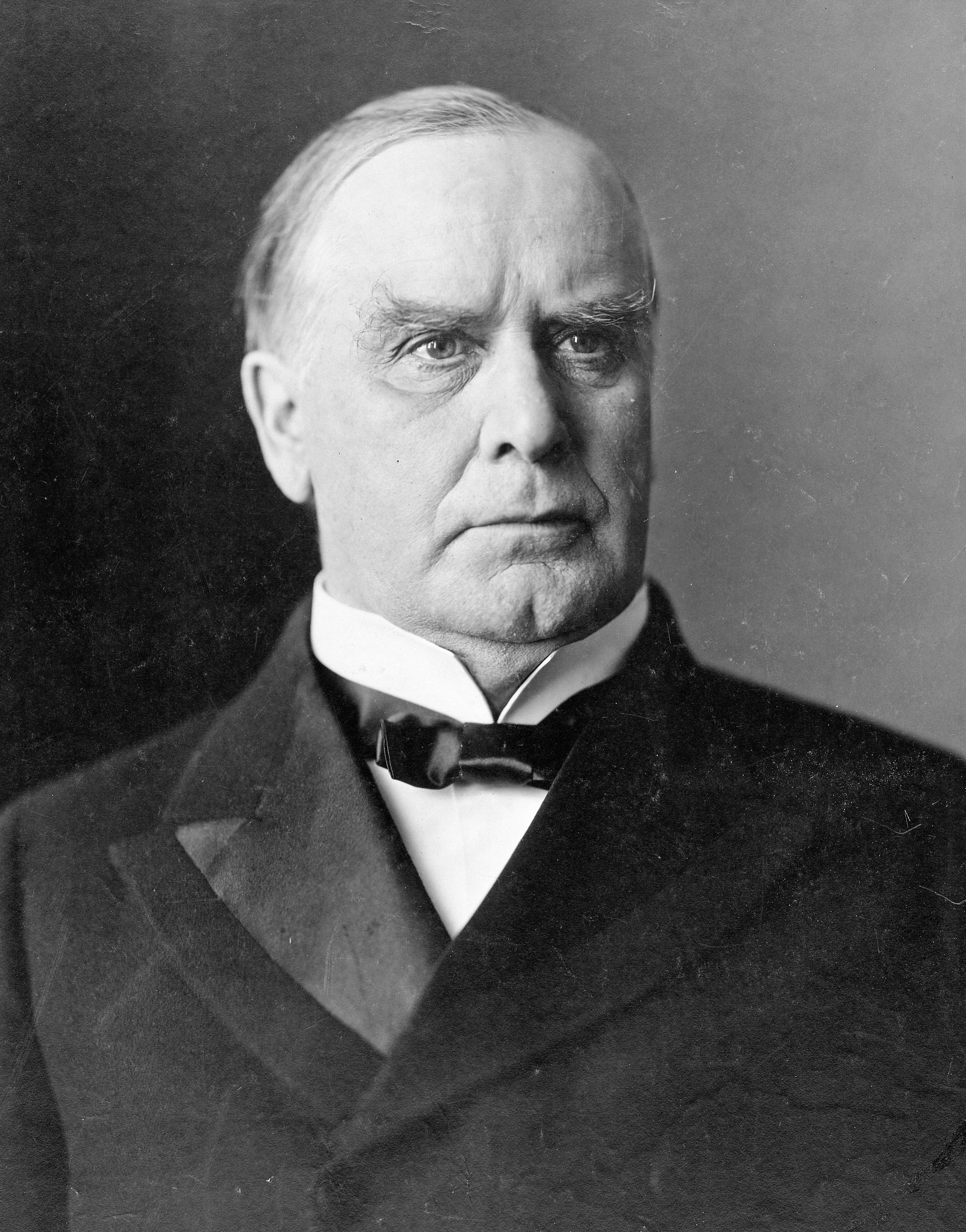
Historical · U.S. President · 25th
25th President of the United States · 1897–1901 · Republican
William McKinley served as 25th President of the United States (1897–1901) — 2 terms for the Republican. The page below collects sourced biographical facts, the consequential decisions of the presidency, and the elections that put McKinley in office.
Sources
Quotes for William McKinley are pending operator curation. The Task 16 admin queue will surface this row for review; ingest sources for narrative-scope provenance remain attached below.
Sources
Curated policy positions for William McKinley are pending operator review. The biographical narrative below carries the same provenance trail and remains the canonical surface until per-topic positions are written.
Sources
Won election[1]
| Candidate | Party | Popular vote | Electoral vote |
|---|---|---|---|
| William McKinley | — | — | — |
| Opponent-level tallies pending operator curation. | |||
Won re-election (term 2)[1]
| Candidate | Party | Popular vote | Electoral vote |
|---|---|---|---|
| William McKinley | — | — | — |
| Opponent-level tallies pending operator curation. | |||
Sources
Per-bill legislation entries for William McKinley are pending operator curation. Era-level legislative impact appears inline in the biographical narrative below; per-bill rows will land in a follow-up sprint.
Sources
1,500 words · sourced from the Wikipedia REST extract
William McKinley (January 29, 1843 – September 14, 1901) was the 25th president of the United States, serving from 1897 until his assassination in 1901. A member of the Republican Party, he led a realignment that made Republicans largely dominant in the industrial states and nationwide for decades. McKinley successfully led the U.S. in the Spanish–American War and oversaw a period of American expansionism, with the annexations of Hawaii, Puerto Rico, Guam, the Philippines, and American Samoa. McKinley was the last president to have served in the American Civil War; he was the only one to begin his service as an enlisted man and end it as a brevet major. After the war, he settled in Canton, Ohio, where he practiced law and married Ida Saxton. In 1876, McKinley was elected to Congress, where he became the Republican expert on the protective tariff, believing protectionism would bring prosperity. His 1890 McKinley Tariff was highly controversial and, together with a Democratic Party redistricting aimed at gerrymandering him out of office, led to his defeat in the Democratic landslide of 1890. He was elected governor of Ohio in 1891 and 1893, steering a moderate course between capital and labor interests. McKinley secured the Republican nomination for president in 1896 amid a deep economic depression and defeated his Democratic rival William Jennings Bryan after a front porch campaign in which he advocated "sound money" (the gold standard unless altered by international agreement) and promised that high tariffs would restore prosperity. McKinley's presidency saw rapid economic growth. He rejected free silver in favor of keeping the nation on the gold standard, and raised protective tariffs, signing the Dingley Tariff of 1897 to protect manufacturers and factory workers from foreign competition and securing the passage of the Gold Standard Act of 1900. McKinley's foreign policy emulated the era's overseas imperialism of the great powers in Oceania, Asia, and the Caribbean Sea. The United States annexed the independent Republic of Hawaii in 1898, and it became the Territory of Hawaii in 1900. McKinley hoped to persuade Spain to grant independence to rebellious Cuba without conflict. Still, when negotiations failed, he requested and signed Congress's declaration of war to begin the Spanish-American War of 1898, in which the United States saw a quick and decisive victory. As part of the peace settlement, Spain turned over to the United States its main overseas colonies of Puerto Rico, Guam, and the Philippines, while Cuba was promised independence but remained under American control until 1902, after McKinley's death. In the Philippines, a pro-independence rebellion began; it was eventually suppressed. McKinley acquired what is now American Samoa when his administration partitioned the Samoan Islands with the empires of Britain and Germany in the Tripartite Convention, during a period of warming ties between the UK and US known as the Great Rapprochement. McKinley defeated Bryan again in the 1900 presidential election in a campaign focused on imperialism, protectionism, and free silver. His second term ended early when he was shot on September 6, 1901, by anarchist Leon Czolgosz. McKinley died eight days later and was succeeded by Vice President Theodore Roosevelt, whose popularity overshadowed McKinley's legacy. Historians regard McKinley's 1896 victory as a realigning election in which the political stalemate of the post-Civil War era gave way to the Republican-dominated Fourth Party System, beginning with the Progressive Era. The United States retains control over the major territories McKinley annexed, aside from the Philippines which became independent in 1946. McKinley is generally ranked among the middle tier of presidents. ### Early life William McKinley Jr. was born in 1843 in Niles, Ohio, the seventh of nine children of William McKinley Sr. and Nancy (née Allison) McKinley. The McKinleys were of English and Scots-Irish descent and had settled in western Pennsylvania in the 18th century. Their immigrant ancestor was David McKinley, born in Dervock, County Antrim, in present-day Northern Ireland. William McKinley Sr. was born in Pennsylvania, in Pine Township, Mercer County. The family moved to Ohio when the senior McKinley was a boy, settling in New Lisbon (now Lisbon). He met Nancy Allison there, and they married later. The Allison family was of mostly English descent and among Pennsylvania's earliest settlers. The family trade on both sides was iron making. McKinley senior operated foundries throughout Ohio, in New Lisbon, Niles, Poland, and finally Canton. The McKinley household was, like many from Ohio's Western Reserve, steeped in Whiggish and abolitionist sentiment, the latter based on the family's staunch Methodist beliefs. The younger William also followed in the Methodist tradition, becoming active in the local Methodist church at the age of sixteen. He was a lifelong pious Methodist. In 1852, the family moved from Niles to Poland, Ohio, so that their children could attend its better schools. Graduating from Poland Seminary in 1859, McKinley enrolled the following year at Allegheny College in Meadville, Pennsylvania. He was an honorary member of the Sigma Alpha Epsilon fraternity. He remained at Allegheny for one year, returning home in 1860 after becoming ill and depressed. He also studied at Mount Union College, now the University of Mount Union, in Alliance, Ohio, where he later served as a member of the board of trustees. Although his health recovered, family finances declined, and McKinley was unable to return to Allegheny. He began working as a postal clerk and later took a job teaching at a school near Poland, Ohio. ### Presidency === Inauguration and appointments === McKinley was sworn in as president on March 4, 1897, as his wife and mother looked on. The new president gave a lengthy inaugural address; he urged tariff reform and stated that the currency issue would have to await tariff legislation. He warned against foreign interventions, "We want no wars of conquest. We must avoid the temptation of territorial aggression." McKinley's most controversial Cabinet appointment was that of John Sherman as Secretary of State. Sherman had an outstanding reputation, but old age was fast reducing his abilities. McKinley needed to have Hanna appointed to the Senate, so Senator Sherman was moved up. Sherman's mental faculties were decaying even in 1896; this was widely spoken of in political circles, but McKinley did not believe the rumors. Nevertheless, McKinley sent his cousin, William McKinley Osborne, to have dinner with the 73-year-old senator; he reported back that Sherman seemed as lucid as ever. McKinley wrote once the appointment was announced, "the stories regarding Senator Sherman's 'mental decay' are without foundation ... When I saw him last I was convinced both of his perfect health, physically and mentally, and that the prospects of life were remarkably good." Maine Representative Nelson Dingley Jr. was McKinley's choice for Secretary of the Treasury; he declined it, preferring to remain as chairman of the Ways and Means Committee. Charles Dawes, who had been Hanna's lieutenant in Chicago during the campaign, was considered for the Treasury post but by some accounts Dawes considered himself too young. Dawes eventually became Comptroller of the Currency; he recorded in his published diary that he had strongly urged McKinley to appoint as secretary the successful candidate, Lyman J. Gage, president of the First National Bank of Chicago and a Gold Democrat. The Navy Department was offered to former Massachusetts Congressman John Davis Long, an old friend from the House, on January 30, 1897. Although McKinley was initially inclined to allow Long to choose his own assistant, there was considerable pressure on the President-elect to appoint Theodore Roosevelt, head of the New York City Police Commission and a published naval historian. McKinley was reluctant, stating to one Roosevelt booster, "I want peace and I am told that your friend Theodore is always getting into rows with everybody." Nevertheless, he made the appointment. In addition to Sherman, McKinley made one other ill-advised Cabinet appointment, that of Secretary of War, which fell to Russell A. Alger, former general and Michigan governor. Competent enough in peacetime, Alger proved inadequate once the conflict with Spain began. With the War Department plagued by scandal, Alger resigned at McKinley's request in mid-1899. Vice President Hobart, as was customary at the time, was not invited to Cabinet meetings. However, he proved a valuable adviser both for McKinley and for his Cabinet members. The wealthy Vice President leased a residence close to the White House; the two families visited each other without formality, and the Vice President's wife, Jennie Tuttle Hobart, sometimes substituted as Executive Mansion hostess when Ida McKinley was unwell. For most of McKinley's administration, George B. Cortelyou served as his personal secretary. Cortelyou, who served in three Cabinet positions under Theodore Roosevelt, became a combination press secretary and chief of staff to McKinley. === Cuba crisis and war with Spain === For decades, rebels in Cuba had waged an intermittent campaign for freedom from Spanish colonial rule. By 1895, the conflict had expanded to a war for Cuban independence. As war engulfed the island, Spanish reprisals against the rebels grew ever harsher. American public opinion favored the rebels, and McKinley shared in their outrage…
https://en.wikipedia.org/wiki/1896_United_States_presidential_election
https://en.wikipedia.org/wiki/1900_United_States_presidential_election
https://en.wikipedia.org/wiki/William_McKinley
https://www.whitehouse.gov/about-the-white-house/presidents/william-mckinley/
Every quantitative or attributable claim above carries a per-section [N] marker that resolves to the corresponding URL below. Each entry records the upstream provider, the canonical URL, and the timestamp at which the underlying source was retrieved by the ingest pipeline.
Key accomplishments
Election results
Key facts
Biographical narrative