
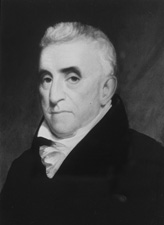
Historical · U.S. Senate · Connecticut
David Daggett
Former U.S. Senator from Connecticut · 1813–1819 · Federalist · Class 3
David Daggett represented Connecticut in the United States Senate (1813–1819) for the Federalist party. The page below collects sourced biographical facts, term history, committee roles, and provenance for Daggett.
Bioguide ID: D000002
Key facts
- Full name
- David Daggett
- State
- Connecticut
- Party
- Federalist
- Senate class
- Class III
- Senate service
- 1813–1819
- First Senate term
- 1813
- Status
- Left office
- Current term ends
- —
- Born
- 1764
- Bioguide ID
- D000002
- Committee assignments
- —
- Dataset version
- 1.20260602
Biographical narrative
955 words · sourced from the Wikipedia REST extract
David Daggett was a prominent American politician and legal figure who served as a U.S. Senator from Connecticut as a member of the Federalist Party. His political career spanned several decades, during which he held various significant positions, including mayor of New Haven and judge of the Connecticut Supreme Court of Errors. Daggett was also instrumental in the establishment of the Yale Law School. His tenure in public service is marked by his involvement in various legislative matters, particularly those concerning race and education, reflecting the complex social dynamics of his time.
Early life and career
David Daggett was born on December 31, 1764, in Attleboro, Massachusetts, into a family with a notable history in the region. His ancestor, John Daggett, arrived from England with Winthrop's company in 1630 and settled in Watertown, Massachusetts. Growing up in a distinguished family, Daggett pursued an education that would set the foundation for his future career. At the age of 16, he enrolled at Yale College, entering the junior class two years ahead of his peers. His choice of Yale over Harvard, which was closer to home, was likely influenced by familial connections, as a cousin of his father had been an officer at Yale. He graduated with high honors in 1783 and subsequently earned a master's degree, during which time he gained recognition as a skilled orator when his commencement speech was published.
Following his graduation, Daggett began studying law under Charles Chauncey in New Haven. To support himself during this period, he worked as a butler and as a preceptor at Hopkins Grammar School. By January 1786, Daggett was admitted to the bar in New Haven County and established his own legal practice shortly thereafter. His early career also included the publication of a controversial work detailing the confession of Joseph Mountain, an African American who was executed for rape, which drew significant public attention.
In 1786, Daggett married Ann Munson, with whom he had 19 children, although only three survived him. His family life and professional endeavors were intertwined, as one of his sons became a clergyman and one of his daughters married a prominent chaplain of the Senate. Daggett's commitment to education and law continued throughout his life, leading to his election as a member of the American Antiquarian Society in 1815 and his later appointment as Kent Professor of Law at Yale in 1826.
Senate tenure
David Daggett's political career began in earnest when he was elected to represent New Haven in the Connecticut General Assembly in 1791. He was re-elected annually for six years, demonstrating his growing influence in state politics. By 1794, he had risen to the position of Speaker of the House at the young age of 29, showcasing his leadership abilities. After serving in the House, Daggett transitioned to the Connecticut State Council, where he served from 1797 until 1804, and then again from 1809 until his election to the U.S. Senate in 1813.
Daggett was elected to the Senate as a Federalist to fill the vacancy left by Chauncey Goodrich's resignation. His Senate term began on May 13, 1813, and lasted until March 3, 1819. During this time, he participated in various legislative discussions and decisions that shaped the early years of the United States. After his Senate tenure, Daggett sought higher office but was unsuccessful in his bids for governor of Connecticut in 1825 and 1826, losing to the incumbent Oliver Wolcott Jr.
In addition to his political roles, Daggett was appointed as State's Attorney for New Haven County in 1811, a position he held until his election to the Senate. His legal expertise and reputation as a public servant led to his later appointment as an associate judge of the Connecticut Supreme Court of Errors in 1826, despite the political opposition he faced. He served in this judicial capacity until he became Chief Justice in 1832, a role he maintained until the mandatory retirement age in 1834.
Legislative focus and committees
Throughout his political career, David Daggett's legislative focus reflected the prevailing issues of his time, particularly concerning race and education. He was notably involved in efforts to oppose the establishment of a college for African Americans in New Haven, which was proposed in 1831. This initiative was significant as it aimed to create one of the first institutions of higher education for Black students in the United States. Daggett played a leading role in the opposition, helping to draft resolutions that were passed at a town meeting, which effectively halted the proposal.
His opposition to the college was accompanied by a broader stance against abolitionist sentiments, as he supported measures that were seen as detrimental to the existing civil institutions of the states. Daggett's views on race and citizenship were controversial; he did not recognize African Americans as citizens and advocated for their colonization to Africa. This perspective was indicative of the racial attitudes prevalent in early 19th-century America and highlighted the complexities of his legacy.
In addition to his legislative work, Daggett's judicial career further emphasized his influence on legal matters in Connecticut. As a judge, he presided over cases that often intersected with the social issues of his time, including those related to race and education. His role in the judiciary allowed him to shape legal precedents and influence public policy in significant ways.
David Daggett's career spanned various facets of public service, from law and politics to education. His contributions to the legal and political landscape of Connecticut and the nation reflect the complexities of an era marked by significant social change. He passed away on April 12, 1851, in New Haven, Connecticut, leaving behind a multifaceted legacy that continues to be examined within the context of American history.
Notable legislation
Sponsored and co-sponsored legislation for David Daggett is pending operator curation. The biographical narrative above carries the same provenance trail until per-bill rows are written.
Sources
- [1]https://en.wikipedia.org/wiki/David_DaggettWikipedia · retrieved 2026-06-02
Notable quotes
Sourced quotes for David Daggett are pending operator curation. Narrative-scope provenance remains attached below.
Sources
- [1]https://en.wikipedia.org/wiki/David_DaggettWikipedia · retrieved 2026-06-02
Key positions
Curated policy positions for David Daggett are pending operator review. The biographical narrative above carries the same provenance trail until per-topic positions are written.
Sources
- [1]https://en.wikipedia.org/wiki/David_DaggettWikipedia · retrieved 2026-06-02
Terms served
- 1813–1819U.S. Senate · Term 1 · Federalist · Class III
Sources & provenance
Every attributable claim above carries a per-section [N] marker that resolves to the corresponding URL below. Each entry records the upstream provider, the canonical URL, and the timestamp at which the source was retrieved by the ingest pipeline.
Key facts
- https://bioguide.congress.gov/search/bio/D000002bioguide · retrieved 2026-06-02
- https://www.govtrack.us/congress/members/403146govtrack · retrieved 2026-06-02
Biographical narrative
- https://en.wikipedia.org/wiki/David_Daggettwikipedia · retrieved 2026-06-02
Find your senator
Every U.S. state elects two senators. Browse Connecticut’s delegation, the full former-senator roster, or explore the role and term length.
Related on The Candidate
- Preceded by Chauncey GoodrichEarlier holder of the Connecticut Class III Senate seat · Federalist.Open
- Succeeded by James LanmanLater holder of the Connecticut Class III Senate seat · Republican.Open
- Abraham RibicoffFormer U.S. Senator from Connecticut · DemocraticOpen
- Augustine LonerganFormer U.S. Senator from Connecticut · DemocraticOpen
- Brien McMahonFormer U.S. Senator from Connecticut · DemocraticOpen
- Calvin WilleyFormer U.S. Senator from Connecticut · AdamsOpen