
Historical · U.S. Senate · Florida
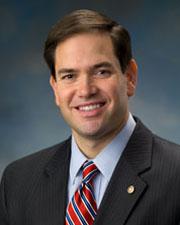
Marco Rubio
Former U.S. Senator from Florida · 2011–2025 · Republican · Class 3
Marco Rubio represented Florida in the United States Senate (2011–2025) for the Republican party. The page below collects sourced biographical facts, term history, committee roles, and provenance for Rubio.
Bioguide ID: R000595
Key facts
- Full name
- Marco Rubio
- State
- Florida
- Party
- Republican
- Senate class
- Class III
- Senate service
- 2011–2025
- First Senate term
- 2011
- Status
- Left office
- Current term ends
- —
- Born
- 1971
- Bioguide ID
- R000595
- Committee assignments
- —
- Dataset version
- 1.20260601-3
Biographical narrative
1,030 words · sourced from the Wikipedia REST extract
Marco Rubio is an American politician and attorney who served as a U.S. Senator from Florida from 2011 until 2025. A member of the Republican Party, he held the position of Florida's Senior Senator starting in January 2019. During his time in the Senate, Rubio was known for his focus on foreign policy, particularly regarding Latin America and China. He was elected to the Senate in a three-way race in 2010 and subsequently re-elected in 2016 and 2022. Following his Senate career, he was appointed as the 72nd United States Secretary of State in 2025.
Early life and career
Marco Antonio Rubio was born on May 28, 1971, in Miami, Florida. He is the second son and third child of Mario Rubio Reina and Oriales (née García) Rubio, both of whom immigrated to the United States from Cuba in 1956. His parents left Cuba during the regime of Fulgencio Batista, a few years before Fidel Castro's rise to power. Initially, Rubio's parents were not U.S. citizens, but they became naturalized citizens in 1975. The family's immigration story is significant, as it reflects the broader narrative of Cuban exiles who fled to the United States during political upheaval.
Rubio's maternal grandfather, Pedro Victor Garcia, also immigrated to the U.S. in 1956. After initially returning to Cuba in search of work, he fled the country again in 1962 due to the communist regime and faced deportation. However, he was allowed to stay in the U.S. under a legal status known as "parolee," later obtaining permanent residency after the Cuban Adjustment Act was enacted in 1966. Rubio had a close relationship with his grandfather during his childhood, which influenced his understanding of his family's history and values.
Rubio grew up in a family that valued education and hard work. He attended the University of Florida, where he earned a degree in political science. He later attended the University of Miami School of Law, obtaining his Juris Doctor degree. After completing his education, Rubio began his political career as a City Commissioner for West Miami in the 1990s. His political journey continued when he was elected to the Florida House of Representatives in 2000, representing the 111th district. During his time in the Florida legislature, he rose to prominence, serving as the Republican majority leader and eventually becoming the Speaker of the Florida House from 2006 to 2008.
After leaving the Florida legislature due to term limits, Rubio transitioned to academia, teaching at Florida International University. His political aspirations did not wane, and he launched his campaign for the U.S. Senate in 2010. Running in a competitive three-way race, he successfully secured his Senate seat, marking the beginning of his tenure in the U.S. Congress.
Senate tenure
Marco Rubio's Senate career began in January 2011, and he quickly established himself as a prominent figure within the Republican Party. His election came during a period of significant political polarization in the United States, and he was part of the larger wave of Republican candidates who gained seats in the Senate during the 2010 midterm elections. Throughout his time in the Senate, Rubio was known for his focus on a range of issues, including economic policy, immigration reform, and foreign relations.
In April 2015, Rubio announced his candidacy for the presidency, opting to pursue the highest office in the land rather than seeking re-election to the Senate. His presidential campaign was marked by a focus on conservative principles and a vision for America's role in the world. However, after facing challenges in the Republican primary, he suspended his campaign in March 2016 following a loss in the Florida primary to Donald Trump. Despite the competitive nature of the primary, Rubio endorsed Trump before the general election and maintained a supportive relationship with the Trump administration.
Following his presidential campaign, Rubio returned to the Senate and successfully ran for re-election in 2016. His political influence continued to grow, and he became Florida's Senior Senator in January 2019 after the defeat of former Senator Bill Nelson. In the 2022 election, Rubio won a third term in the Senate, defeating Democratic nominee Val Demings in a significant victory.
Throughout his Senate tenure, Rubio was recognized for his active engagement in foreign policy, particularly regarding Latin America. His efforts in this area led to him being described as a "virtual secretary of state for Latin America" during the Trump administration. He was also known for his strong stance on China and the Chinese Communist Party, which resulted in sanctions against him by the Chinese government in 2020.
Legislative focus and committees
During his time in the Senate, Marco Rubio served on several key committees that shaped his legislative focus and priorities. His work on these committees allowed him to influence a variety of issues, including national security, foreign relations, and economic policy. Rubio's role in the Senate positioned him as a leading voice on matters related to U.S. engagement with Latin America and Asia, particularly in the context of rising geopolitical tensions.
Rubio's legislative agenda often reflected his commitment to conservative principles, emphasizing the importance of a strong national defense and economic growth. He was involved in discussions surrounding immigration reform, advocating for policies that balanced border security with pathways to citizenship for certain undocumented immigrants. His approach to immigration was shaped by his own family's history and the experiences of Cuban-Americans in Florida.
In addition to his work on immigration, Rubio was a vocal advocate for issues related to human rights and democracy promotion, particularly in Latin America. He often highlighted the challenges faced by countries under authoritarian regimes and sought to support democratic movements in the region. His influence on U.S. policy towards Latin America was significant, particularly during the Trump administration, where he played a key role in shaping the administration's approach to countries like Venezuela and Cuba.
Rubio's tenure in the Senate concluded in January 2025, after which he was appointed as the Secretary of State in the second Trump administration. His appointment marked a significant milestone in his political career, as he became the first Latino to serve in this role, further solidifying his position as a prominent figure in American politics.
Notable legislation
Sponsored and co-sponsored legislation for Marco Rubio is pending operator curation. The biographical narrative above carries the same provenance trail until per-bill rows are written.
Sources
- [1]https://en.wikipedia.org/wiki/Marco_RubioWikipedia · retrieved 2026-06-01
Notable quotes
Sourced quotes for Marco Rubio are pending operator curation. Narrative-scope provenance remains attached below.
Sources
- [1]https://en.wikipedia.org/wiki/Marco_RubioWikipedia · retrieved 2026-06-01
Key positions
Curated policy positions for Marco Rubio are pending operator review. The biographical narrative above carries the same provenance trail until per-topic positions are written.
Sources
- [1]https://en.wikipedia.org/wiki/Marco_RubioWikipedia · retrieved 2026-06-01
Terms served
- 2011–2017U.S. Senate · Term 1 · Republican · Class III
- 2017–2023U.S. Senate · Term 2 · Republican · Class III
- 2023–2025U.S. Senate · Term 3 · Republican · Class III
Sources & provenance
Every attributable claim above carries a per-section [N] marker that resolves to the corresponding URL below. Each entry records the upstream provider, the canonical URL, and the timestamp at which the source was retrieved by the ingest pipeline.
Key facts
- https://bioguide.congress.gov/search/bio/R000595bioguide · retrieved 2026-06-01
- https://www.rubio.senate.govsenate.gov · retrieved 2026-06-01
Biographical narrative
- https://en.wikipedia.org/wiki/Marco_Rubiowikipedia · retrieved 2026-06-01
Find your senator
Every U.S. state elects two senators. Browse Florida’s delegation, the full former-senator roster, or explore the role and term length.
Related on The Candidate
- Preceded by George LeMieuxEarlier holder of the Florida Class III Senate seat · Republican.Open
- Abijah GilbertFormer U.S. Senator from Florida · RepublicanOpen
- Adonijah WelchFormer U.S. Senator from Florida · RepublicanOpen
- Bill NelsonFormer U.S. Senator from Florida · DemocraticOpen
- Bob GrahamFormer U.S. Senator from Florida · DemocraticOpen
- Republican PartyFederal candidates and office holders on the Republican line.Open