
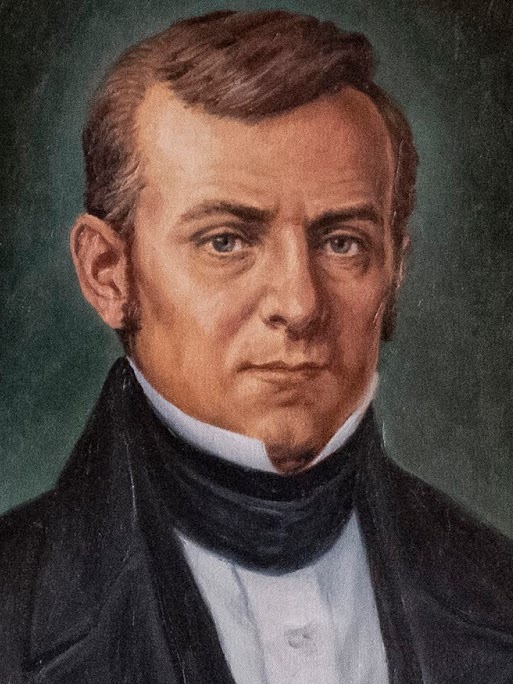
Historical · U.S. Senate · Illinois
William Ewing
Former U.S. Senator from Illinois · 1835–1837 · Jackson · Class 3
William Ewing represented Illinois in the United States Senate (1835–1837) for the Jackson party. The page below collects sourced biographical facts, term history, committee roles, and provenance for Ewing.
Bioguide ID: E000283
Key facts
- Full name
- William Ewing
- State
- Illinois
- Party
- Jackson
- Senate class
- Class III
- Senate service
- 1835–1837
- First Senate term
- 1835
- Status
- Left office
- Current term ends
- —
- Born
- 1795
- Bioguide ID
- E000283
- Committee assignments
- —
- Dataset version
- 1.20260602
Biographical narrative
807 words · sourced from the Wikipedia REST extract
William Ewing was a prominent American politician from Illinois, known for his service as a U.S. Senator and his brief tenure as the state's fifth governor. Born in 1795, Ewing's political career spanned several key roles in state governance and legislative processes, reflecting the evolving political landscape of the early 19th century. His contributions to Illinois politics were marked by a series of significant appointments and legislative responsibilities, culminating in his role in the U.S. Senate.
Early life and career
William Ewing was born on August 31, 1795, in Paris, Kentucky. He pursued a legal career, establishing himself as a lawyer in Shawneetown, Illinois. His early professional life included a notable appointment in 1820 when he was designated as a land office receiver in Vandalia by President James Monroe. This position was significant as it involved managing land transactions, a critical function in the rapidly developing state of Illinois during that period.
Ewing's political involvement began to take shape in the early 1830s. He was elected to the Illinois House of Representatives, where he served as Speaker, demonstrating his leadership capabilities. His political career continued to advance when he became a State Senator from 1832 to 1834, during which time he held the position of President pro tempore of the State Senate in 1832. Ewing's military service also played a role in his life; he served as a Colonel in the "Spy Battalion" during the Black Hawk War, a conflict that arose in the early 1830s between the United States and Native American tribes in the Northwest Territory.
In addition to his legislative duties, Ewing briefly held the office of acting Lieutenant Governor of Illinois in 1833. His most notable executive role came in 1834 when he served as Governor of Illinois for a mere fourteen days, marking the shortest gubernatorial term in the state's history. This brief tenure was a result of his appointment to fill the vacancy left by the death of Governor Elias Kane.
Senate tenure
Ewing's entry into the U.S. Senate occurred in 1835 when he was appointed to fill the vacancy left by the late Elias Kane. His appointment was made by Joseph Duncan, the then-governor of Illinois. Ewing served as a U.S. Senator representing Illinois as a member of the Jacksonian Party, a political group that emerged in the 1820s and was associated with the presidency of Andrew Jackson.
During his time in the Senate, which lasted until March 3, 1837, Ewing participated in various legislative discussions and decisions that were pivotal to the nation at that time. His tenure coincided with a period of significant political and economic change in the United States, including issues related to land policy, westward expansion, and relations with Native American tribes. However, specific details regarding the legislation he supported or opposed during his Senate term are not extensively documented.
After his Senate term concluded, Ewing continued to engage in public service. He was appointed in 1838 as Commissioner to adjust the claims of mixed-bloods and traders at Fort Snelling, a role that involved addressing the claims made under the 1837 Dakota treaty. This position highlighted his ongoing involvement in matters concerning land and Native American relations, which were critical issues in the context of U.S. expansion during the 19th century.
Legislative focus and committees
While specific details about Ewing's committee assignments during his Senate tenure are not available, his political background suggests a focus on issues pertinent to land management and state governance. Given his previous roles in the Illinois legislature and his involvement in land office operations, it is likely that he engaged with legislation related to land use, property rights, and the administration of state affairs.
Ewing's earlier experiences as a state legislator and his military service may have influenced his perspectives on various legislative matters, particularly those affecting the development of Illinois and its relationship with Native American tribes. His appointment as Commissioner for claims adjustment further indicates a continued commitment to addressing the complexities of land treaties and the rights of mixed-blood individuals, which were significant issues in the context of U.S. policy towards Native Americans.
After his Senate term, Ewing returned to the Illinois State House, where he resumed his role as Speaker of the House. This return to state politics underscores his enduring influence and involvement in the governance of Illinois, reflecting his dedication to public service throughout his career.
William Ewing passed away on March 25, 1846, at his home in Springfield, Illinois. His legacy as a politician is marked by his contributions to the early governance of Illinois and his participation in the U.S. Senate during a formative period in American history. His career encapsulates the complexities of political life in the early 19th century, characterized by rapid growth, conflict, and the evolving role of government in addressing the needs of its constituents.
Notable legislation
Sponsored and co-sponsored legislation for William Ewing is pending operator curation. The biographical narrative above carries the same provenance trail until per-bill rows are written.
Sources
- [1]https://en.wikipedia.org/wiki/William_Lee_D._EwingWikipedia · retrieved 2026-06-02
Notable quotes
Sourced quotes for William Ewing are pending operator curation. Narrative-scope provenance remains attached below.
Sources
- [1]https://en.wikipedia.org/wiki/William_Lee_D._EwingWikipedia · retrieved 2026-06-02
Key positions
Curated policy positions for William Ewing are pending operator review. The biographical narrative above carries the same provenance trail until per-topic positions are written.
Sources
- [1]https://en.wikipedia.org/wiki/William_Lee_D._EwingWikipedia · retrieved 2026-06-02
Terms served
- 1835–1837U.S. Senate · Term 1 · Jackson · Class III
Sources & provenance
Every attributable claim above carries a per-section [N] marker that resolves to the corresponding URL below. Each entry records the upstream provider, the canonical URL, and the timestamp at which the source was retrieved by the ingest pipeline.
Key facts
- https://bioguide.congress.gov/search/bio/E000283bioguide · retrieved 2026-06-02
- https://www.govtrack.us/congress/members/403961govtrack · retrieved 2026-06-02
Biographical narrative
- https://en.wikipedia.org/wiki/William_Lee_D._Ewingwikipedia · retrieved 2026-06-02
Find your senator
Every U.S. state elects two senators. Browse Illinois’s delegation, the full former-senator roster, or explore the role and term length.
Related on The Candidate
- Preceded by Elias KaneEarlier holder of the Illinois Class III Senate seat · Jackson.Open
- Succeeded by Richard YoungLater holder of the Illinois Class III Senate seat · Democratic.Open
- Adlai Stevenson IIIFormer U.S. Senator from Illinois · DemocraticOpen
- Alan DixonFormer U.S. Senator from Illinois · DemocraticOpen
- Albert HopkinsFormer U.S. Senator from Illinois · RepublicanOpen
- Barack ObamaFormer U.S. Senator from Illinois · DemocraticOpen