
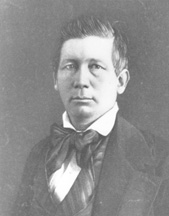
Historical · U.S. Senate · Indiana
Edward Hannegan
Former U.S. Senator from Indiana · 1843–1849 · Democratic · Class 3
Edward Hannegan represented Indiana in the United States Senate (1843–1849) for the Democratic party. The page below collects sourced biographical facts, term history, committee roles, and provenance for Hannegan.
Bioguide ID: H000167
Key facts
- Full name
- Edward Hannegan
- State
- Indiana
- Party
- Democratic
- Senate class
- Class III
- Senate service
- 1843–1849
- First Senate term
- 1843
- Status
- Left office
- Current term ends
- —
- Born
- 1807
- Bioguide ID
- H000167
- Committee assignments
- —
- Dataset version
- 1.20260602
Biographical narrative
825 words · sourced from the Wikipedia REST extract
Edward Hannegan was an American lawyer and politician who served as a United States Senator from Indiana. A member of the Democratic Party, he held office from 1843 until 1849, following a prior tenure as a U.S. Representative. Hannegan's political career was marked by his involvement in various legislative committees and his later appointment as a diplomat. His life was characterized by personal struggles, including issues with alcohol, which ultimately affected his political and personal life.
Early life and career
Edward Hannegan was born on June 25, 1807, in Hamilton County, Ohio. Shortly after his birth, his family relocated to Bourbon County, Kentucky. Hannegan's early education took place in public schools, where he developed a foundation for his future pursuits. He later attended Transylvania University, where he studied law. In addition to his studies, Hannegan worked as a schoolteacher and a farmhand, experiences that would contribute to his understanding of the needs of his constituents in the future.
In the early 1820s, Hannegan moved to Fountain County, Indiana, where he continued to work as a farmhand and teacher. His legal career began when he was admitted to the bar in April 1828 in Fountain County. He subsequently moved to Warren County, Indiana, where he was admitted to practice law on May 27, 1829, and settled in Williamsport. Shortly thereafter, he relocated to Covington, Indiana, where he continued his legal practice. Hannegan's early career also included a brief stint in politics; he served in the Indiana House of Representatives during two non-consecutive terms, first from 1832 to 1833 and later from 1841 to 1842.
Hannegan's political career began in earnest when he was elected as a Democrat to the United States House of Representatives, serving from March 4, 1833, to March 4, 1837. After his time in the House, he returned to his law practice but remained active in political circles. His commitment to public service led him to seek higher office, and he was elected to the U.S. Senate in 1842.
Senate tenure
Hannegan's Senate career commenced on March 4, 1843, and lasted until March 4, 1849. During his time in the Senate, he served as chairman of the Committee on Private Land Claims during the Twenty-ninth Congress. He was also a member of the Committee on Roads and Canals and the Committee on Foreign Relations during the Twenty-ninth and Thirtieth Congresses. His involvement in these committees allowed him to influence legislation related to land claims, infrastructure, and foreign policy.
Despite his active participation in the Senate, Hannegan faced challenges in securing his political future. He was not a candidate for renomination in 1849, ultimately losing to James Whitcomb, the sitting governor of Indiana. Following his Senate tenure, Hannegan's political ambitions continued, but he faced difficulties that would affect his reputation and career trajectory.
Legislative focus and committees
Throughout his Senate career, Hannegan focused on various legislative issues, particularly those related to land claims and infrastructure development. His role as chairman of the Committee on Private Land Claims was significant, as this committee dealt with matters concerning land ownership and disputes, which were particularly relevant in a rapidly expanding nation. Hannegan's work on this committee reflected the broader concerns of his constituents and the nation during a time of westward expansion.
In addition to his work on land claims, Hannegan's involvement in the Committee on Roads and Canals highlighted his interest in infrastructure development. This committee was responsible for overseeing legislation related to transportation and public works, areas crucial for economic growth and connectivity in the growing United States. His participation in the Committee on Foreign Relations also indicated his engagement with international issues, reflecting the complexities of U.S. foreign policy during the mid-19th century.
After leaving the Senate, Hannegan was appointed by President James K. Polk as the United States Minister to Prussia in 1849, a position he held until 1850. His diplomatic career was marked by a notable incident involving the Queen consort of King Frederick William IV, which ultimately led to his recall. Despite these challenges, Hannegan continued to practice law after returning to the United States, demonstrating his resilience and commitment to his profession.
Hannegan's personal life was marked by struggles with alcohol, which had significant implications for his career and relationships. His involvement in a tragic incident resulting in the death of his brother-in-law further complicated his legacy. Despite these challenges, Hannegan's contributions to Indiana's political landscape and his service in the U.S. Senate remain a part of his historical narrative.
In summary, Edward Hannegan's life and career reflect the complexities of American politics in the 19th century. His journey from a young lawyer in Indiana to a U.S. Senator and diplomat illustrates the opportunities and challenges faced by politicians of his era. Hannegan's legislative focus on land claims and infrastructure, coupled with his personal struggles, paints a multifaceted picture of a man who navigated the turbulent waters of American politics during a time of significant change.
Notable legislation
Sponsored and co-sponsored legislation for Edward Hannegan is pending operator curation. The biographical narrative above carries the same provenance trail until per-bill rows are written.
Sources
- [1]https://en.wikipedia.org/wiki/Edward_A._HanneganWikipedia · retrieved 2026-06-02
Notable quotes
Sourced quotes for Edward Hannegan are pending operator curation. Narrative-scope provenance remains attached below.
Sources
- [1]https://en.wikipedia.org/wiki/Edward_A._HanneganWikipedia · retrieved 2026-06-02
Key positions
Curated policy positions for Edward Hannegan are pending operator review. The biographical narrative above carries the same provenance trail until per-topic positions are written.
Sources
- [1]https://en.wikipedia.org/wiki/Edward_A._HanneganWikipedia · retrieved 2026-06-02
Terms served
- 1835–1837U.S. House · District 7 · Term 1 · Jackson
- 1843–1849U.S. Senate · Term 2 · Democratic · Class III
Sources & provenance
Every attributable claim above carries a per-section [N] marker that resolves to the corresponding URL below. Each entry records the upstream provider, the canonical URL, and the timestamp at which the source was retrieved by the ingest pipeline.
Key facts
- https://bioguide.congress.gov/search/bio/H000167bioguide · retrieved 2026-06-02
- https://www.govtrack.us/congress/members/405049govtrack · retrieved 2026-06-02
Biographical narrative
- https://en.wikipedia.org/wiki/Edward_A._Hanneganwikipedia · retrieved 2026-06-02
Find your senator
Every U.S. state elects two senators. Browse Indiana’s delegation, the full former-senator roster, or explore the role and term length.
Related on The Candidate
- Preceded by Oliver SmithEarlier holder of the Indiana Class III Senate seat · Whig.Open
- Succeeded by James WhitcombLater holder of the Indiana Class III Senate seat · Democratic.Open
- Albert BeveridgeFormer U.S. Senator from Indiana · RepublicanOpen
- Albert WhiteFormer U.S. Senator from Indiana · WhigOpen
- Arthur RobinsonFormer U.S. Senator from Indiana · RepublicanOpen
- Benjamin HarrisonFormer U.S. Senator from Indiana · RepublicanOpen