
Historical · U.S. Senate · Indiana
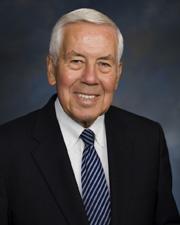
Richard Lugar
Former U.S. Senator from Indiana · 1977–2013 · Republican · Class 1
Richard Lugar represented Indiana in the United States Senate (1977–2013) for the Republican party. The page below collects sourced biographical facts, term history, committee roles, and provenance for Lugar.
Bioguide ID: L000504
Key facts
- Full name
- Richard Lugar
- State
- Indiana
- Party
- Republican
- Senate class
- Class I
- Senate service
- 1977–2013
- First Senate term
- 1977
- Status
- Left office
- Current term ends
- —
- Born
- 1932
- Bioguide ID
- L000504
- Committee assignments
- —
- Dataset version
- 1.20260601-3
Biographical narrative
937 words · sourced from the Wikipedia REST extract
Richard G. Lugar was an influential American politician who served as a United States Senator from Indiana for 36 years, from 1977 until 2013. A member of the Republican Party, Lugar was known for his significant contributions to foreign relations, particularly in the areas of nuclear disarmament and agricultural policy. His long tenure in the Senate was marked by a commitment to bipartisan cooperation and a focus on international security issues.
Early life and career
Richard Lugar was born on April 4, 1932, in Indianapolis, Indiana. He was the son of Bertha and Marvin Lugar and had part German ancestry. Lugar's early education took place at Shortridge High School, where he graduated at the top of his class in 1950. During his time in high school, he achieved the rank of Eagle Scout, the highest honor in the Boy Scouts, and later received the Distinguished Eagle Scout Award.
Following high school, Lugar attended Denison University, where he graduated in 1954. He was an active member of the Beta Theta Pi fraternity during his college years. Afterward, he became a Rhodes Scholar and studied at Pembroke College, Oxford, where he earned both a bachelor's degree and a master's degree in 1956. At Oxford, Lugar was also a member of the university's men's basketball team, which won a national championship in 1955.
After completing his education, Lugar served in the United States Navy from 1956 to 1960, achieving the rank of Lieutenant, Junior Grade. One of his notable assignments was as an intelligence briefer for Admiral Arleigh Burke. After his military service, Lugar returned to Indianapolis, where he managed his family's 604-acre farm and assisted in running a food machinery manufacturing business with his brother.
Lugar's entry into public service began in 1964 when he was appointed to the Indianapolis Board of School Commissioners, a position he held until 1967. His political career advanced when he was elected as the mayor of Indianapolis in 1967, defeating incumbent Democrat John J. Barton. He served two terms as mayor from 1968 to 1976. During his tenure, Lugar was instrumental in the implementation of Unigov, a plan that unified the city and county governments, which contributed to significant economic growth in the area. His leadership earned him recognition, including the presidency of the National League of Cities in 1971, and he was selected as the keynote speaker at the 1972 Republican National Convention.
Senate tenure
Richard Lugar's political aspirations led him to run for the United States Senate in 1974, where he faced incumbent Democratic Senator Birch Bayh. Although he lost that election, Lugar persevered and successfully ran for the Senate again in 1976, defeating Democratic incumbent Vance Hartke. This victory marked the beginning of Lugar's long and impactful Senate career, which spanned six terms.
Throughout his time in the Senate, Lugar was known for his ability to build bipartisan coalitions. He faced various electoral challenges over the years but consistently won reelection. In 1982, he secured a second term by defeating Democratic Congressman Floyd Fithian. His third term came in 1988 when he won against Democrat Jack Wickes, and in 1994, he was reelected for a fourth term, defeating former Congressman Jim Jontz. This made him the first U.S. senator from Indiana to be elected to a fourth term.
Lugar continued to build on his electoral success, winning a fifth term in 2000 against Democrat David Johnson, and a sixth term in 2006, where he faced Libertarian candidate Steve Osborn. Notably, in the 2006 election, Lugar achieved the highest percentage of votes among Senate candidates that year, despite a broader Democratic shift in the national landscape.
However, in 2012, Lugar faced a significant challenge in the Republican primary for a seventh term. His positions on various issues, including immigration, judicial nominations, and gun control, drew criticism from some factions within the party, particularly from Tea Party supporters. Ultimately, he was defeated by Indiana State Treasurer Richard Mourdock in the primary election. Mourdock subsequently lost in the general election to Democrat Joe Donnelly, marking the end of Lugar's 36-year tenure in the Senate.
Legislative focus and committees
During his time in the Senate, Richard Lugar served on several important committees, focusing primarily on foreign relations and agricultural policy. He was the chairman of the Senate Committee on Foreign Relations from 1985 to 1987 and again from 2003 to 2007. Following his chairmanship, he served as the ranking member of the committee until his departure from the Senate in 2013. His leadership in this role was characterized by a commitment to addressing global security challenges, particularly the proliferation of nuclear, biological, and chemical weapons.
One of Lugar's most notable legislative achievements was his collaboration with Georgia Democrat Sam Nunn on the Nunn–Lugar Act, which aimed to secure and dismantle weapons of mass destruction in former Soviet states following the Cold War. This legislation was a significant step in international disarmament efforts and showcased Lugar's dedication to global security.
In addition to his work on foreign relations, Lugar also served as chairman of the Senate Committee on Agriculture, Nutrition and Forestry from 1995 to 2001, and briefly again in part of 2001. His focus on agricultural policy reflected his background and experience in farming, and he advocated for policies that supported farmers and rural communities.
After leaving the Senate, Lugar founded a nonprofit organization dedicated to the policy areas he championed during his time in office, continuing his commitment to public service and international cooperation. His legacy includes a lasting impact on U.S. foreign policy and agricultural practices, as well as a reputation for bipartisanship in an increasingly polarized political environment.
Notable legislation
Sponsored and co-sponsored legislation for Richard Lugar is pending operator curation. The biographical narrative above carries the same provenance trail until per-bill rows are written.
Sources
- [1]https://en.wikipedia.org/wiki/Richard_LugarWikipedia · retrieved 2026-06-01
Notable quotes
Sourced quotes for Richard Lugar are pending operator curation. Narrative-scope provenance remains attached below.
Sources
- [1]https://en.wikipedia.org/wiki/Richard_LugarWikipedia · retrieved 2026-06-01
Key positions
Curated policy positions for Richard Lugar are pending operator review. The biographical narrative above carries the same provenance trail until per-topic positions are written.
Sources
- [1]https://en.wikipedia.org/wiki/Richard_LugarWikipedia · retrieved 2026-06-01
Terms served
- 1977–1983U.S. Senate · Term 1 · Republican · Class I
- 1983–1989U.S. Senate · Term 2 · Republican · Class I
- 1989–1995U.S. Senate · Term 3 · Republican · Class I
- 1995–2001U.S. Senate · Term 4 · Republican · Class I
- 2001–2007U.S. Senate · Term 5 · Republican · Class I
- 2007–2013U.S. Senate · Term 6 · Republican · Class I
Sources & provenance
Every attributable claim above carries a per-section [N] marker that resolves to the corresponding URL below. Each entry records the upstream provider, the canonical URL, and the timestamp at which the source was retrieved by the ingest pipeline.
Key facts
- https://bioguide.congress.gov/search/bio/L000504bioguide · retrieved 2026-06-01
- http://lugar.senate.gov/senate.gov · retrieved 2026-06-01
Biographical narrative
- https://en.wikipedia.org/wiki/Richard_Lugarwikipedia · retrieved 2026-06-01
Find your senator
Every U.S. state elects two senators. Browse Indiana’s delegation, the full former-senator roster, or explore the role and term length.
Related on The Candidate
- Preceded by Rupert HartkeEarlier holder of the Indiana Class I Senate seat · Democratic.Open
- Succeeded by Joe DonnellyLater holder of the Indiana Class I Senate seat · Democratic.Open
- Albert BeveridgeFormer U.S. Senator from Indiana · RepublicanOpen
- Albert WhiteFormer U.S. Senator from Indiana · WhigOpen
- Arthur RobinsonFormer U.S. Senator from Indiana · RepublicanOpen
- Benjamin HarrisonFormer U.S. Senator from Indiana · RepublicanOpen