
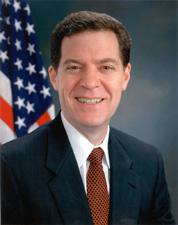
Historical · U.S. Senate · Kansas
Sam Brownback
Former U.S. Senator from Kansas · 1996–2011 · Republican · Class 3
Sam Brownback represented Kansas in the United States Senate (1996–2011) for the Republican party. The page below collects sourced biographical facts, term history, committee roles, and provenance for Brownback.
Bioguide ID: B000953
Key facts
- Full name
- Sam Brownback
- State
- Kansas
- Party
- Republican
- Senate class
- Class III
- Senate service
- 1996–2011
- First Senate term
- 1996
- Status
- Left office
- Current term ends
- —
- Born
- 1956
- Bioguide ID
- B000953
- Committee assignments
- —
- Dataset version
- 1.20260601-4
Biographical narrative
908 words · sourced from the Wikipedia REST extract
Samuel Dale Brownback is a former United States Senator from Kansas, who served from 1996 until 2011. A member of the Republican Party, he also held the position of the 46th governor of Kansas from 2011 to 2018 and later served as the U.S. Ambassador-at-Large for International Religious Freedom under President Donald Trump. His political career includes a candidacy for the Republican presidential nomination in 2008. Brownback's tenure in the Senate was marked by his involvement in various legislative issues and his alignment with conservative values.
Early life and career
Sam Brownback was born on September 12, 1956, in Garnett, Kansas. He was raised in a farming family in Parker, Kansas, where he developed an early interest in agriculture. His family's roots in the region trace back to German-American settlers who moved to Kansas after the Civil War. During his youth, Brownback was actively involved in the Future Farmers of America (FFA), where he held leadership positions, including serving as the national vice president from 1976 to 1977.
Brownback completed his secondary education at Prairie View High School before enrolling at Kansas State University. There, he earned a degree in Agricultural Economics in 1978. His college years were marked by leadership roles, including serving as the student body president and joining the Alpha Gamma Rho agricultural fraternity. Following his graduation, he worked briefly as a radio broadcaster for the now-defunct KSAC farm department, where he hosted a weekly program.
In 1982, Brownback earned his Juris Doctor degree from the University of Kansas. He began his professional career as an attorney in Manhattan, Kansas. His entry into public service came in 1986 when he was appointed Secretary of Agriculture for Kansas by Democratic Governor John W. Carlin. This role allowed him to gain valuable experience in agricultural policy and state governance. In 1990, he participated in the White House Fellow program, which provided him with an opportunity to work in the Office of the U.S. Trade Representative until 1991. After completing this fellowship, he returned to his position as Secretary of Agriculture, serving until 1993.
Brownback's political career took a significant turn in 1994 when he was elected to the U.S. House of Representatives, representing Kansas's 2nd congressional district. He served a single term in the House before running for the U.S. Senate in a special election in 1996 to fill the seat vacated by Bob Dole, who had resigned to pursue a presidential campaign.
Senate tenure
Sam Brownback's Senate career began in 1996 when he won a special election to succeed Bob Dole. He first defeated Sheila Frahm in the Republican primary and then went on to secure victory against Democrat Jill Docking in the general election. His initial tenure was marked by a notable campaign that included significant financial backing, particularly from the Koch brothers, who were prominent donors during his political career.
In 1998, Brownback was elected to a full six-year term, defeating Democrat Paul Feleciano by a substantial margin. He successfully won reelection in 2004, again defeating a Democratic opponent, former lobbyist Lee Jones. Throughout his time in the Senate, Brownback was involved in various legislative matters and was known for his conservative stance on numerous issues.
However, his Senate career was not without controversy. In 2001, the Federal Election Commission imposed fines on Brownback's campaign committee due to improper campaign contributions during the 1996 election cycle. The campaign was required to pay a fine, and his in-laws were also penalized for their role in funneling contributions improperly.
Brownback's Senate tenure concluded on January 3, 2011, when he opted not to seek reelection. Instead, he chose to run for the governorship of Kansas, a decision that marked the next phase of his political career.
Legislative focus and committees
During his time in the U.S. Senate, Sam Brownback was involved in various legislative initiatives and served on several committees that shaped his legislative focus. His work often reflected his conservative values and priorities, particularly in areas related to agriculture, trade, and social issues.
Brownback was a member of the Senate Judiciary Committee, where he participated in discussions and decisions regarding judicial appointments and legal reforms. His involvement in this committee allowed him to influence significant legislative matters, particularly those concerning civil rights and criminal justice.
In addition to his work on the Judiciary Committee, Brownback was known for his advocacy on issues related to international religious freedom. This focus later became a defining aspect of his career when he was appointed as the U.S. Ambassador-at-Large for International Religious Freedom after his governorship. His commitment to this cause was evident during his Senate tenure, where he supported policies aimed at promoting religious liberty both domestically and internationally.
Brownback's legislative agenda also included a focus on agricultural policies, reflecting his background in agricultural economics and his experience as Secretary of Agriculture. He worked on initiatives that aimed to support farmers and promote agricultural development in Kansas and beyond.
Throughout his Senate career, Brownback maintained a strong alignment with conservative principles, advocating for limited government, tax cuts, and traditional social values. His legislative actions and public statements often mirrored the priorities of the Republican Party during his time in office.
In summary, Sam Brownback's career as a U.S. Senator was characterized by significant electoral victories, a focus on conservative legislative priorities, and involvement in key committees that shaped his policy influence. His tenure laid the groundwork for his subsequent roles in state governance and international diplomacy.
Notable legislation
Sponsored and co-sponsored legislation for Sam Brownback is pending operator curation. The biographical narrative above carries the same provenance trail until per-bill rows are written.
Sources
- [1]https://en.wikipedia.org/wiki/Sam_BrownbackWikipedia · retrieved 2026-06-01
Notable quotes
Sourced quotes for Sam Brownback are pending operator curation. Narrative-scope provenance remains attached below.
Sources
- [1]https://en.wikipedia.org/wiki/Sam_BrownbackWikipedia · retrieved 2026-06-01
Key positions
Curated policy positions for Sam Brownback are pending operator review. The biographical narrative above carries the same provenance trail until per-topic positions are written.
Sources
- [1]https://en.wikipedia.org/wiki/Sam_BrownbackWikipedia · retrieved 2026-06-01
Terms served
- 1995–1996U.S. House · District 2 · Term 1 · Republican
- 1996–1999U.S. Senate · Term 2 · Republican · Class III
- 1999–2005U.S. Senate · Term 3 · Republican · Class III
- 2005–2011U.S. Senate · Term 4 · Republican · Class III
Sources & provenance
Every attributable claim above carries a per-section [N] marker that resolves to the corresponding URL below. Each entry records the upstream provider, the canonical URL, and the timestamp at which the source was retrieved by the ingest pipeline.
Key facts
- https://bioguide.congress.gov/search/bio/B000953bioguide · retrieved 2026-06-01
- http://brownback.senate.govsenate.gov · retrieved 2026-06-01
Biographical narrative
- https://en.wikipedia.org/wiki/Sam_Brownbackwikipedia · retrieved 2026-06-01
Find your senator
Every U.S. state elects two senators. Browse Kansas’s delegation, the full former-senator roster, or explore the role and term length.
Related on The Candidate
- Preceded by Robert DoleEarlier holder of the Kansas Class III Senate seat · Republican.Open
- Alexander CaldwellFormer U.S. Senator from Kansas · RepublicanOpen
- Alfred BensonFormer U.S. Senator from Kansas · RepublicanOpen
- Andrew SchoeppelFormer U.S. Senator from Kansas · RepublicanOpen
- Arthur CapperFormer U.S. Senator from Kansas · RepublicanOpen
- Republican PartyFederal candidates and office holders on the Republican line.Open