
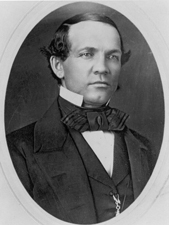
Historical · U.S. Senate · Michigan
Charles Stuart
Former U.S. Senator from Michigan · 1853–1859 · Democratic · Class 2
Charles Stuart represented Michigan in the United States Senate (1853–1859) for the Democratic party. The page below collects sourced biographical facts, term history, committee roles, and provenance for Stuart.
Bioguide ID: S001033
Key facts
- Full name
- Charles Stuart
- State
- Michigan
- Party
- Democratic
- Senate class
- Class II
- Senate service
- 1853–1859
- First Senate term
- 1853
- Status
- Left office
- Current term ends
- —
- Born
- 1810
- Bioguide ID
- S001033
- Committee assignments
- —
- Dataset version
- 1.20260602
Biographical narrative
858 words · sourced from the Wikipedia REST extract
Charles Stuart was a prominent political figure in the mid-19th century, serving as a U.S. Senator from Michigan as a member of the Democratic Party. His political career spanned several years, during which he also held a position in the U.S. House of Representatives. Stuart's contributions to American politics occurred during a tumultuous period leading up to the Civil War, and his legislative work reflected the challenges and issues of his time. After his Senate tenure, he returned to his legal practice and remained active in local politics until his death in 1887.
Early life and career
Charles Stuart was born on November 25, 1810, in New York, with some sources indicating he may have been born near Waterloo or in Columbia County. He pursued a legal education and was admitted to the bar in 1832, beginning his law practice in Waterloo, New York. In 1835, seeking new opportunities, he relocated to Michigan, where he settled in Portage. His early career in Michigan included a role in the state house of representatives in 1842, marking the beginning of his political involvement.
Stuart's entry into national politics came when he was elected as a Democrat to represent Michigan's 2nd congressional district in the U.S. House of Representatives. He filled a vacancy created by the death of Edward Bradley and served from December 6, 1847, until March 4, 1849. However, his initial congressional tenure was cut short when he was defeated in the 1848 election by William Sprague.
After a brief hiatus from Congress, Stuart returned to the political arena by winning election to the 32nd Congress, serving from March 4, 1851, to March 3, 1853. During this time, he held the position of chairman of the Committee on Expenditures in the Department of State, where he was involved in overseeing the financial operations of the department. His experience in the House laid the groundwork for his subsequent election to the Senate.
Senate tenure
Stuart's Senate career began when he was elected in 1852, and he served as a U.S. Senator from Michigan from March 4, 1853, to March 3, 1859. During his time in the Senate, he was a member of the 33rd, 34th, and 35th Congresses. His role in the Senate was marked by a brief period as President pro tempore during the 34th Congress, which is a ceremonial position typically held by a senior member of the majority party.
In addition to his leadership role, Stuart was actively involved in legislative matters, particularly as chairman of the Committee on Public Lands during the 34th and 35th Congresses. This committee was responsible for overseeing legislation related to public land management, an important issue during a time of westward expansion in the United States. His work on this committee allowed him to influence policies that would shape land use and distribution in the growing nation.
Despite his contributions, Stuart chose not to seek reelection to the Senate after his term ended in 1859. Instead, he turned his attention to state politics and ran for the position of Governor of Michigan in 1858, although he was unsuccessful in that bid. Following his departure from the Senate, he returned to his legal practice in Kalamazoo, Michigan, where he continued to engage in local affairs.
Legislative focus and committees
Throughout his political career, Charles Stuart's legislative focus reflected the pressing issues of his time, particularly concerning land management and state governance. As a member of the Senate, he was involved in discussions and decisions regarding public lands, which were critical as the nation expanded westward. His leadership as chairman of the Committee on Public Lands allowed him to play a significant role in shaping policies that affected land distribution and usage, which were vital for economic development and settlement.
Stuart's earlier experience in the House of Representatives also contributed to his understanding of federal governance and the intricacies of legislative processes. His position as chairman of the Committee on Expenditures in the Department of State demonstrated his engagement with the financial aspects of government operations, which likely informed his later work in the Senate.
In addition to his legislative responsibilities, Stuart's involvement in the Civil War era was notable. He took an active role in supporting the war effort by raising and equipping the 13th Michigan Infantry, for which he was commissioned as a colonel. However, his military service was cut short due to health issues, leading to his resignation from the military.
After his political career, Stuart remained active in civic matters, including serving as a delegate to the 1860 Democratic National Convention from Michigan. His continued involvement in politics and law reflected his commitment to public service and the issues facing his community and state.
Charles Stuart passed away on May 19, 1887, in Kalamazoo, Michigan. He was interred in Mountain Home Cemetery, and his former residence in Kalamazoo is recognized for its historical significance, being listed on the National Register of Historic Places. The surrounding area, known as the Stuart Area Historic District, also holds historical importance, reflecting the legacy of his contributions to Michigan and American politics during a pivotal time in the nation's history.
Notable legislation
Sponsored and co-sponsored legislation for Charles Stuart is pending operator curation. The biographical narrative above carries the same provenance trail until per-bill rows are written.
Sources
- [1]https://en.wikipedia.org/wiki/Charles_E._StuartWikipedia · retrieved 2026-06-02
Notable quotes
Sourced quotes for Charles Stuart are pending operator curation. Narrative-scope provenance remains attached below.
Sources
- [1]https://en.wikipedia.org/wiki/Charles_E._StuartWikipedia · retrieved 2026-06-02
Key positions
Curated policy positions for Charles Stuart are pending operator review. The biographical narrative above carries the same provenance trail until per-topic positions are written.
Sources
- [1]https://en.wikipedia.org/wiki/Charles_E._StuartWikipedia · retrieved 2026-06-02
Terms served
- 1847–1849U.S. House · District 2 · Term 1 · Democratic
- 1851–1853U.S. House · District 2 · Term 2 · Democratic
- 1853–1859U.S. Senate · Term 3 · Democratic · Class II
Sources & provenance
Every attributable claim above carries a per-section [N] marker that resolves to the corresponding URL below. Each entry records the upstream provider, the canonical URL, and the timestamp at which the source was retrieved by the ingest pipeline.
Key facts
- https://bioguide.congress.gov/search/bio/S001033bioguide · retrieved 2026-06-02
- https://www.govtrack.us/congress/members/410489govtrack · retrieved 2026-06-02
Biographical narrative
- https://en.wikipedia.org/wiki/Charles_E._Stuartwikipedia · retrieved 2026-06-02
Find your senator
Every U.S. state elects two senators. Browse Michigan’s delegation, the full former-senator roster, or explore the role and term length.
Related on The Candidate
- Preceded by Alpheus FelchEarlier holder of the Michigan Class II Senate seat · Democratic.Open
- Succeeded by Kinsley BinghamLater holder of the Michigan Class II Senate seat · Republican.Open
- Arthur MoodyFormer U.S. Senator from Michigan · DemocraticOpen
- Arthur VandenbergFormer U.S. Senator from Michigan · RepublicanOpen
- Augustus PorterFormer U.S. Senator from Michigan · WhigOpen
- Democratic PartyFederal candidates and office holders on the Democratic line.Open