
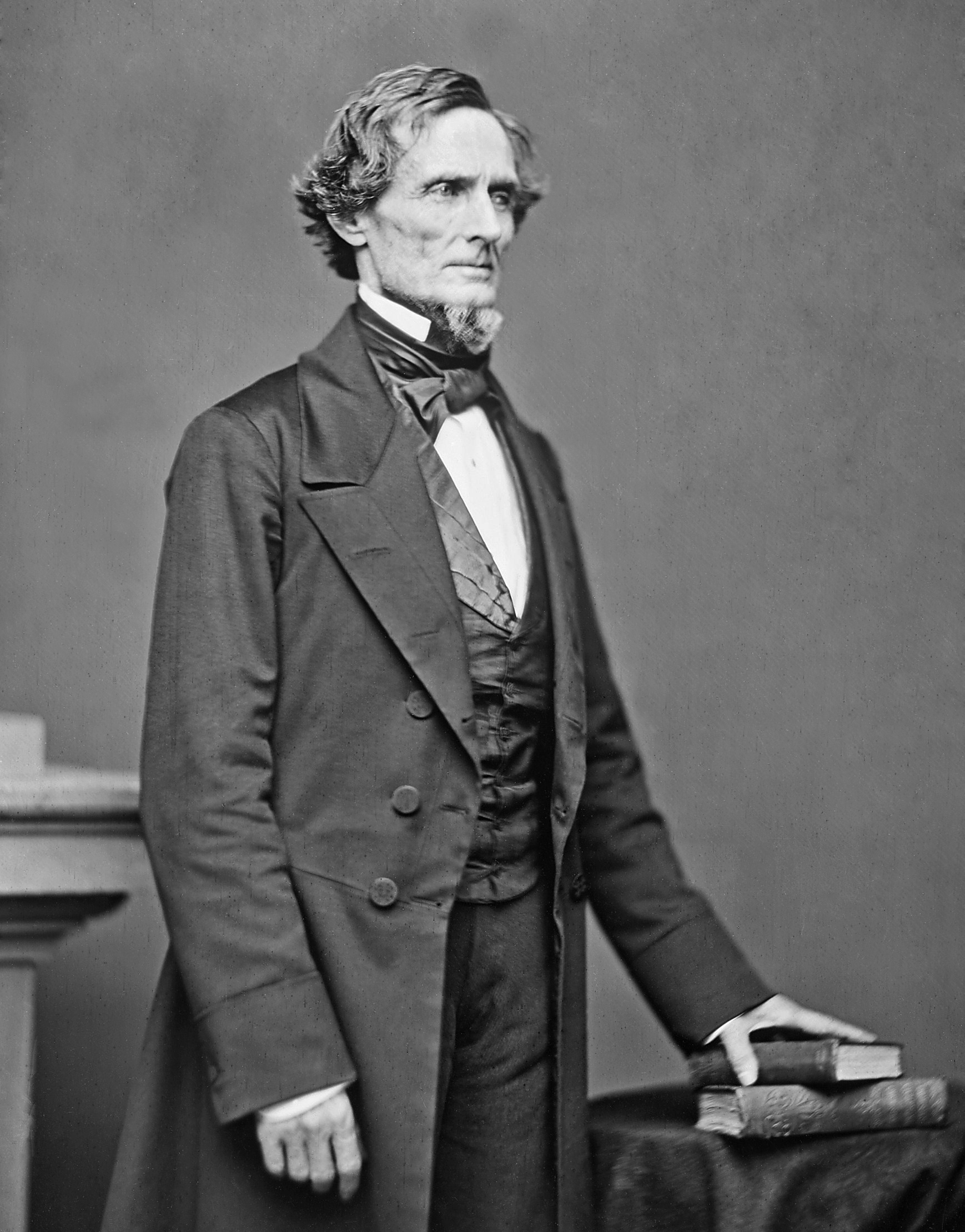
Historical · U.S. Senate · Mississippi
Jefferson Davis
Former U.S. Senator from Mississippi · 1847–1861 · Democratic · Class 1
Jefferson Davis represented Mississippi in the United States Senate (1847–1861) for the Democratic party. The page below collects sourced biographical facts, term history, committee roles, and provenance for Davis.
Bioguide ID: D000113
Key facts
- Full name
- Jefferson Davis
- State
- Mississippi
- Party
- Democratic
- Senate class
- Class I
- Senate service
- 1847–1861
- First Senate term
- 1847
- Status
- Left office
- Current term ends
- —
- Born
- 1808
- Bioguide ID
- D000113
- Committee assignments
- —
- Dataset version
- 1.20260602
Biographical narrative
888 words · sourced from the Wikipedia REST extract
Jefferson Davis was a prominent American politician and military leader who served as a U.S. Senator from Mississippi and later became the only president of the Confederate States during the American Civil War. Born on June 3, 1808, in Fairview, Kentucky, Davis's early life was marked by a blend of military service, political involvement, and personal tragedy. His tenure in the Senate spanned from 1847 until the end of 1861, during which he was affiliated with the Democratic Party. Following his political career, Davis became a significant figure in the Confederacy, leading the southern states during a tumultuous period in American history.
Early life and career
Jefferson Davis was born to Jane and Samuel Emory Davis, the youngest of ten children. His father, Samuel, was a veteran of the Continental Army during the American Revolutionary War and received land in Georgia as a reward for his service. The family moved to Kentucky around 1793, where Samuel established a homestead. Jefferson was named after Thomas Jefferson, the third President of the United States.
Davis's early education began in a rudimentary schoolhouse near Woodville, Mississippi, where his family relocated when he was a child. He attended various educational institutions, including Saint Thomas College in Kentucky and Jefferson College in Washington, Mississippi. In 1824, he enrolled at Transylvania University in Lexington, Kentucky, where he continued his studies until the death of his father, which significantly impacted his family’s financial situation.
In 1824, Davis's older brother Joseph secured him an appointment to the United States Military Academy at West Point. His time at West Point was marked by challenges to the institution's discipline, including a court-martial for drinking and involvement in an eggnog riot. Despite these issues, he graduated in 1828 and was commissioned as a second lieutenant in the U.S. Army. He served under Colonel Zachary Taylor, who would later become President of the United States, and was stationed at various posts, including Forts Crawford and Winnebago.
Davis's military career was temporarily interrupted when he resigned from the Army in 1835 to pursue a career in agriculture. He became a cotton planter and established Brierfield Plantation in Mississippi, where he owned enslaved individuals to work the land. His personal life was marked by tragedy; his first wife, Sarah Knox Taylor, the daughter of future President Zachary Taylor, died shortly after their marriage. He remarried in 1845 to Varina Howell, with whom he had several children.
Davis's political career began in earnest when he was elected to the U.S. House of Representatives in 1845, serving for a single year. He then participated in the Mexican-American War, where he commanded a volunteer regiment. Following the war, he was appointed to the U.S. Senate in 1847, representing Mississippi. However, he resigned from the Senate to run for governor of Mississippi, a bid that was unsuccessful.
Senate tenure
Jefferson Davis's first term in the U.S. Senate began in 1847, during a period of significant national debate over issues such as slavery and territorial expansion. As a member of the Democratic Party, he aligned with the interests of the southern states, advocating for policies that supported slavery and the rights of states. His tenure in the Senate was characterized by his strong defense of southern interests and his opposition to the growing abolitionist movement.
In 1853, Davis was appointed Secretary of War under President Franklin Pierce, a position he held until 1857. During his time as Secretary of War, he focused on military preparedness and infrastructure improvements, including the expansion of the U.S. Army and the development of military installations. After his service in the cabinet, he returned to the Senate, where he continued to represent Mississippi until the onset of the Civil War.
Davis's Senate career came to an end in December 1861 when Mississippi seceded from the Union. His resignation was part of a broader movement among southern politicians who sought to establish a separate government in response to perceived threats to their way of life and the institution of slavery. Following his resignation, Davis was appointed as the president of the Confederate States, a role he held throughout the Civil War.
Legislative focus and committees
During his time in the Senate, Jefferson Davis was involved in various legislative matters, primarily focusing on issues pertinent to the southern states. His advocacy for slavery and states' rights was a defining feature of his political career. He participated in debates concerning the expansion of slavery into new territories acquired through the Mexican-American War, arguing for the protection of southern interests.
Davis served on several Senate committees, where he contributed to discussions on military and defense issues, reflecting his background as a military officer. His experience as Secretary of War also informed his legislative priorities, as he sought to enhance the military capabilities of the United States during a period of increasing sectional tensions.
In summary, Jefferson Davis's legislative focus was heavily influenced by his commitment to the southern cause and the preservation of slavery. His political career, marked by his service in the Senate and later as the president of the Confederacy, was a reflection of the complex and often contentious issues facing the nation during the mid-19th century. His legacy remains a topic of significant historical debate, particularly regarding his role in the Confederacy and the broader implications of his political actions.
Notable legislation
Sponsored and co-sponsored legislation for Jefferson Davis is pending operator curation. The biographical narrative above carries the same provenance trail until per-bill rows are written.
Sources
- [1]https://en.wikipedia.org/wiki/Jefferson_DavisWikipedia · retrieved 2026-06-02
Notable quotes
Sourced quotes for Jefferson Davis are pending operator curation. Narrative-scope provenance remains attached below.
Sources
- [1]https://en.wikipedia.org/wiki/Jefferson_DavisWikipedia · retrieved 2026-06-02
Key positions
Curated policy positions for Jefferson Davis are pending operator review. The biographical narrative above carries the same provenance trail until per-topic positions are written.
Sources
- [1]https://en.wikipedia.org/wiki/Jefferson_DavisWikipedia · retrieved 2026-06-02
Terms served
- 1845–1847U.S. House · District -1 · Term 1 · Democratic
- 1847–1851U.S. Senate · Term 2 · Democratic · Class I
- 1857–1861U.S. Senate · Term 3 · Democratic · Class I
Sources & provenance
Every attributable claim above carries a per-section [N] marker that resolves to the corresponding URL below. Each entry records the upstream provider, the canonical URL, and the timestamp at which the source was retrieved by the ingest pipeline.
Key facts
- https://bioguide.congress.gov/search/bio/D000113bioguide · retrieved 2026-06-02
- https://www.govtrack.us/congress/members/403249govtrack · retrieved 2026-06-02
Biographical narrative
- https://en.wikipedia.org/wiki/Jefferson_Daviswikipedia · retrieved 2026-06-02
Find your senator
Every U.S. state elects two senators. Browse Mississippi’s delegation, the full former-senator roster, or explore the role and term length.
Related on The Candidate
- Preceded by Jesse SpeightEarlier holder of the Mississippi Class I Senate seat · Democratic.Open
- Succeeded by Adelbert AmesLater holder of the Mississippi Class I Senate seat · Republican.Open
- Albert BrownFormer U.S. Senator from Mississippi · DemocraticOpen
- Anselm McLaurinFormer U.S. Senator from Mississippi · DemocraticOpen
- Blanche BruceFormer U.S. Senator from Mississippi · RepublicanOpen
- Democratic PartyFederal candidates and office holders on the Democratic line.Open