
Historical · U.S. Senate · Mississippi
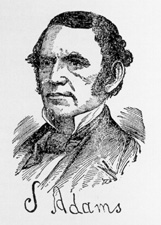
Stephen Adams
Former U.S. Senator from Mississippi · 1852–1857 · Democratic · Class 1
Stephen Adams represented Mississippi in the United States Senate (1852–1857) for the Democratic party. The page below collects sourced biographical facts, term history, committee roles, and provenance for Adams.
Bioguide ID: A000048
Key facts
- Full name
- Stephen Adams
- State
- Mississippi
- Party
- Democratic
- Senate class
- Class I
- Senate service
- 1852–1857
- First Senate term
- 1852
- Status
- Left office
- Current term ends
- —
- Born
- 1807
- Bioguide ID
- A000048
- Committee assignments
- —
- Dataset version
- 1.20260602
Biographical narrative
800 words · sourced from the Wikipedia REST extract
Stephen Adams was a 19th-century American politician, lawyer, and clergyman who served as a United States Senator from Mississippi. A member of the Democratic Party, Adams held office in the Senate from 1852 until 1857, following a career that included serving as a U.S. Representative and a circuit court judge. His early life and legal career were rooted in the Southern United States, where he became a prominent figure in Mississippi politics during a tumultuous period in American history.
Early life and career
Stephen Adams was born on October 17, 1807, in Pendleton, South Carolina. He was the son of David Adams, a Baptist clergyman, which likely influenced his early upbringing. In 1812, when Adams was just a child, his family moved to Franklin County, Tennessee. This relocation marked the beginning of his formative years in the South, where he would later establish his professional career.
Adams received his education in public schools and pursued the study of law, ultimately gaining admission to the bar in 1829. Following his admission, he began practicing law in Franklin County, Tennessee. His legal career coincided with his involvement in politics, as he became active in local governance. From 1833 to 1834, he served as a member of the Tennessee Senate, marking his entry into formal political life.
In 1834, Adams relocated to Aberdeen, Mississippi, where he continued his legal practice. His career in Mississippi was marked by a series of judicial appointments. He served as a circuit court judge from 1837 until 1846, a role that allowed him to influence the legal landscape of the state. After his judicial tenure, he was elected as a Democratic representative to the Twenty-ninth Congress, where he served from March 4, 1845, to March 3, 1847. Following his congressional service, he returned to the judiciary as a circuit court judge in 1848. Additionally, he was a member of the Mississippi House of Representatives in 1850 and participated as a delegate in the State constitutional convention in 1851.
Senate tenure
Stephen Adams was elected to the United States Senate on February 19, 1852, to fill the vacancy left by the resignation of Jefferson Davis. He officially took office on March 17, 1852, and served until March 3, 1857. During his time in the Senate, Adams was involved in various legislative activities and held the position of chairman of the Committee on Retrenchment during the Thirty-third and Thirty-fourth Congresses. This committee was responsible for overseeing government expenditures and ensuring fiscal responsibility, reflecting the economic concerns of the era.
Adams's Senate tenure occurred during a period of significant national tension, particularly surrounding issues related to slavery and states' rights. As a senator from Mississippi, a state that was deeply entrenched in the institution of slavery, Adams's political actions and decisions were likely influenced by the prevailing attitudes of his constituents and the broader Southern political landscape.
Despite the challenges of the time, Adams's role in the Senate allowed him to contribute to discussions and decisions that would shape the future of the nation. His legislative focus, while not extensively documented, would have included matters pertinent to the interests of Mississippi and the Southern states, particularly in the context of the growing sectional divide that would eventually lead to the Civil War.
Legislative focus and committees
Throughout his Senate career, Stephen Adams was primarily concerned with issues related to fiscal policy and government efficiency, as evidenced by his chairmanship of the Committee on Retrenchment. This committee's work was crucial during a time when the federal government was facing increasing demands for financial accountability and responsible spending. The focus on retrenchment was particularly relevant given the economic pressures of the mid-19th century, which included debates over tariffs, public spending, and the management of federal resources.
While specific legislative achievements during Adams's Senate term are not detailed in the available records, his position as a senator from Mississippi placed him at the heart of critical discussions regarding the future of the Union. The period leading up to the Civil War was marked by intense debates over slavery, states' rights, and the balance of power between the federal government and the states. As a member of the Democratic Party, Adams likely aligned with the prevailing views of his party, which at the time supported the interests of slaveholding states.
After completing his Senate term, Adams returned to Memphis, Tennessee, where he resumed his legal practice. His life came to an untimely end when he died of smallpox on May 11, 1857. He was interred in Elmwood Cemetery, leaving behind a legacy as a politician who navigated the complexities of his time. Despite the challenges he faced, Adams's contributions to Mississippi politics and his role in the U.S. Senate reflect the intricate interplay of law, governance, and societal issues in 19th-century America.
Notable legislation
Sponsored and co-sponsored legislation for Stephen Adams is pending operator curation. The biographical narrative above carries the same provenance trail until per-bill rows are written.
Sources
- [1]https://en.wikipedia.org/wiki/Stephen_Adams_(politician)Wikipedia · retrieved 2026-06-02
Notable quotes
Sourced quotes for Stephen Adams are pending operator curation. Narrative-scope provenance remains attached below.
Sources
- [1]https://en.wikipedia.org/wiki/Stephen_Adams_(politician)Wikipedia · retrieved 2026-06-02
Key positions
Curated policy positions for Stephen Adams are pending operator review. The biographical narrative above carries the same provenance trail until per-topic positions are written.
Sources
- [1]https://en.wikipedia.org/wiki/Stephen_Adams_(politician)Wikipedia · retrieved 2026-06-02
Terms served
- 1845–1847U.S. House · District -1 · Term 1 · Democratic
- 1852–1857U.S. Senate · Term 2 · Democratic · Class I
Sources & provenance
Every attributable claim above carries a per-section [N] marker that resolves to the corresponding URL below. Each entry records the upstream provider, the canonical URL, and the timestamp at which the source was retrieved by the ingest pipeline.
Key facts
- https://bioguide.congress.gov/search/bio/A000048bioguide · retrieved 2026-06-02
- https://www.govtrack.us/congress/members/400709govtrack · retrieved 2026-06-02
Biographical narrative
- https://en.wikipedia.org/wiki/Stephen_Adams_(politician)wikipedia · retrieved 2026-06-02
Find your senator
Every U.S. state elects two senators. Browse Mississippi’s delegation, the full former-senator roster, or explore the role and term length.
Related on The Candidate
- Preceded by Jesse SpeightEarlier holder of the Mississippi Class I Senate seat · Democratic.Open
- Succeeded by Adelbert AmesLater holder of the Mississippi Class I Senate seat · Republican.Open
- Albert BrownFormer U.S. Senator from Mississippi · DemocraticOpen
- Anselm McLaurinFormer U.S. Senator from Mississippi · DemocraticOpen
- Blanche BruceFormer U.S. Senator from Mississippi · RepublicanOpen
- Democratic PartyFederal candidates and office holders on the Democratic line.Open