
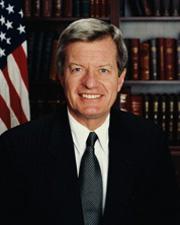
Historical · U.S. Senate · Montana
Max Baucus
Former U.S. Senator from Montana · 1978–2014 · Democratic · Class 2
Max Baucus represented Montana in the United States Senate (1978–2014) for the Democratic party. The page below collects sourced biographical facts, term history, committee roles, and provenance for Baucus.
Bioguide ID: B000243
Key facts
- Full name
- Max Baucus
- State
- Montana
- Party
- Democratic
- Senate class
- Class II
- Senate service
- 1978–2014
- First Senate term
- 1978
- Status
- Left office
- Current term ends
- —
- Born
- 1941
- Bioguide ID
- B000243
- Committee assignments
- —
- Dataset version
- 1.20260601-3
Biographical narrative
902 words · sourced from the Wikipedia REST extract
Max Baucus is a former United States senator who represented Montana from 1978 until 2014. A member of the Democratic Party, he holds the distinction of being the longest-serving U.S. senator in Montana's history. Throughout his tenure, Baucus was known for his influential role in various legislative areas, particularly in health care reform and tax policy. Following his departure from the Senate, he was appointed by President Barack Obama as the U.S. ambassador to China, a position he held until 2017.
Early life and career
Maxwell Sieben Enke was born on December 11, 1941, in Helena, Montana, to Jean Sheriff, a historian and rancher, and Stephen Enke, a demographer and economist. His early life was marked by a significant transition when his parents separated, leading his mother to return to Helena with him when he was just two years old. After marrying John J. Baucus, Jean Sheriff and her son adopted his surname, which Max would carry throughout his political career.
Baucus completed his secondary education at Helena High School, graduating in 1959. He began his higher education at Carleton College in Minnesota before transferring to Stanford University, where he earned a Bachelor of Arts degree in economics in 1964. During his time at Stanford, he was a member of the Sigma Alpha Epsilon fraternity. Following his undergraduate studies, he attended Stanford Law School, obtaining his Juris Doctor degree in 1967.
Upon graduating from law school, Baucus began his professional career as a staff attorney for the Civil Aeronautics Board, where he worked for two years. He then spent another two years at the Securities and Exchange Commission in Washington, D.C. In 1971, he returned to Montana to serve as the executive director of the state's Constitutional Convention and subsequently opened a law office in Missoula. His political career commenced in November 1972 when he was elected to the Montana House of Representatives. Baucus continued to build his political profile, winning a seat in the United States House of Representatives in November 1974, where he was re-elected in 1976.
Senate tenure
Baucus was elected to the United States Senate on November 7, 1978, with his term officially beginning on January 3, 1979. However, he was appointed to fill a vacancy created by the resignation of Senator Paul G. Hatfield shortly before his official term commenced. This appointment was made by Montana's Democratic Governor Thomas Lee Judge on December 15, 1978. Baucus subsequently won multiple re-elections, serving a total of seven terms in the Senate until he announced in 2013 that he would not seek a seventh term. His Senate career concluded on February 6, 2014.
During his time in the Senate, Baucus was involved in numerous legislative initiatives and held several key committee positions. He served as the chairman of the Senate Committee on Finance, where he played a significant role in shaping health care reform in the United States. His leadership extended to the Joint Committee on Taxation, where he also served as chairman. Additionally, Baucus was a member of the Senate Committee on Agriculture, Nutrition and Forestry, and the Senate Committee on Environment and Public Works. He chaired the Subcommittee on Transportation and Infrastructure, further highlighting his influence in various legislative domains.
Legislative focus and committees
Baucus's legislative focus encompassed a range of issues, reflecting both his party affiliation and his personal political philosophy. As a Democratic senator, he often took conservative stances, diverging from his party on several key issues, including taxes, environmental policy, health care, and gun control. His voting record indicated a moderate approach, with a notable pro-business orientation, as evidenced by a 74% rating from the United States Chamber of Commerce.
In the realm of health care, Baucus was particularly influential during the debates surrounding reform efforts. As chairman of the Senate Committee on Finance, he was a central figure in discussions that aimed to reshape the American health care system. His involvement in this area was marked by both support and criticism, particularly regarding his ties to the health insurance and pharmaceutical industries, which raised concerns about potential conflicts of interest.
Baucus's record on civil rights and social issues was mixed. He received a 60% rating from the American Civil Liberties Union in 2002, indicating a varied voting history on civil rights matters. His stance on LGBT rights evolved over time; while he initially supported the Defense of Marriage Act in 1996, he later voted against a constitutional amendment to ban same-sex marriage and publicly endorsed same-sex marriage in 2012. He also supported measures aimed at preventing job discrimination based on sexual orientation.
In addition to health care and civil rights, Baucus was involved in economic issues, including tax policy and bankruptcy legislation. His voting record reflected a tendency to support measures that made bankruptcy more challenging for debtors. He also played a role in extending regulations for tobacco manufacturers, demonstrating his engagement with public health and regulatory issues.
Baucus's tenure in the Senate was characterized by his extensive committee work and his ability to navigate complex legislative landscapes. His contributions to the Senate and his state of Montana were significant, culminating in a long and varied career that transitioned into diplomatic service when he was appointed as the U.S. ambassador to China following his Senate career. Baucus's legacy includes his long-standing commitment to public service and his influence on key legislative issues that shaped national policy during his time in office.
Notable legislation
Sponsored and co-sponsored legislation for Max Baucus is pending operator curation. The biographical narrative above carries the same provenance trail until per-bill rows are written.
Sources
- [1]https://en.wikipedia.org/wiki/Max_BaucusWikipedia · retrieved 2026-06-01
Notable quotes
Sourced quotes for Max Baucus are pending operator curation. Narrative-scope provenance remains attached below.
Sources
- [1]https://en.wikipedia.org/wiki/Max_BaucusWikipedia · retrieved 2026-06-01
Key positions
Curated policy positions for Max Baucus are pending operator review. The biographical narrative above carries the same provenance trail until per-topic positions are written.
Sources
- [1]https://en.wikipedia.org/wiki/Max_BaucusWikipedia · retrieved 2026-06-01
Terms served
- 1975–1977U.S. House · District 1 · Term 1 · Democratic
- 1977–1978U.S. House · District 1 · Term 2 · Democratic
- 1978–1979U.S. Senate · Term 3 · Democratic · Class II
- 1979–1985U.S. Senate · Term 4 · Democratic · Class II
- 1985–1991U.S. Senate · Term 5 · Democratic · Class II
- 1991–1997U.S. Senate · Term 6 · Democratic · Class II
- 1997–2003U.S. Senate · Term 7 · Democratic · Class II
- 2003–2009U.S. Senate · Term 8 · Democratic · Class II
- 2009–2014U.S. Senate · Term 9 · Democratic · Class II
Sources & provenance
Every attributable claim above carries a per-section [N] marker that resolves to the corresponding URL below. Each entry records the upstream provider, the canonical URL, and the timestamp at which the source was retrieved by the ingest pipeline.
Key facts
- https://bioguide.congress.gov/search/bio/B000243bioguide · retrieved 2026-06-01
- http://www.baucus.senate.govsenate.gov · retrieved 2026-06-01
Biographical narrative
- https://en.wikipedia.org/wiki/Max_Baucuswikipedia · retrieved 2026-06-01
Find your senator
Every U.S. state elects two senators. Browse Montana’s delegation, the full former-senator roster, or explore the role and term length.
Related on The Candidate
- Preceded by Lee MetcalfEarlier holder of the Montana Class II Senate seat · Democratic.Open
- Succeeded by John WalshLater holder of the Montana Class II Senate seat · Democratic.Open
- Burton WheelerFormer U.S. Senator from Montana · DemocraticOpen
- Conrad BurnsFormer U.S. Senator from Montana · RepublicanOpen
- Henry MyersFormer U.S. Senator from Montana · DemocraticOpen
- James MurrayFormer U.S. Senator from Montana · DemocraticOpen