
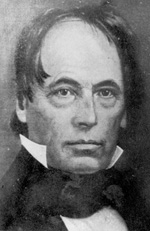
Historical · U.S. Senate · New Hampshire
Jared Williams
Former U.S. Senator from New Hampshire · 1853–1855 · Democratic · Class 2
Jared Williams represented New Hampshire in the United States Senate (1853–1855) for the Democratic party. The page below collects sourced biographical facts, term history, committee roles, and provenance for Williams.
Bioguide ID: W000511
Key facts
- Full name
- Jared Williams
- State
- New Hampshire
- Party
- Democratic
- Senate class
- Class II
- Senate service
- 1853–1855
- First Senate term
- 1853
- Status
- Left office
- Current term ends
- —
- Born
- 1796
- Bioguide ID
- W000511
- Committee assignments
- —
- Dataset version
- 1.20260602
Biographical narrative
803 words · sourced from the Wikipedia REST extract
Jared Williams was a prominent American lawyer and politician from New Hampshire, known for his service as a U.S. Senator and as the 21st governor of New Hampshire. A member of the Democratic Party, he held various political offices throughout his career, including terms in both the U.S. House of Representatives and the New Hampshire State Legislature. His tenure in the Senate was marked by a brief appointment following the death of a predecessor, and he contributed to the political landscape of his time until his death in 1864.
Early life and career
Jared Williams was born on December 22, 1796, in West Woodstock, Connecticut. He pursued higher education at Brown University, where he graduated in 1818. Following his graduation, Williams attended the Litchfield Law School, a prestigious institution known for training many prominent lawyers of the era. After completing his studies, he established himself as an attorney in Lancaster, New Hampshire, where he began his legal career.
Williams's political journey commenced in the early 1830s when he became involved in local governance. He served in the New Hampshire House of Representatives from 1830 to 1831 and subsequently in the New Hampshire State Senate from 1832 to 1834. His early political involvement laid the groundwork for his future roles in both state and federal government. After a brief hiatus, he returned to the New Hampshire House from 1835 to 1836, further solidifying his political presence in the state.
In 1836, Williams transitioned to national politics by winning election to the U.S. House of Representatives. He served two consecutive terms from March 4, 1837, to March 3, 1841. His experience in the House provided him with a platform to influence legislation and engage with national issues. Following his time in Congress, Williams was elected as the governor of New Hampshire in 1847, a position he held for two one-year terms until June 7, 1849. His governorship was characterized by his efforts to address various state matters, although specific achievements during this period are not detailed in the available records.
After completing his gubernatorial duties, Williams was appointed as the Coos County Judge of Probate, a role he occupied until 1852. This position allowed him to continue his involvement in the legal system and contribute to the administration of justice in his region.
Senate tenure
Jared Williams's tenure in the U.S. Senate began when he was appointed to fill a vacancy left by the death of Senator Charles G. Atherton. He took office on November 29, 1853, as a member of the Democratic Party. His time in the Senate was relatively brief, lasting until August 4, 1854. During this period, Williams participated in the legislative process and contributed to discussions on various issues facing the nation. However, the specific details of his Senate activities and the legislation he supported are not extensively documented in the available resources.
Williams's appointment to the Senate was significant as it reflected the political dynamics of the time, particularly the influence of the Democratic Party in New Hampshire. His service in the Senate was part of a broader career that included various roles in both state and federal government, showcasing his commitment to public service.
Following his departure from the Senate, Williams returned to private life and continued to engage with his community until his death. He passed away in Lancaster, New Hampshire, on September 29, 1864, and was laid to rest in the Summer Street Cemetery in the same town.
Legislative focus and committees
While specific details regarding Jared Williams's legislative focus and committee assignments during his time in the Senate are not provided, it can be inferred that, as a member of the Democratic Party during the mid-19th century, his interests may have aligned with the party's priorities of the time. This period in American history was marked by significant political and social changes, including debates over issues such as states' rights, slavery, and economic development.
In his previous roles as a state legislator and governor, Williams likely engaged with a variety of local and state issues, which may have influenced his perspectives in the Senate. His background as an attorney and his experience in the New Hampshire political landscape would have informed his contributions to legislative discussions and decision-making processes.
Although his Senate tenure was short, Williams's broader political career encompassed various aspects of governance and law, reflecting a commitment to public service that spanned several decades. His involvement in both state and national politics illustrates the interconnectedness of local and federal governance during a transformative period in American history.
In summary, Jared Williams's career as a lawyer and politician highlights his contributions to New Hampshire's political landscape and his brief service in the U.S. Senate. His legacy is marked by his roles in various governmental capacities, reflecting the complexities of 19th-century American politics.
Notable legislation
Sponsored and co-sponsored legislation for Jared Williams is pending operator curation. The biographical narrative above carries the same provenance trail until per-bill rows are written.
Sources
- [1]https://en.wikipedia.org/wiki/Jared_W._WilliamsWikipedia · retrieved 2026-06-02
Notable quotes
Sourced quotes for Jared Williams are pending operator curation. Narrative-scope provenance remains attached below.
Sources
- [1]https://en.wikipedia.org/wiki/Jared_W._WilliamsWikipedia · retrieved 2026-06-02
Key positions
Curated policy positions for Jared Williams are pending operator review. The biographical narrative above carries the same provenance trail until per-topic positions are written.
Sources
- [1]https://en.wikipedia.org/wiki/Jared_W._WilliamsWikipedia · retrieved 2026-06-02
Terms served
- 1837–1839U.S. House · District -1 · Term 1 · Democratic
- 1839–1841U.S. House · District -1 · Term 2 · Democratic
- 1853–1855U.S. Senate · Term 3 · Democratic · Class II
Sources & provenance
Every attributable claim above carries a per-section [N] marker that resolves to the corresponding URL below. Each entry records the upstream provider, the canonical URL, and the timestamp at which the source was retrieved by the ingest pipeline.
Key facts
- https://bioguide.congress.gov/search/bio/W000511bioguide · retrieved 2026-06-02
- https://www.govtrack.us/congress/members/411668govtrack · retrieved 2026-06-02
Biographical narrative
- https://en.wikipedia.org/wiki/Jared_W._Williamswikipedia · retrieved 2026-06-02
Find your senator
Every U.S. state elects two senators. Browse New Hampshire’s delegation, the full former-senator roster, or explore the role and term length.
Related on The Candidate
- Preceded by Charles AthertonEarlier holder of the New Hampshire Class II Senate seat · Democratic.Open
- Succeeded by Aaron CraginLater holder of the New Hampshire Class II Senate seat · Republican.Open
- Austin PikeFormer U.S. Senator from New Hampshire · RepublicanOpen
- Bainbridge WadleighFormer U.S. Senator from New Hampshire · RepublicanOpen
- Benning JennessFormer U.S. Senator from New Hampshire · DemocraticOpen
- Democratic PartyFederal candidates and office holders on the Democratic line.Open