
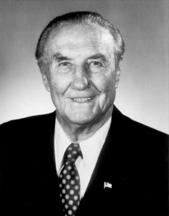
Historical · U.S. Senate · South Carolina
J. Thurmond
Former U.S. Senator from South Carolina · 1954–2003 · Republican · Class 2
J. Thurmond represented South Carolina in the United States Senate (1954–2003) for the Republican party. The page below collects sourced biographical facts, term history, committee roles, and provenance for Thurmond.
Bioguide ID: T000254
Key facts
- Full name
- J. Thurmond
- State
- South Carolina
- Party
- Republican
- Senate class
- Class II
- Senate service
- 1954–2003
- First Senate term
- 1954
- Status
- Left office
- Current term ends
- —
- Born
- 1902
- Bioguide ID
- T000254
- Committee assignments
- —
- Dataset version
- 1.20260602
Biographical narrative
966 words · sourced from the Wikipedia REST extract
Strom Thurmond was a prominent American politician who served as a U.S. Senator from South Carolina for nearly half a century. A member of the Republican Party, Thurmond's political career began in the mid-20th century and spanned several decades, during which he became known for his long tenure in the Senate. He was a significant figure in Southern politics and played a notable role in shaping various legislative agendas throughout his time in office.
Early life and career
Strom Thurmond was born on December 5, 1902, in Edgefield, South Carolina. He grew up in a rural environment, which influenced his perspectives and political views throughout his life. Thurmond pursued higher education at Clemson College, where he earned a degree in agricultural education. Following his graduation, he worked as a teacher and later served as a coach at a local high school, demonstrating an early commitment to public service and community involvement.
Thurmond's military service began when he enlisted in the United States Army during World War II. He served with distinction, rising to the rank of colonel and participating in significant campaigns in Europe. His military experience contributed to his leadership skills and bolstered his public image upon returning to civilian life.
After the war, Thurmond entered politics, initially serving as the state’s Governor from 1947 to 1951. His governorship was marked by a focus on education and infrastructure, as well as a commitment to maintaining the social order of the time. Following his term as governor, he sought a seat in the U.S. Senate, which he successfully attained in 1954. This marked the beginning of a lengthy and influential career in the Senate, where he would become one of the longest-serving senators in U.S. history.
Senate tenure
Strom Thurmond's Senate career began in 1954, and he served continuously until his retirement in 2003. Over the course of his ten terms, he became a fixture in American politics, known for his strong conservative views and his advocacy for states' rights. His tenure was characterized by significant political shifts in the United States, including the civil rights movement and the changing dynamics of the Republican Party.
Thurmond initially entered the Senate as a member of the Democratic Party but switched to the Republican Party in the 1960s, aligning himself with the party's growing conservative base. His political philosophy was heavily influenced by his Southern roots, and he often championed issues that resonated with his constituents in South Carolina. Thurmond's political strategies included a focus on traditional values and a commitment to limited government, which appealed to many voters in his state.
Throughout his time in the Senate, Thurmond was involved in numerous high-profile legislative battles. He was known for his ability to navigate complex political landscapes and build coalitions, which allowed him to exert considerable influence on various issues. His lengthy service in the Senate also made him a senior member of several important committees, where he played a role in shaping policy and legislation.
Thurmond's Senate career was marked by several notable moments, including his record-setting filibuster against the Civil Rights Act of 1957. This event underscored his commitment to states' rights and opposition to federal intervention in local matters. Despite the controversies surrounding his positions, Thurmond maintained a strong base of support in South Carolina, which contributed to his electoral successes.
As he approached the end of his Senate career, Thurmond's age became a topic of discussion. He was the oldest serving senator at the time of his retirement, having served in the Senate for nearly 50 years. His departure from the Senate in January 2003 marked the end of an era in South Carolina politics and left a lasting legacy on the state's political landscape.
Legislative focus and committees
During his long tenure in the U.S. Senate, Strom Thurmond focused on a variety of legislative issues, reflecting both his personal beliefs and the interests of his constituents. His commitment to conservative principles was evident in his advocacy for limited government, fiscal responsibility, and a strong national defense. Thurmond often positioned himself as a defender of traditional values, which resonated with many voters in South Carolina.
Thurmond's legislative priorities included education, military affairs, and veterans' issues. He was a strong supporter of the military and worked to secure funding for defense initiatives, particularly those that benefited South Carolina's military installations. His background as a veteran informed his commitment to ensuring that service members received adequate support and resources.
In addition to military and defense issues, Thurmond was involved in discussions surrounding civil rights, although his early opposition to civil rights legislation drew criticism. Over time, he adapted his stance on certain issues, reflecting the evolving political landscape of the South and the nation. His ability to navigate these changes was a hallmark of his political career.
Thurmond served on several key Senate committees, including the Judiciary Committee and the Armed Services Committee. His roles on these committees allowed him to influence significant legislation and contribute to national policy discussions. His seniority and experience enabled him to play a pivotal role in shaping the direction of various legislative initiatives.
Throughout his Senate career, Thurmond was known for his strong work ethic and dedication to his constituents. He often emphasized the importance of constituent services and was recognized for his efforts to address the needs and concerns of South Carolinians. His long-standing presence in the Senate allowed him to build relationships across party lines, although he remained a staunch advocate for his party's principles.
In summary, Strom Thurmond's legislative focus and committee work reflected his commitment to conservative values and his dedication to serving the people of South Carolina. His lengthy career in the Senate left a significant mark on American politics, and his influence can still be felt in the political landscape today.
Notable legislation
Sponsored and co-sponsored legislation for J. Thurmond is pending operator curation. The biographical narrative above carries the same provenance trail until per-bill rows are written.
Sources
- [1]https://en.wikipedia.org/wiki/Strom_ThurmondWikipedia · retrieved 2026-06-02
Notable quotes
Sourced quotes for J. Thurmond are pending operator curation. Narrative-scope provenance remains attached below.
Sources
- [1]https://en.wikipedia.org/wiki/Strom_ThurmondWikipedia · retrieved 2026-06-02
Key positions
Curated policy positions for J. Thurmond are pending operator review. The biographical narrative above carries the same provenance trail until per-topic positions are written.
Sources
- [1]https://en.wikipedia.org/wiki/Strom_ThurmondWikipedia · retrieved 2026-06-02
Terms served
- 1954–1955U.S. Senate · Term 1 · Democratic · Class II
- 1955–1956U.S. Senate · Term 2 · Democratic · Class II
- 1956–1961U.S. Senate · Term 3 · Democratic · Class II
- 1961–1967U.S. Senate · Term 4 · Republican · Class II
- 1967–1973U.S. Senate · Term 5 · Republican · Class II
- 1973–1979U.S. Senate · Term 6 · Republican · Class II
- 1979–1985U.S. Senate · Term 7 · Republican · Class II
- 1985–1991U.S. Senate · Term 8 · Republican · Class II
- 1991–1997U.S. Senate · Term 9 · Republican · Class II
- 1997–2003U.S. Senate · Term 10 · Republican · Class II
Sources & provenance
Every attributable claim above carries a per-section [N] marker that resolves to the corresponding URL below. Each entry records the upstream provider, the canonical URL, and the timestamp at which the source was retrieved by the ingest pipeline.
Key facts
- https://bioguide.congress.gov/search/bio/T000254bioguide · retrieved 2026-06-02
- https://www.govtrack.us/congress/members/300157govtrack · retrieved 2026-06-02
Biographical narrative
- https://en.wikipedia.org/wiki/Strom_Thurmondwikipedia · retrieved 2026-06-02
Find your senator
Every U.S. state elects two senators. Browse South Carolina’s delegation, the full former-senator roster, or explore the role and term length.
Related on The Candidate
- Preceded by Alva LumpkinEarlier holder of the South Carolina Class II Senate seat · Democratic.Open
- Andrew ButlerFormer U.S. Senator from South Carolina · DemocraticOpen
- Arthur HayneFormer U.S. Senator from South Carolina · DemocraticOpen
- Asbury LatimerFormer U.S. Senator from South Carolina · DemocraticOpen
- Republican PartyFederal candidates and office holders on the Republican line.Open
- Senators from South CarolinaEvery former U.S. Senator who has represented South Carolina.Open