
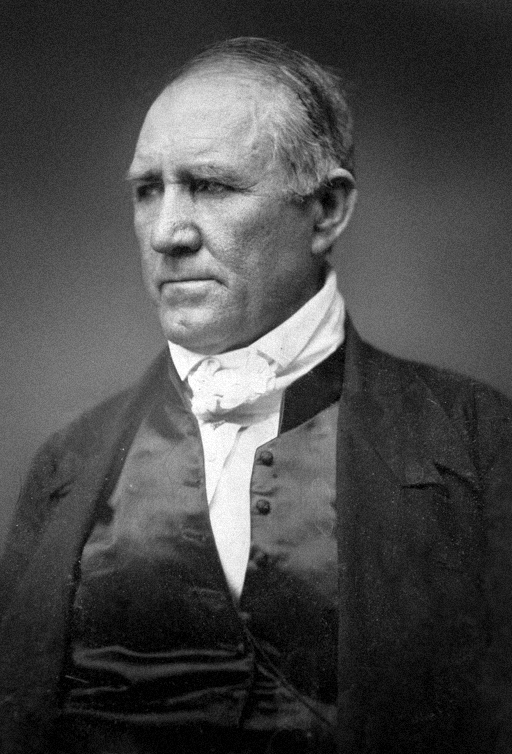
Historical · U.S. Senate · Texas
Samuel Houston
Former U.S. Senator from Texas · 1846–1859 · American · Class 2
Samuel Houston represented Texas in the United States Senate (1846–1859) for the American party. The page below collects sourced biographical facts, term history, committee roles, and provenance for Houston.
Bioguide ID: H000827
Key facts
- Full name
- Samuel Houston
- State
- Texas
- Party
- American
- Senate class
- Class II
- Senate service
- 1846–1859
- First Senate term
- 1846
- Status
- Left office
- Current term ends
- —
- Born
- 1793
- Bioguide ID
- H000827
- Committee assignments
- —
- Dataset version
- 1.20260602
Biographical narrative
1,083 words · sourced from the Wikipedia REST extract
Samuel Houston was an American military general and statesman who played a significant role in the history of Texas and the United States. He served as a U.S. Senator from Texas, representing the American Party, and was known for his complex political career that included terms as the first and third president of the Republic of Texas, as well as serving as the sixth governor of Tennessee and the seventh governor of Texas. Houston's political legacy is marked by his involvement in pivotal events such as the Texas Revolution and the Mexican-American War, as well as his staunch opposition to secession during the Civil War era.
Early life and career
Samuel Houston was born on March 2, 1793, in Rockbridge County, Virginia, to Samuel Houston and Elizabeth Paxton. His family had deep roots in America, with Scottish and Irish ancestry tracing back to the 1730s. Houston inherited the Timber Ridge plantation, which was worked by enslaved African Americans. His father served in the American Revolutionary War and later in the Virginian militia, which strained the family's finances due to the costs incurred during his service.
Houston was the fifth of nine children in his family, having five brothers and three sisters. Following the death of his father in 1806, his mother moved the family to Maryville, Tennessee, seeking more affordable land. At that time, Tennessee was still considered the frontier, and the family faced challenges from Native American raids. Elizabeth Houston worked tirelessly to establish their new home, while her older children helped manage the farm and a local store.
Despite the hardships, Houston's early life was characterized by a sense of adventure and a desire to explore. He was not particularly interested in formal education, often clashing with the religious beliefs of his mother, a Presbyterian. However, he developed a love for reading, delving into both classical literature and contemporary works. At the age of 16, feeling constrained by his family obligations and the expectations of farm life, Houston ran away to live with the Cherokee tribe, where he was given the name "Raven." This experience allowed him to learn the Cherokee language and customs, fostering a lifelong respect for Native American culture.
Houston's early adulthood was marked by military service. He fought in the War of 1812 under General Andrew Jackson, which further shaped his political and military career. After the war, he was appointed as a sub-agent overseeing the removal of the Cherokee from Tennessee to the Arkansas Territory in 1818. His connections with Jackson and his growing political acumen eventually led to his election to the United States House of Representatives in 1823, where he began to establish his reputation as a politician.
Senate tenure
Samuel Houston's first term in the U.S. Senate began in 1846, shortly after Texas was annexed by the United States. He was one of the first two senators to represent Texas, reflecting his significant role in the state's transition from an independent republic to a U.S. state. Houston's political affiliations shifted during his career; he initially aligned with the Democratic Party, supporting President James K. Polk's policies, including the Mexican-American War.
During his time in the Senate, Houston was known for his unionist stance, advocating for compromise and moderation in a politically divided nation. He opposed radical elements from both the North and the South, seeking to maintain the Union amid rising tensions over slavery. His support for the Compromise of 1850 illustrated his commitment to resolving sectional disputes, as it aimed to address various territorial and slavery-related issues stemming from the Mexican-American War and the annexation of Texas.
Houston's opposition to the Kansas-Nebraska Act of 1854 marked a turning point in his political career. He believed that the act would exacerbate sectional tensions regarding slavery, leading him to distance himself from the Democratic Party. This opposition ultimately contributed to his candidacy for the presidential nomination of the American Party in the 1856 election, although he was unsuccessful. He later sought the nomination from the Constitutional Union Party in 1860 but did not secure it.
Houston's Senate tenure concluded on March 3, 1859, after serving a total of three terms in Congress. His political career was characterized by a commitment to national unity and a reluctance to embrace the extremes of the political landscape, which would later play a crucial role in his actions as governor of Texas.
Legislative focus and committees
Throughout his Senate career, Samuel Houston focused on issues that reflected his commitment to unionism and moderation. He was a vocal advocate for compromise, particularly during a time when the nation was increasingly polarized over the issue of slavery. His support for the Compromise of 1850 was a significant aspect of his legislative agenda, as it aimed to address the contentious issues arising from the expansion of slavery into newly acquired territories.
Houston's opposition to the Kansas-Nebraska Act was rooted in his belief that it would lead to heightened conflict between pro-slavery and anti-slavery factions. This act allowed for the possibility of slavery in territories where it had previously been prohibited, which he feared would intensify sectional tensions. His stance on this issue ultimately led to a fracture in his political affiliations and contributed to his departure from the Democratic Party.
In addition to his legislative focus on slavery and sectional conflict, Houston's Senate career was marked by his involvement in various committees that addressed issues pertinent to the rapidly changing landscape of the United States. His experience as a military leader and statesman informed his perspectives on national defense and foreign policy, particularly in relation to the ongoing conflicts with Native American tribes and the implications of westward expansion.
After leaving the Senate, Houston returned to Texas politics, where he was elected governor in 1859. His tenure as governor was characterized by his staunch opposition to secession, as he sought to keep Texas in the Union during the tumultuous period leading up to the Civil War. His efforts to maintain unity in Texas were met with resistance, ultimately leading to his removal from office in 1861.
Samuel Houston's legacy is complex, reflecting his multifaceted career as a military leader, statesman, and politician. His contributions to the early history of Texas and his efforts to navigate the challenges of a divided nation continue to be recognized in the context of American history. Houston's name endures in various ways, including the city of Houston, Texas, which stands as a testament to his significant impact on the state and the nation.
Notable legislation
Sponsored and co-sponsored legislation for Samuel Houston is pending operator curation. The biographical narrative above carries the same provenance trail until per-bill rows are written.
Sources
- [1]https://en.wikipedia.org/wiki/Sam_HoustonWikipedia · retrieved 2026-06-02
Notable quotes
Sourced quotes for Samuel Houston are pending operator curation. Narrative-scope provenance remains attached below.
Sources
- [1]https://en.wikipedia.org/wiki/Sam_HoustonWikipedia · retrieved 2026-06-02
Key positions
Curated policy positions for Samuel Houston are pending operator review. The biographical narrative above carries the same provenance trail until per-topic positions are written.
Sources
- [1]https://en.wikipedia.org/wiki/Sam_HoustonWikipedia · retrieved 2026-06-02
Terms served
- 1823–1825U.S. House · District 7 · Term 1 · Democratic
- 1825–1827U.S. House · District 7 · Term 2 · Jackson
- 1846–1847U.S. Senate · Term 3 · Democratic · Class II
- 1847–1853U.S. Senate · Term 4 · Democratic · Class II
- 1853–1859U.S. Senate · Term 5 · American · Class II
Sources & provenance
Every attributable claim above carries a per-section [N] marker that resolves to the corresponding URL below. Each entry records the upstream provider, the canonical URL, and the timestamp at which the source was retrieved by the ingest pipeline.
Key facts
- https://bioguide.congress.gov/search/bio/H000827bioguide · retrieved 2026-06-02
- https://www.govtrack.us/congress/members/405674govtrack · retrieved 2026-06-02
Biographical narrative
- https://en.wikipedia.org/wiki/Sam_Houstonwikipedia · retrieved 2026-06-02
Find your senator
Every U.S. state elects two senators. Browse Texas’s delegation, the full former-senator roster, or explore the role and term length.
Related on The Candidate
- Succeeded by John HemphillLater holder of the Texas Class II Senate seat · Democratic.Open
- Andrew HoustonFormer U.S. Senator from Texas · DemocraticOpen
- Charles CulbersonFormer U.S. Senator from Texas · DemocraticOpen
- Earle MayfieldFormer U.S. Senator from Texas · DemocraticOpen
- Horace ChiltonFormer U.S. Senator from Texas · DemocraticOpen
- Senators from TexasEvery former U.S. Senator who has represented Texas.Open