
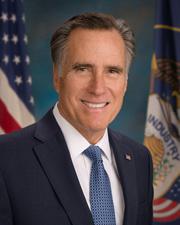
Historical · U.S. Senate · Utah
Mitt Romney
Former U.S. Senator from Utah · 2019–2025 · Republican · Class 1
Mitt Romney represented Utah in the United States Senate (2019–2025) for the Republican party. The page below collects sourced biographical facts, term history, committee roles, and provenance for Romney.
Bioguide ID: R000615
Key facts
- Full name
- Mitt Romney
- State
- Utah
- Party
- Republican
- Senate class
- Class I
- Senate service
- 2019–2025
- First Senate term
- 2019
- Status
- Left office
- Current term ends
- —
- Born
- 1947
- Bioguide ID
- R000615
- Committee assignments
- —
- Dataset version
- 1.20260601-3
Biographical narrative
1,178 words · sourced from the Wikipedia REST extract
Willard Mitt Romney is an American businessman and retired politician who served as a United States Senator from Utah from 2019 until 2025. A member of the Republican Party, he previously held the position of the 70th governor of Massachusetts from 2003 to 2007 and was the party's nominee for President in the 2012 election. Throughout his career, Romney has been recognized for his moderate political stance and has engaged in various significant legislative actions during his time in office.
Early life and career
Mitt Romney was born on March 12, 1947, in Detroit, Michigan, to George W. Romney and Lenore Romney. His father was a prominent automobile executive who served as the governor of Michigan and later as the U.S. Secretary of Housing and Urban Development. Mitt is the youngest of four children in the Romney family, which has deep roots in the Church of Jesus Christ of Latter-day Saints (LDS Church). His heritage includes a lineage of influential figures within the church, including great-grandparents who were early converts to Mormonism.
Romney's early education began in public elementary schools, but he transitioned to Cranbrook School, a prestigious private preparatory institution, during his seventh grade. At Cranbrook, he was one of the few Mormon students and participated in various extracurricular activities, including managing the ice hockey team and joining the pep squad. He was not particularly noted for his athletic or academic prowess but was involved in numerous school organizations. His formative years were marked by his admiration for his father, who became a nationally recognized figure in the automotive industry.
After graduating from Cranbrook, Romney attended Stanford University for a year before serving a mission in France for the LDS Church. Upon his return to the United States in late 1968, he enrolled at Brigham Young University (BYU), where he graduated with a Bachelor of Arts in English in 1971. He later pursued further education at Harvard University, earning both a Juris Doctor and a Master of Business Administration (JD–MBA) in 1975.
Romney's professional career began in management consulting, and he joined Bain & Company in Boston in 1977. He eventually became the CEO of Bain, where he played a pivotal role in steering the company out of financial difficulties. In 1984, he co-founded Bain Capital, a private equity investment firm that has grown to be one of the largest in its field. His work in the private sector established him as a successful businessman and laid the groundwork for his future political endeavors.
Romney's initial foray into politics came in 1994 when he ran as the Republican nominee for the U.S. Senate seat in Massachusetts but was defeated by the incumbent, Ted Kennedy. Following this loss, he returned to Bain Capital. His political career gained momentum when he took on the role of president and CEO of the organizing committee for the 2002 Winter Olympics in Salt Lake City, which was facing significant challenges at the time. His successful management of the Olympics helped to revitalize his political ambitions.
In 2002, Romney was elected governor of Massachusetts, where he implemented a health care reform law that aimed to provide near-universal health insurance access. His tenure as governor was marked by efforts to address budget deficits through spending cuts and tax reforms. After serving one term, he chose not to seek reelection in 2006, instead focusing on a bid for the Republican presidential nomination in the 2008 election, which he ultimately lost to Senator John McCain.
Senate tenure
Romney's political journey took a significant turn when he relocated to Utah and successfully ran for the U.S. Senate in 2018. He made history by becoming the first individual to be elected as governor of one state and then as a senator from another state in modern U.S. history. His Senate term commenced in January 2019, and he served as a member of Senate Class 1 until his term ended on January 3, 2025.
During his time in the Senate, Romney was known for his willingness to cross party lines on various issues. He gained national attention for his votes during the impeachment trials of former President Donald Trump. Romney was the only Republican senator to vote to convict Trump in his first impeachment trial, marking a historic moment as he became the first senator from his party to vote for the removal of a sitting president. He also voted to convict Trump in the second impeachment trial in 2021.
Romney's Senate tenure was characterized by a moderate approach to governance, often aligning with centrist positions on key issues. He participated in various bipartisan efforts and was involved in discussions surrounding critical national policies. His actions included supporting gun control measures and voting in favor of Ketanji Brown Jackson's confirmation to the Supreme Court. Additionally, he demonstrated a commitment to international relations, advocating for strong ties with allies such as Israel and Ukraine and expressing concerns regarding adversarial nations like Iran, China, and Russia.
Romney's political stances have often placed him at odds with more conservative factions within the Republican Party. He did not support Trump in the 2016, 2020, or 2024 presidential elections, reflecting his independent approach to party politics. His willingness to engage with social movements, such as marching alongside Black Lives Matter protesters, further illustrated his moderate stance on social issues.
In 2023, Romney announced that he would not seek reelection in 2024, signaling a transition away from his political career. His term in the Senate concluded on January 3, 2025, marking the end of a significant chapter in his public service.
Legislative focus and committees
Throughout his time in the Senate, Romney served on several committees that shaped his legislative focus. His work included involvement in committees related to finance, foreign relations, and health, among others. These roles allowed him to address a wide range of issues, from economic policy to international affairs.
Romney's legislative priorities often reflected his moderate Republican stance, emphasizing bipartisanship and pragmatic solutions. He was known for advocating for fiscal responsibility and effective governance, often seeking to bridge divides between parties on contentious issues. His engagement in health care reform during his governorship informed his perspectives on health policy in the Senate, where he continued to support measures aimed at improving access to care.
In addition to his domestic policy interests, Romney's focus on foreign relations underscored his belief in a strong American presence on the global stage. He frequently spoke on issues related to national security and international alliances, advocating for policies that would strengthen the United States' position in global affairs.
Romney's tenure in the Senate was marked by a commitment to public service and a willingness to engage in difficult conversations about the future of the Republican Party and the nation as a whole. His approach to governance was characterized by a blend of traditional Republican values and a recognition of the need for adaptation in a changing political landscape. As he concluded his time in office, he left behind a legacy of moderation and a focus on collaboration in an increasingly polarized political environment.
Notable legislation
Sponsored and co-sponsored legislation for Mitt Romney is pending operator curation. The biographical narrative above carries the same provenance trail until per-bill rows are written.
Sources
- [1]https://en.wikipedia.org/wiki/Mitt_RomneyWikipedia · retrieved 2026-06-01
Notable quotes
Sourced quotes for Mitt Romney are pending operator curation. Narrative-scope provenance remains attached below.
Sources
- [1]https://en.wikipedia.org/wiki/Mitt_RomneyWikipedia · retrieved 2026-06-01
Key positions
Curated policy positions for Mitt Romney are pending operator review. The biographical narrative above carries the same provenance trail until per-topic positions are written.
Sources
- [1]https://en.wikipedia.org/wiki/Mitt_RomneyWikipedia · retrieved 2026-06-01
Terms served
- 2019–2025U.S. Senate · Term 1 · Republican · Class I
Sources & provenance
Every attributable claim above carries a per-section [N] marker that resolves to the corresponding URL below. Each entry records the upstream provider, the canonical URL, and the timestamp at which the source was retrieved by the ingest pipeline.
Key facts
- https://bioguide.congress.gov/search/bio/R000615bioguide · retrieved 2026-06-01
- https://www.romney.senate.govsenate.gov · retrieved 2026-06-01
Biographical narrative
- https://en.wikipedia.org/wiki/Mitt_Romneywikipedia · retrieved 2026-06-01
Find your senator
Every U.S. state elects two senators. Browse Utah’s delegation, the full former-senator roster, or explore the role and term length.
Related on The Candidate
- Preceded by Orrin HatchEarlier holder of the Utah Class I Senate seat · Republican.Open
- Abe Murdock Jr.Former U.S. Senator from Utah · DemocraticOpen
- Arthur BrownFormer U.S. Senator from Utah · RepublicanOpen
- Arthur WatkinsFormer U.S. Senator from Utah · RepublicanOpen
- Elbert ThomasFormer U.S. Senator from Utah · DemocraticOpen
- Republican PartyFederal candidates and office holders on the Republican line.Open