
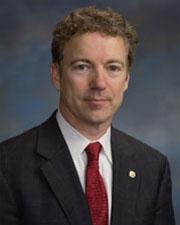
Serving · U.S. Senate · Kentucky
Rand Paul
U.S. Senator from Kentucky · 2011–present · Republican · Class 3
Rand Paul represents Kentucky in the United States Senate (2011–present) for the Republican party. The page below collects sourced biographical facts, term history, committee roles, and provenance for Paul.
Bioguide ID: P000603
Key facts
- Full name
- Rand Paul
- State
- Kentucky
- Party
- Republican
- Senate class
- Class III
- Senate service
- 2011–present
- First Senate term
- 2011
- Status
- Currently serving
- Current term ends
- 2029
- Born
- 1963
- Bioguide ID
- P000603
- Committee assignments
- 4
- Dataset version
- 1.20260601-4
Biographical narrative
930 words · sourced from the Wikipedia REST extract
Randal Howard Paul, commonly known as Rand Paul, is an American politician who has served as the junior United States senator from Kentucky since 2011. A member of the Republican Party, Paul is recognized for his libertarian views and is currently the chair of the Senate Homeland Security Committee. He has been a prominent figure in American politics, particularly known for his alignment with the Tea Party movement and his advocacy for constitutional conservatism. Prior to his political career, Paul was a practicing ophthalmologist and has also made a bid for the Republican presidential nomination in 2016.
Early life and career
Rand Paul was born on January 7, 1963, in Pittsburgh, Pennsylvania, to Carol and Ron Paul, who is a notable politician and physician. He is the middle child in a family of five, with siblings including Ronald "Ronnie" Paul Jr., Lori Paul Pyeatt, Robert Paul, and Joy Paul LeBlanc. Raised in Lake Jackson, Texas, after his family moved there in 1968, Paul experienced a childhood influenced by his father's medical career and political activities. His father, Ron Paul, served as the only obstetrician in Brazoria County, which provided Rand with early exposure to both medicine and politics.
At the age of 13, Paul witnessed his father's election to the United States House of Representatives, an event that significantly shaped his political awareness. He attended the 1976 Republican National Convention, where his father led the Texas delegation for Ronald Reagan. During his teenage years, Paul interned in his father's congressional office, further deepening his interest in public service. He was educated at Brazoswood High School, where he participated in sports such as swimming and football.
Paul's higher education began at Baylor University, where he enrolled in the honors program from 1981 to 1984. He completed his pre-med requirements in a condensed timeframe and was actively involved in campus life, including participation in the swim team and the Young Conservatives of Texas. He also contributed to The Baylor Lariat, the university's student newspaper. Paul left Baylor before completing his undergraduate degree to attend Duke University School of Medicine, where he earned his Doctor of Medicine degree in 1988.
Following his medical education, Rand Paul completed his residency in ophthalmology at Duke and subsequently moved to Bowling Green, Kentucky, in 1993. He practiced at Downing McPeak Vision Centers for five years before joining the Graves Gilbert Clinic, where he worked for a decade. In 2008, he established his own private practice. Throughout his medical career, Paul specialized in cataract and glaucoma surgeries, LASIK procedures, and corneal transplants. He also founded the Southern Kentucky Lions Eye Clinic in 2009 to provide eye care to those in need, earning recognition for his humanitarian efforts.
Senate tenure
Rand Paul's political career began with his election to the U.S. Senate in 2010, where he has since served as a member of the Republican Party. His first term in the Senate commenced in 2011, and he has been re-elected twice, with his current term set to conclude on January 3, 2029. Paul has positioned himself as a constitutional conservative, advocating for limited government and individual liberties. His political ideology aligns closely with libertarian principles, which he has inherited from his father, Ron Paul, a three-time presidential candidate.
In addition to his role as a senator, Paul has been active in various political movements, including the Tea Party, which emphasizes fiscal conservatism and a strict interpretation of the U.S. Constitution. His political activities have included a bid for the Republican presidential nomination in 2016, where he sought to promote his libertarian-leaning policies on a national stage.
Throughout his tenure, Paul has been involved in numerous legislative initiatives and has often taken a contrarian stance on issues, advocating for civil liberties, privacy rights, and a non-interventionist foreign policy. His approach has garnered both support and criticism, reflecting the polarized nature of contemporary American politics.
Legislative focus and committees
During his time in the Senate, Rand Paul has served on several committees, with a notable focus on issues related to national security, healthcare, and civil liberties. As the chair of the Senate Homeland Security Committee, he has been influential in shaping policies related to domestic security and has emphasized the importance of protecting individual rights in the context of national security.
Paul's legislative focus often reflects his commitment to reducing government spending and promoting transparency in government operations. He has been an advocate for auditing the Federal Reserve and has called for reforms aimed at increasing accountability within federal agencies. His libertarian views have led him to oppose various government surveillance programs, arguing that they infringe upon the privacy rights of American citizens.
In addition to his work on national security, Paul has also been active in healthcare policy, drawing on his background as a physician. He has expressed concerns about government involvement in healthcare and has advocated for market-based solutions to improve access and affordability. His medical expertise has informed his positions on various health-related issues, including the regulation of pharmaceuticals and medical practices.
Throughout his Senate career, Paul has maintained a consistent focus on issues that resonate with his constituents in Kentucky, as well as with a broader audience of libertarian-leaning voters across the country. His ability to navigate complex political landscapes while adhering to his principles has established him as a prominent figure within the Republican Party and American politics at large. As he continues his service in the Senate, Paul is set to become Kentucky's senior senator upon the retirement of Mitch McConnell in 2027, marking a significant milestone in his political career.
Committees & roles
- Senate Committee on Homeland Security and Governmental AffairsChair · since 2025
- Senate Committee on Foreign RelationsMember · since 2025
- Senate Committee on Health, Education, Labor, and PensionsMember · since 2025
- Senate Committee on Small Business and EntrepreneurshipMember · since 2025
Notable legislation
Sponsored and co-sponsored legislation for Rand Paul is pending operator curation. The biographical narrative above carries the same provenance trail until per-bill rows are written.
Sources
- [1]https://en.wikipedia.org/wiki/Rand_PaulWikipedia · retrieved 2026-06-01
Notable quotes
Sourced quotes for Rand Paul are pending operator curation. Narrative-scope provenance remains attached below.
Sources
- [1]https://en.wikipedia.org/wiki/Rand_PaulWikipedia · retrieved 2026-06-01
Key positions
Curated policy positions for Rand Paul are pending operator review. The biographical narrative above carries the same provenance trail until per-topic positions are written.
Sources
- [1]https://en.wikipedia.org/wiki/Rand_PaulWikipedia · retrieved 2026-06-01
Terms served
- 2011–2017U.S. Senate · Term 1 · Republican · Class III
- 2017–2023U.S. Senate · Term 2 · Republican · Class III
- 2023–2029U.S. Senate · Term 3 · Republican · Class III
Sources & provenance
Every attributable claim above carries a per-section [N] marker that resolves to the corresponding URL below. Each entry records the upstream provider, the canonical URL, and the timestamp at which the source was retrieved by the ingest pipeline.
Key facts
- https://bioguide.congress.gov/search/bio/P000603bioguide · retrieved 2026-06-01
- https://www.paul.senate.govsenate.gov · retrieved 2026-06-01
Biographical narrative
- https://en.wikipedia.org/wiki/Rand_Paulwikipedia · retrieved 2026-06-01
Find your senator
Every U.S. state elects two senators. Browse Kentucky’s delegation, the full currently-serving-senator roster, or explore the role and term length.
Related on The Candidate
- Mitch McConnellServing U.S. Senator from Kentucky · RepublicanOpen
- Republican PartyFederal candidates and office holders on the Republican line.Open
- Senators from KentuckyEvery currently-serving U.S. Senator who has represented Kentucky.Open
- All serving senatorsEvery individual currently serving in the United States Senate, grouped by state.Open
- U.S. SenateRole, term length, qualifications, and the full Senate candidate directory.Open