
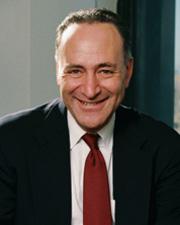
Serving · U.S. Senate · New York
Chuck Schumer
U.S. Senator from New York · 1999–present · Democratic · Class 3
Chuck Schumer represents New York in the United States Senate (1999–present) for the Democratic party. The page below collects sourced biographical facts, term history, committee roles, and provenance for Schumer.
Bioguide ID: S000148
Key facts
- Full name
- Chuck Schumer
- State
- New York
- Party
- Democratic
- Senate class
- Class III
- Senate service
- 1999–present
- First Senate term
- 1999
- Status
- Currently serving
- Current term ends
- 2029
- Born
- 1950
- Bioguide ID
- S000148
- Committee assignments
- 2
- Dataset version
- 1.20260601-4
Biographical narrative
999 words · sourced from the Wikipedia REST extract
Charles E. Schumer is an American politician currently serving as a United States Senator from New York. A member of the Democratic Party, he has been in office since 1999 and has held various leadership positions, including Senate majority leader from 2021 to 2025. Schumer is recognized for his extensive legislative experience and leadership within the Senate, where he has played a significant role in shaping policy and advancing the Democratic agenda. He is the longest-serving U.S. senator from New York and the dean of the state's congressional delegation.
Early life and career
Charles Ellis Schumer was born on November 23, 1950, in the Midwood neighborhood of Brooklyn, New York. He is the son of Selma and Abraham Schumer, with his father managing an exterminating business while his mother was a homemaker. Schumer's family is Jewish, and he has roots tracing back to Chortkiv, Galicia, in present-day Ukraine. He is also related to comedian Amy Schumer as a second cousin, once removed.
Schumer's education began in the public schools of Brooklyn, where he excelled academically. He graduated as the valedictorian of James Madison High School in 1967, achieving a perfect score of 1600 on the SAT. During his high school years, he participated in the television quiz show "It's Academic," showcasing his knowledge and quick thinking.
Following high school, Schumer attended Harvard College, initially majoring in chemistry. However, after engaging in volunteer work for Eugene McCarthy's presidential campaign in 1968, he shifted his focus to social studies. He graduated magna cum laude and was inducted into Phi Beta Kappa in 1971. Schumer continued his education at Harvard Law School, where he earned his Juris Doctor with honors in 1974. Although he passed the New York state bar exam in early 1975, he chose not to practice law, instead pursuing a career in politics.
Schumer's political career began in 1974 when he ran for and was elected to the New York State Assembly. He filled a seat that had previously been held by his mentor, U.S. Representative Stephen Solarz. Schumer served three terms in the Assembly from 1975 to 1981, participating in the 181st, 182nd, and 183rd New York State Legislatures.
In 1980, after Elizabeth Holtzman secured the Democratic nomination for the Senate seat held by Republican Jacob Javits, Schumer ran for Holtzman's vacated House seat. He won the election and was subsequently reelected eight times, representing a district that underwent redistricting during his tenure. Initially, he served New York's 16th congressional district from 1981 to 1983, then the 10th district until 1993, and finally the 9th district until 1999. Throughout his time in the House, Schumer established a reputation for his legislative work, including introducing the Religious Freedom Restoration Act in 1993. He also served on the House Judiciary Committee, where he was involved in significant investigations, including the hearings related to the Waco siege in 1995.
Senate tenure
In 1998, Schumer transitioned to the U.S. Senate, winning the Democratic primary with a plurality of the vote. He defeated three-term incumbent Republican Al D'Amato in the general election, marking the beginning of his long tenure in the Senate. Schumer's first term commenced in January 1999, and he has since been reelected multiple times, solidifying his position as a prominent figure in New York politics.
In 2001, Schumer became New York's senior senator following the retirement of Daniel Patrick Moynihan. His influence grew within the Senate, and he took on various leadership roles, including chairing the Democratic Senatorial Campaign Committee from 2005 to 2009. During his tenure in this role, he oversaw significant Democratic gains in the Senate during the 2006 and 2008 elections.
Schumer's leadership capabilities were further recognized when he was elected as the Vice Chair of the Democratic Caucus in the Senate from 2007 to 2017. He also chaired the Senate Democratic Policy Committee from 2011 to 2017. In 2016, he was reelected for a fourth Senate term, and upon the retirement of Harry Reid, he was unanimously elected as the Democratic leader of the Senate.
In January 2021, Schumer ascended to the position of Senate majority leader, making history as the first Jewish individual to hold this role. His leadership during this period was marked by the passage of several significant legislative initiatives aligned with the Biden administration's agenda. These included the American Rescue Plan Act of 2021, the Infrastructure Investment and Jobs Act, and the Inflation Reduction Act of 2022, among others. Under his stewardship, the Senate confirmed a record number of federal judges, including the first African American woman to serve on the Supreme Court.
Legislative focus and committees
Throughout his Senate career, Schumer has focused on a wide range of legislative issues, reflecting the diverse interests of his constituents in New York. His work has often centered on economic development, healthcare, and social justice, aligning with broader Democratic priorities. Schumer has been an advocate for policies aimed at improving the lives of working families, enhancing access to healthcare, and addressing climate change.
In addition to his legislative initiatives, Schumer has played a crucial role in various Senate committees, contributing to discussions and decisions that shape national policy. His experience in the House of Representatives and his leadership roles within the Senate have equipped him with the skills necessary to navigate complex legislative challenges.
As a senior member of the Senate, Schumer has also been involved in bipartisan efforts, working with colleagues across the aisle to address pressing national issues. His ability to build coalitions and foster dialogue has been a hallmark of his approach to governance.
Schumer's tenure in the Senate has been characterized by a commitment to public service and a focus on the needs of his constituents. As he continues to serve in the Senate, he remains a prominent figure in American politics, representing New York and influencing national policy through his leadership and legislative efforts. His current term is set to conclude on January 3, 2029, marking a significant chapter in his long and impactful political career.
Committees & roles
- Senate Select Committee on IntelligenceEx Officio · since 2025
- Senate Committee on Rules and AdministrationMember · since 2025
Notable legislation
Sponsored and co-sponsored legislation for Chuck Schumer is pending operator curation. The biographical narrative above carries the same provenance trail until per-bill rows are written.
Sources
- [1]https://en.wikipedia.org/wiki/Chuck_SchumerWikipedia · retrieved 2026-06-01
Notable quotes
Sourced quotes for Chuck Schumer are pending operator curation. Narrative-scope provenance remains attached below.
Sources
- [1]https://en.wikipedia.org/wiki/Chuck_SchumerWikipedia · retrieved 2026-06-01
Key positions
Curated policy positions for Chuck Schumer are pending operator review. The biographical narrative above carries the same provenance trail until per-topic positions are written.
Sources
- [1]https://en.wikipedia.org/wiki/Chuck_SchumerWikipedia · retrieved 2026-06-01
Terms served
- 1981–1983U.S. House · District 16 · Term 1 · Democratic
- 1983–1985U.S. House · District 10 · Term 2 · Democratic
- 1985–1987U.S. House · District 10 · Term 3 · Democratic
- 1987–1989U.S. House · District 10 · Term 4 · Democratic
- 1989–1991U.S. House · District 10 · Term 5 · Democratic
- 1991–1993U.S. House · District 10 · Term 6 · Democratic
- 1993–1995U.S. House · District 9 · Term 7 · Democratic
- 1995–1997U.S. House · District 9 · Term 8 · Democratic
- 1997–1999U.S. House · District 9 · Term 9 · Democratic
- 1999–2005U.S. Senate · Term 10 · Democratic · Class III
- 2005–2011U.S. Senate · Term 11 · Democratic · Class III
- 2011–2017U.S. Senate · Term 12 · Democratic · Class III
- 2017–2023U.S. Senate · Term 13 · Democratic · Class III
- 2023–2029U.S. Senate · Term 14 · Democratic · Class III
Sources & provenance
Every attributable claim above carries a per-section [N] marker that resolves to the corresponding URL below. Each entry records the upstream provider, the canonical URL, and the timestamp at which the source was retrieved by the ingest pipeline.
Key facts
- https://bioguide.congress.gov/search/bio/S000148bioguide · retrieved 2026-06-01
- https://www.schumer.senate.gov/senate.gov · retrieved 2026-06-01
Biographical narrative
- https://en.wikipedia.org/wiki/Chuck_Schumerwikipedia · retrieved 2026-06-01
Find your senator
Every U.S. state elects two senators. Browse New York’s delegation, the full currently-serving-senator roster, or explore the role and term length.
Related on The Candidate
- Kirsten GillibrandServing U.S. Senator from New York · DemocraticOpen
- Democratic PartyFederal candidates and office holders on the Democratic line.Open
- Senators from New YorkEvery currently-serving U.S. Senator who has represented New York.Open
- All serving senatorsEvery individual currently serving in the United States Senate, grouped by state.Open
- U.S. SenateRole, term length, qualifications, and the full Senate candidate directory.Open