
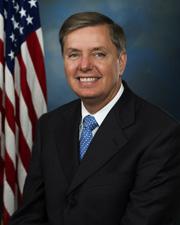
Serving · U.S. Senate · South Carolina
Lindsey Graham
U.S. Senator from South Carolina · 2003–present · Republican · Class 2
Lindsey Graham represents South Carolina in the United States Senate (2003–present) for the Republican party. The page below collects sourced biographical facts, term history, committee roles, and provenance for Graham.
Bioguide ID: G000359
Key facts
- Full name
- Lindsey Graham
- State
- South Carolina
- Party
- Republican
- Senate class
- Class II
- Senate service
- 2003–present
- First Senate term
- 2003
- Status
- Currently serving
- Current term ends
- 2027
- Born
- 1955
- Bioguide ID
- G000359
- Committee assignments
- 4
- Dataset version
- 1.20260601-4
Biographical narrative
948 words · sourced from the Wikipedia REST extract
Lindsey Olin Graham is an American politician and attorney currently serving as the senior United States senator from South Carolina. A member of the Republican Party, he has held this position since 2003 and is recognized for his involvement in various legislative matters, particularly in foreign policy and judicial nominations. Graham has also held significant roles within the Senate, including chairing the Senate Committee on the Judiciary from 2019 to 2021. His career spans multiple terms in Congress, including service in the U.S. House of Representatives and the South Carolina House of Representatives.
Early life and career
Lindsey Graham was born on July 9, 1955, in Central, South Carolina. He grew up in a family that owned and operated a restaurant, bar, pool hall, and liquor store known as the Sanitary Cafe. His family has Scots-Irish roots. Graham attended D. W. Daniel High School and became the first member of his family to pursue higher education. He enrolled in the Reserve Officers' Training Corps (ROTC) during his college years.
Graham faced personal tragedy early in his life when his mother passed away from Hodgkin's lymphoma when he was 21 years old. His father died 15 months later from a heart attack. Following these events, Graham became the legal guardian of his younger sister, who was only 13 at the time. This responsibility influenced his decision to attend the University of South Carolina in Columbia, allowing him to stay close to home. He graduated with a Bachelor of Arts degree in psychology in 1977 and later earned a Juris Doctor from the University of South Carolina School of Law in 1981.
After completing his law degree, Graham was commissioned as an officer in the Judge Advocate General's Corps (JAG Corps) of the United States Air Force in 1982. He began his military career as a defense attorney and later served as the chief prosecutor in Europe from 1984 to 1988, stationed at Rhein-Main Air Base in Frankfurt, Germany. During this time, he gained media attention for his involvement in a case that highlighted flaws in the Air Force's drug-testing procedures.
Upon returning to South Carolina in 1989, Graham transitioned to private legal practice. He served as the assistant county attorney for Oconee County from 1988 to 1992 and as the city attorney for Central from 1990 to 1994. In 1989, he joined the South Carolina Air National Guard, continuing his military service until 1995, after which he joined the U.S. Air Force Reserve.
Graham was recalled to active duty during the Gulf War, where he served as a judge advocate at McEntire Air National Guard Station. He was later promoted to lieutenant colonel in 1998 and to colonel in 2004. His military career included service in Iraq and Afghanistan, where he worked on detainee and rule-of-law issues. In recognition of his service, he received a Bronze Star medal in 2014 for his role as a senior legal adviser to the Air Force.
Senate tenure
Lindsey Graham's political career began in the South Carolina House of Representatives, where he served from 1993 to 1995. He then moved to the U.S. House of Representatives, representing South Carolina's 3rd congressional district from 1995 until 2003. In 2002, Graham was elected to the U.S. Senate, succeeding retiring Senator Fritz Hollings. He has been re-elected multiple times since then, with his current term set to end on January 3, 2027.
During his time in the Senate, Graham has been involved in various legislative initiatives and has established himself as a prominent figure within the Republican Party. His tenure has included significant involvement in foreign policy, where he has advocated for interventionist strategies and increased defense spending. He has also been known for his willingness to collaborate with Democrats on certain issues, such as immigration reform and judicial nominations.
Graham's political journey has seen him navigate various political landscapes, including his candidacy for the Republican nomination in the 2016 U.S. presidential election, although he withdrew before the primaries commenced. His relationship with former President Donald Trump evolved over time; initially a critic, Graham became a notable ally following a meeting with Trump in 2017. This shift has been marked by Graham's support for Trump's foreign policy initiatives and military interventions.
Legislative focus and committees
Throughout his Senate career, Lindsey Graham has focused on a range of legislative issues, with a particular emphasis on foreign policy, national security, and judicial matters. As a member of the Senate Committee on the Judiciary, which he chaired from 2019 to 2021, Graham played a crucial role in overseeing judicial nominations, including those for the Supreme Court. His leadership in this committee has been characterized by a commitment to advancing conservative judicial philosophies.
Graham has been an outspoken advocate for a strong military presence and interventionist foreign policy, often emphasizing the importance of U.S. engagement in global affairs. His positions reflect a neoconservative ideology, advocating for proactive measures to address international conflicts and security challenges. He has been involved in discussions surrounding military funding and has consistently supported initiatives aimed at enhancing the capabilities of the U.S. armed forces.
In addition to his work on foreign policy, Graham has engaged in bipartisan efforts on various domestic issues, including immigration reform and environmental policies such as cap and trade. His willingness to collaborate with members of the opposing party has sometimes drawn both support and criticism from different factions within the Republican Party.
As of now, Graham is preparing for his re-election campaign in 2026, continuing his long-standing commitment to public service and legislative engagement. His career reflects a blend of military experience, legal expertise, and political acumen, positioning him as a significant figure in contemporary American politics.
Committees & roles
- Senate Committee on the BudgetChair · since 2025
- Senate Committee on AppropriationsMember · since 2025
- Senate Committee on Environment and Public WorksMember · since 2025
- Senate Committee on the JudiciaryMember · since 2025
Notable legislation
Sponsored and co-sponsored legislation for Lindsey Graham is pending operator curation. The biographical narrative above carries the same provenance trail until per-bill rows are written.
Sources
- [1]https://en.wikipedia.org/wiki/Lindsey_GrahamWikipedia · retrieved 2026-06-01
Notable quotes
Sourced quotes for Lindsey Graham are pending operator curation. Narrative-scope provenance remains attached below.
Sources
- [1]https://en.wikipedia.org/wiki/Lindsey_GrahamWikipedia · retrieved 2026-06-01
Key positions
Curated policy positions for Lindsey Graham are pending operator review. The biographical narrative above carries the same provenance trail until per-topic positions are written.
Sources
- [1]https://en.wikipedia.org/wiki/Lindsey_GrahamWikipedia · retrieved 2026-06-01
Terms served
- 1995–1997U.S. House · District 3 · Term 1 · Republican
- 1997–1999U.S. House · District 3 · Term 2 · Republican
- 1999–2001U.S. House · District 3 · Term 3 · Republican
- 2001–2003U.S. House · District 3 · Term 4 · Republican
- 2003–2009U.S. Senate · Term 5 · Republican · Class II
- 2009–2015U.S. Senate · Term 6 · Republican · Class II
- 2015–2021U.S. Senate · Term 7 · Republican · Class II
- 2021–2027U.S. Senate · Term 8 · Republican · Class II
Sources & provenance
Every attributable claim above carries a per-section [N] marker that resolves to the corresponding URL below. Each entry records the upstream provider, the canonical URL, and the timestamp at which the source was retrieved by the ingest pipeline.
Key facts
- https://bioguide.congress.gov/search/bio/G000359bioguide · retrieved 2026-06-01
- https://www.lgraham.senate.gov/senate.gov · retrieved 2026-06-01
Biographical narrative
- https://en.wikipedia.org/wiki/Lindsey_Grahamwikipedia · retrieved 2026-06-01
Find your senator
Every U.S. state elects two senators. Browse South Carolina’s delegation, the full currently-serving-senator roster, or explore the role and term length.
Related on The Candidate
- Tim ScottServing U.S. Senator from South Carolina · RepublicanOpen
- Republican PartyFederal candidates and office holders on the Republican line.Open
- Senators from South CarolinaEvery currently-serving U.S. Senator who has represented South Carolina.Open
- All serving senatorsEvery individual currently serving in the United States Senate, grouped by state.Open
- U.S. SenateRole, term length, qualifications, and the full Senate candidate directory.Open