
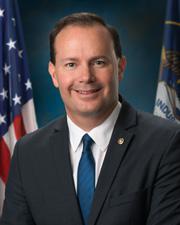
Serving · U.S. Senate · Utah
Mike Lee
U.S. Senator from Utah · 2011–present · Republican · Class 3
Mike Lee represents Utah in the United States Senate (2011–present) for the Republican party. The page below collects sourced biographical facts, term history, committee roles, and provenance for Lee.
Bioguide ID: L000577
Key facts
- Full name
- Mike Lee
- State
- Utah
- Party
- Republican
- Senate class
- Class III
- Senate service
- 2011–present
- First Senate term
- 2011
- Status
- Currently serving
- Current term ends
- 2029
- Born
- 1971
- Bioguide ID
- L000577
- Committee assignments
- 4
- Dataset version
- 1.20260601-4
Biographical narrative
1,003 words · sourced from the Wikipedia REST extract
Michael Shumway Lee is an American lawyer and politician currently serving as the senior United States senator from Utah. A member of the Republican Party, he has held this position since 2011 and has been the senior senator from Utah since 2019. Lee is recognized as the dean of Utah's congressional delegation, a title he has held since 2021. Throughout his tenure, he has been involved in various legislative activities and has served on multiple committees, reflecting his engagement in national policy discussions.
Early life and career
Mike Lee was born on June 4, 1971, in Mesa, Arizona, to Janet and Rex E. Lee. His father, Rex E. Lee, served as the U.S. Solicitor General under President Ronald Reagan, which likely influenced Mike's early interest in law and politics. The family relocated to Provo, Utah, when Mike was just a year old, as his father became the founding dean of the J. Reuben Clark Law School at Brigham Young University (BYU). Lee spent a significant portion of his childhood in Utah, but he also lived in McLean, Virginia, a suburb of Washington, D.C., for part of his upbringing. This exposure to both Utah and the nation's capital may have shaped his political perspectives.
Lee's educational journey began at Timpview High School, where he graduated in 1989. He then attended BYU, where he earned a Bachelor of Arts degree in political science in 1994. During his time at BYU, he was active in student government, serving as president of the students' association while his father was the university president. Following his undergraduate studies, he pursued a Juris Doctor degree at BYU's J. Reuben Clark Law School, where he contributed to the BYU Law Review and graduated in 1997.
After completing his legal education, Lee began his career in law by clerking for Judge Dee Benson of the U.S. District Court for the District of Utah from 1997 to 1998. He then clerked for Samuel Alito, who was a judge on the U.S. Court of Appeals for the Third Circuit at that time, from 1998 to 1999. Following his clerkships, Lee entered private practice at the law firm Sidley Austin in Washington, D.C., where he specialized in appellate and Supreme Court litigation.
In 2002, Lee returned to Utah to serve as an assistant U.S. attorney, where he prepared legal briefs and argued cases before the U.S. Court of Appeals for the Tenth Circuit. His legal career continued as he served as general counsel to Utah Governor Jon Huntsman Jr. from 2005 to 2006. Lee returned to clerking for Alito after Alito's appointment to the U.S. Supreme Court, working in this capacity from 2006 to 2007. Afterward, he resumed private practice in Utah, joining the Salt Lake City office of the law firm Howrey LLP.
During his legal practice, Lee represented EnergySolutions Inc., a provider of Class A low-level radioactive waste facilities, in a notable dispute regarding the storage of radioactive waste in Utah. The controversy arose when the company sought to store waste from Italy, leading to public objections and legal challenges. Lee argued that the U.S. Constitution's Commerce Clause permitted the acceptance of foreign waste and that the waste could be reduced in grade by mixing it with lower-grade materials. Ultimately, EnergySolutions abandoned its plans to store the foreign waste, and the legal dispute was resolved with a ruling from the 10th U.S. Circuit Court.
Senate tenure
Mike Lee's political career in the U.S. Senate began when he ran for office in 2010. His campaign focused on issues such as the size of the federal government and proposed amendments to the U.S. Constitution aimed at establishing a flat tax system and imposing term limits on members of Congress. At the Republican State Convention, he garnered significant support, receiving 28.75% of the votes on the first ballot, which placed him in a competitive position for the primary election.
Lee successfully secured the Republican nomination in the June 2010 primary election, winning with 51% of the vote against Tim Bridgewater. He then advanced to the general election, where he won decisively, receiving 62% of the votes against Democratic nominee Sam Granato and Constitution Party nominee Scott Bradley.
In the 2016 election, Lee was reelected to the Senate, receiving endorsements from various conservative organizations, including the Club for Growth and the Senate Conservatives Fund. His reelection campaign emphasized his commitment to conservative principles and fiscal responsibility.
Lee's most recent reelection came in 2022, where he faced challengers in the Republican primary, including Becky Edwards and Ally Isom. His campaign strategies and positions continued to reflect his longstanding political beliefs and priorities, ultimately leading to his victory.
Legislative focus and committees
Throughout his Senate career, Mike Lee has focused on a range of legislative issues, particularly those aligned with conservative values. He has been an advocate for limited government, fiscal responsibility, and constitutional adherence. His legislative agenda has included efforts to reform the tax system, reduce federal spending, and impose term limits on Congress.
In addition to his legislative initiatives, Lee has served on several important Senate committees. Notably, he chaired the Joint Economic Committee from 2019 to 2021, where he contributed to discussions on economic policy and fiscal matters. His role on this committee allowed him to engage with various economic issues, including taxation, government spending, and economic growth strategies.
Lee's involvement in the Senate has also included participation in discussions surrounding national security, healthcare, and education policy. His positions often reflect a commitment to conservative principles, advocating for policies that he believes will benefit Utah and the nation as a whole.
As a senior senator, Lee has played a significant role in representing Utah's interests at the national level. His tenure has been marked by a consistent focus on issues important to his constituents, as well as a commitment to the principles of the Republican Party. With his current term set to end in January 2029, Lee continues to be an influential figure in the U.S. Senate, shaping policy discussions and legislative outcomes.
Committees & roles
- Senate Committee on Energy and Natural ResourcesChair · since 2025
- Senate Committee on Foreign RelationsMember · since 2025
- Senate Committee on the BudgetMember · since 2025
- Senate Committee on the JudiciaryMember · since 2025
Notable legislation
Sponsored and co-sponsored legislation for Mike Lee is pending operator curation. The biographical narrative above carries the same provenance trail until per-bill rows are written.
Sources
- [1]https://en.wikipedia.org/wiki/Mike_LeeWikipedia · retrieved 2026-06-01
Notable quotes
Sourced quotes for Mike Lee are pending operator curation. Narrative-scope provenance remains attached below.
Sources
- [1]https://en.wikipedia.org/wiki/Mike_LeeWikipedia · retrieved 2026-06-01
Key positions
Curated policy positions for Mike Lee are pending operator review. The biographical narrative above carries the same provenance trail until per-topic positions are written.
Sources
- [1]https://en.wikipedia.org/wiki/Mike_LeeWikipedia · retrieved 2026-06-01
Terms served
- 2011–2017U.S. Senate · Term 1 · Republican · Class III
- 2017–2023U.S. Senate · Term 2 · Republican · Class III
- 2023–2029U.S. Senate · Term 3 · Republican · Class III
Sources & provenance
Every attributable claim above carries a per-section [N] marker that resolves to the corresponding URL below. Each entry records the upstream provider, the canonical URL, and the timestamp at which the source was retrieved by the ingest pipeline.
Key facts
- https://bioguide.congress.gov/search/bio/L000577bioguide · retrieved 2026-06-01
- https://www.lee.senate.gov/senate.gov · retrieved 2026-06-01
Biographical narrative
- https://en.wikipedia.org/wiki/Mike_Leewikipedia · retrieved 2026-06-01
Find your senator
Every U.S. state elects two senators. Browse Utah’s delegation, the full currently-serving-senator roster, or explore the role and term length.
Related on The Candidate
- John CurtisServing U.S. Senator from Utah · RepublicanOpen
- Republican PartyFederal candidates and office holders on the Republican line.Open
- Senators from UtahEvery currently-serving U.S. Senator who has represented Utah.Open
- All serving senatorsEvery individual currently serving in the United States Senate, grouped by state.Open
- U.S. SenateRole, term length, qualifications, and the full Senate candidate directory.Open