
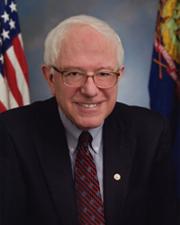
Serving · U.S. Senate · Vermont
Bernie Sanders
U.S. Senator from Vermont · 2007–present · Independent · Class 1
Bernie Sanders represents Vermont in the United States Senate (2007–present) for the Independent party. The page below collects sourced biographical facts, term history, committee roles, and provenance for Sanders.
Bioguide ID: S000033
Key facts
- Full name
- Bernie Sanders
- State
- Vermont
- Party
- Independent
- Senate class
- Class I
- Senate service
- 2007–present
- First Senate term
- 2007
- Status
- Currently serving
- Current term ends
- 2031
- Born
- 1941
- Bioguide ID
- S000033
- Committee assignments
- 5
- Dataset version
- 1.20260601-4
Biographical narrative
991 words · sourced from the Wikipedia REST extract
Bernard Sanders is an American politician and activist currently serving as the senior United States senator from Vermont. He has held this position since 2007 and is recognized as the longest-serving independent in the history of the U.S. Congress. Although he identifies as an independent, Sanders has maintained a close relationship with the Democratic Party, often caucusing with its members. He is known for his democratic socialist ideology and is considered a prominent figure in the modern American progressive movement. Throughout his political career, Sanders has focused on issues such as healthcare, education, and economic inequality.
Early life and career
Bernard Sanders was born on September 8, 1941, in Brooklyn, New York City. He was raised in a working-class Jewish family; his father, Elias Ben Yehuda Sanders, immigrated from Poland in 1921 and worked as a paint salesman. His mother, Dorothy Sanders, was born in New York City. Sanders has one older brother, Larry Sanders. The family's experiences during World War II, particularly the loss of relatives in the Holocaust, significantly influenced Sanders's political views and interests.
Growing up in the Midwood neighborhood of Brooklyn, Sanders attended P.S. 197 for elementary school, where he excelled in basketball, winning a borough championship. He also attended Hebrew school and celebrated his bar mitzvah in 1954. While his family was able to provide basic necessities, they often struggled with larger expenses, which shaped Sanders's understanding of economic hardship. He later attended James Madison High School, where he was the captain of the track team and participated in various fundraising activities, including organizing a charity basketball game for Korean War orphans. Despite his early interest in politics, Sanders faced a setback when he lost his first election for student body president.
After graduating high school, Sanders studied at Brooklyn College for a year before transferring to the University of Chicago, where he earned a Bachelor of Arts degree in political science in 1964. His time at the university was marked by significant political engagement; he joined the Young People's Socialist League and became actively involved in the civil rights movement. Sanders worked with organizations such as the Congress of Racial Equality (CORE) and the Student Nonviolent Coordinating Committee (SNCC), where he played a key role in merging the university chapters of these groups. He described this period as a transformative time in his life, filled with intellectual growth and activism.
Following his graduation, Sanders settled in Vermont in 1968. He initially ran for political office in the 1970s as a third-party candidate, although these early campaigns were unsuccessful. His political career gained traction when he was elected mayor of Burlington in 1981 as an independent. He was subsequently reelected three times, during which he implemented various progressive policies and initiatives that garnered local support.
Senate tenure
Bernard Sanders was elected to the U.S. House of Representatives in 1990, representing Vermont's at-large congressional district. During his time in the House, he co-founded the Congressional Progressive Caucus in 1991, which aimed to promote progressive policies and legislation. Sanders served as a U.S. representative for 16 years before successfully running for the U.S. Senate in 2006. His election marked a historic moment, as he became the first non-Republican to hold Vermont's Class 1 Senate seat since 1850.
Sanders's Senate career began in 2007, and he has since been reelected multiple times, with his current term set to end on January 3, 2031. As a senator, he has held various leadership positions, including chairing the Senate Veterans' Affairs Committee from 2013 to 2015, the Senate Budget Committee from 2021 to 2023, and the Senate Health, Education, Labor and Pensions Committee from 2023 to 2025. He is recognized as the senior senator and dean of the Vermont congressional delegation, reflecting his long-standing influence in the state's political landscape.
Throughout his Senate tenure, Sanders has been a vocal advocate for progressive policies, often aligning with the Democratic Party on key issues. His campaigns for the Democratic presidential nomination in 2016 and 2020 garnered significant attention and support, particularly among younger voters. In 2016, his campaign was notable for its grassroots enthusiasm and funding from small-dollar donors, leading him to win numerous primaries and caucuses. In 2020, he emerged as a front-runner in a crowded field of Democratic candidates, further solidifying his position as a leading voice for progressive change.
Legislative focus and committees
Bernard Sanders's legislative focus has consistently centered on issues of economic inequality, healthcare, education, and workers' rights. He is a strong proponent of universal and single-payer healthcare, advocating for policies that would ensure access to medical services for all Americans. Additionally, he supports tuition-free higher education and paid parental leave, aiming to alleviate the financial burdens faced by families and students.
Sanders has been a prominent advocate for a Green New Deal, which seeks to address climate change while creating jobs and promoting sustainable economic practices. He emphasizes the importance of worker control and self-management in the economy, supporting cooperatives, unions, and democratic public enterprises as means to empower workers and reduce corporate influence.
On foreign policy, Sanders has called for a reduction in military spending and a greater emphasis on diplomacy and international cooperation. He advocates for labor rights and environmental considerations to be prioritized in international trade agreements, reflecting his commitment to social justice and sustainability on a global scale.
Throughout his Senate career, Sanders has served on various committees, including the Senate Veterans' Affairs Committee, the Senate Budget Committee, and the Senate Health, Education, Labor and Pensions Committee. His leadership roles in these committees have allowed him to shape significant legislation and influence policy discussions on critical issues affecting the nation.
In summary, Bernard Sanders's political career has been characterized by a commitment to progressive values and advocacy for marginalized communities. His long tenure in public service, beginning with local government and extending to the national stage, has established him as a key figure in American politics, particularly within the progressive movement.
Committees & roles
- Senate Committee on Health, Education, Labor, and PensionsRanking Member · since 2025
- Senate Committee on Environment and Public WorksMember · since 2025
- Senate Committee on FinanceMember · since 2025
- Senate Committee on the BudgetMember · since 2025
- Senate Committee on Veterans' AffairsMember · since 2025
Notable legislation
Sponsored and co-sponsored legislation for Bernie Sanders is pending operator curation. The biographical narrative above carries the same provenance trail until per-bill rows are written.
Sources
- [1]https://en.wikipedia.org/wiki/Bernie_SandersWikipedia · retrieved 2026-06-01
Notable quotes
Sourced quotes for Bernie Sanders are pending operator curation. Narrative-scope provenance remains attached below.
Sources
- [1]https://en.wikipedia.org/wiki/Bernie_SandersWikipedia · retrieved 2026-06-01
Key positions
Curated policy positions for Bernie Sanders are pending operator review. The biographical narrative above carries the same provenance trail until per-topic positions are written.
Sources
- [1]https://en.wikipedia.org/wiki/Bernie_SandersWikipedia · retrieved 2026-06-01
Terms served
- 1991–1993U.S. House · District 0 · Term 1 · Independent
- 1993–1995U.S. House · District 0 · Term 2 · Independent
- 1995–1997U.S. House · District 0 · Term 3 · Independent
- 1997–1999U.S. House · District 0 · Term 4 · Independent
- 1999–2001U.S. House · District 0 · Term 5 · Independent
- 2001–2003U.S. House · District 0 · Term 6 · Independent
- 2003–2005U.S. House · District 0 · Term 7 · Independent
- 2005–2007U.S. House · District 0 · Term 8 · Independent
- 2007–2013U.S. Senate · Term 9 · Independent · Class I
- 2013–2019U.S. Senate · Term 10 · Independent · Class I
- 2019–2025U.S. Senate · Term 11 · Independent · Class I
- 2025–2031U.S. Senate · Term 12 · Independent · Class I
Sources & provenance
Every attributable claim above carries a per-section [N] marker that resolves to the corresponding URL below. Each entry records the upstream provider, the canonical URL, and the timestamp at which the source was retrieved by the ingest pipeline.
Key facts
- https://bioguide.congress.gov/search/bio/S000033bioguide · retrieved 2026-06-01
- https://www.sanders.senate.gov/senate.gov · retrieved 2026-06-01
Biographical narrative
- https://en.wikipedia.org/wiki/Bernie_Sanderswikipedia · retrieved 2026-06-01
Find your senator
Every U.S. state elects two senators. Browse Vermont’s delegation, the full currently-serving-senator roster, or explore the role and term length.
Related on The Candidate
- Peter WelchServing U.S. Senator from Vermont · DemocraticOpen
- Independent PartyFederal candidates and office holders on the Independent line.Open
- Senators from VermontEvery currently-serving U.S. Senator who has represented Vermont.Open
- All serving senatorsEvery individual currently serving in the United States Senate, grouped by state.Open
- U.S. SenateRole, term length, qualifications, and the full Senate candidate directory.Open