
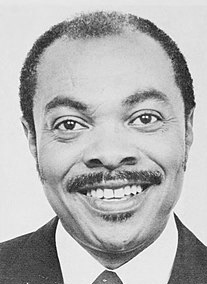
Former · State Senate · Massachusetts
Bill Owens
Former State Senator · Massachusetts · senate-s-second-suffolk · Democratic
Bill Owens served as a State Senator in the Massachusetts State Senate, representing senate-s-second-suffolk for the Democratic party. The page below collects sourced biographical facts, the seat and district served, and provenance for Owens.
Key facts
- Full name
- Bill Owens
- Office
- State Senator
- Chamber
- Massachusetts State Senate
- State
- Massachusetts
- District
- senate-s-second-suffolk
- Party
- Democratic
- Status
- Left office
- Born
- 1937
- OpenStates ID
- —
- Dataset version
- 1.20260610
Biographical narrative
873 words · sourced from the Wikipedia REST extract
William Owens was an influential American politician and businessman who served as a member of the Massachusetts State Senate. He is recognized as the first Black state senator in the history of the Massachusetts State Senate. His political career spanned multiple decades, during which he held significant positions and contributed to various legislative initiatives focused on racial justice and economic equity.
Early life and career
William Owens was born on July 6, 1937, in Demopolis, Alabama. He spent his formative years in Boston, Massachusetts, where he attended the English High School of Boston. After completing high school, Owens pursued higher education at several institutions, including Boston University, Harvard University, and the University of Massachusetts Amherst. His academic background provided him with a strong foundation for his future endeavors in both business and politics.
Before entering the political arena, Owens worked as a private consultant and resided in Mattapan, a neighborhood in Boston. His early career experiences likely shaped his understanding of the challenges faced by his community, particularly regarding issues of race and economic opportunity. This understanding would later inform his legislative priorities and initiatives.
Owens's political career began in the Massachusetts House of Representatives, where he served from 1973 to 1975 as a member of the Democratic Party. His tenure in the House set the stage for his subsequent election to the Massachusetts State Senate, where he would make history as the first Black senator in the state.
Legislative service
Owens's transition to the Massachusetts Senate occurred after the establishment of a majority-Black State Senate seat in South Boston. He successfully ran for this seat, defeating incumbent Royal L. Bolling. His first term in the Senate began in 1974 and lasted until 1982, during which he was involved in various legislative efforts aimed at improving the lives of his constituents.
In the early 1980s, Owens made a significant political shift by changing his party affiliation from Democrat to Republican. This decision was largely influenced by his frustrations with the Democratic Party's handling of issues related to racial justice and economic equity. He perceived the State Senate as being tightly controlled and felt that the Democratic leadership was not adequately addressing the needs of marginalized communities.
Following his party switch, Owens faced a challenging re-election campaign against Royal L. Bolling, who had regained his position as a formidable opponent. Owens lost this rematch, prompting him to return to the Democratic Party. He subsequently won a second term in the Massachusetts Senate, serving from 1989 to 1993. During this period, he continued to advocate for policies that aligned with his commitment to social justice and economic opportunity.
Owens's legislative contributions included the creation of the Massachusetts Office of Minority Business Assistance, which aimed to support minority-owned businesses in the state. He also played a role in establishing the Summer Youth Jobs Program, which provided employment opportunities for young people during the summer months. Additionally, Owens was a proponent of gun control measures and sponsored legislation that sought to address the historical injustices faced by Black Americans. Notably, in the 1980s, he introduced a bill that would have required the state government to pay reparations to the descendants of enslaved Black Americans in Massachusetts.
Despite his significant contributions, Owens's final term in the Senate concluded when he lost the 1992 Democratic primary to Dianne Wilkerson, who succeeded him in office. His legislative career, marked by two distinct terms, reflects his dedication to public service and advocacy for marginalized communities.
Policy focus and district
Throughout his legislative career, Owens focused on a range of policy issues that were particularly relevant to the communities he represented. His work in the Massachusetts Senate was characterized by a commitment to racial justice, economic equity, and support for minority businesses. The establishment of the Massachusetts Office of Minority Business Assistance is a testament to his efforts to create opportunities for minority entrepreneurs and to address systemic barriers to economic success.
Owens's advocacy for youth employment through the Summer Youth Jobs Program demonstrated his understanding of the importance of providing young people with meaningful work experiences. By facilitating job opportunities, he aimed to empower the next generation and help them build skills that would benefit them in the long term.
In addition to his focus on economic issues, Owens was also an advocate for gun control, reflecting his concern for public safety and the well-being of his constituents. His legislative initiatives were often informed by his personal experiences and the challenges faced by the communities he represented.
Owens's district, the Second Suffolk district, was significant in its demographic composition, and his election to the Massachusetts State Senate marked a historic moment for representation in the state. As the first Black state senator, Owens's presence in the Senate symbolized progress in the fight for racial equity and inclusion in Massachusetts politics.
William Owens passed away on January 22, 2022, after a battle with COVID-19. His legacy as a trailblazer in Massachusetts politics and his contributions to the advancement of racial justice and economic equity continue to be recognized and remembered. His sister, Shirley Owens-Hicks, also made her mark in politics, serving in the Massachusetts House of Representatives from 1987 to 2006, further highlighting the family's commitment to public service.
Notable legislation
Sponsored and co-sponsored legislation for Bill Owens is pending operator curation. The biographical narrative above carries the same provenance trail until per-bill rows are written.
Sources
- [1]https://en.wikipedia.org/wiki/Bill_Owens_(Massachusetts_politician)Wikipedia · retrieved 2026-06-10
Notable quotes
Sourced quotes for Bill Owens are pending operator curation. Narrative-scope provenance remains attached below.
Sources
- [1]https://en.wikipedia.org/wiki/Bill_Owens_(Massachusetts_politician)Wikipedia · retrieved 2026-06-10
Key positions
Curated policy positions for Bill Owens are pending operator review. The biographical narrative above carries the same provenance trail until per-topic positions are written.
Sources
- [1]https://en.wikipedia.org/wiki/Bill_Owens_(Massachusetts_politician)Wikipedia · retrieved 2026-06-10
Legislative service
- Massachusetts State Senatesenate-s-second-suffolk · Democratic
Sources & provenance
Every attributable claim above carries a per-section [N] marker that resolves to the corresponding URL below. Each entry records the upstream provider, the canonical URL, and the timestamp at which the source was retrieved by the ingest pipeline.
Key facts
- https://www.wikidata.org/wiki/Q48973580wikidata · retrieved 2026-06-10
- https://ballotpedia.org/Bill_Owensballotpedia · retrieved 2026-06-10
Biographical narrative
- https://en.wikipedia.org/wiki/Bill_Owens_(Massachusetts_politician)wikipedia · retrieved 2026-06-10
Explore the State Senate
Browse Massachusetts’s senate-s-second-suffolk seat, the full Massachusetts State Senate roster, or Massachusetts’s federal candidates.
Related on The Candidate
- Massachusetts senate-s-second-suffolkEvery member representing senate-s-second-suffolk in the Massachusetts State Senate.Open
- Massachusetts State SenateThe full roster of the Massachusetts State Senate, by district.Open
- Massachusetts legislatureBoth chambers of the Massachusetts state legislature.Open
- Massachusetts federal candidatesEvery 2026 federal House and Senate candidate in Massachusetts.Open