
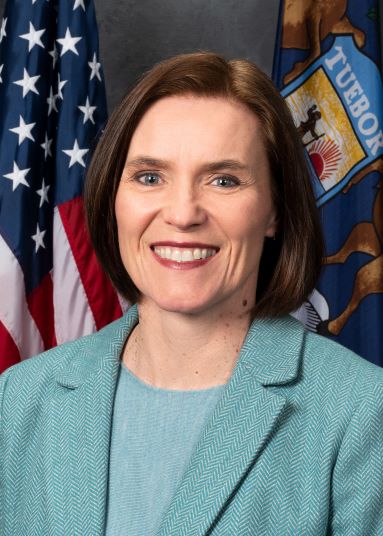
Serving · State Senate · Michigan
Winnie Brinks
State Senator · Michigan · District 29 · Democratic
Winnie Brinks serves as a State Senator in the Michigan State Senate, representing District 29 for the Democratic party. The page below collects sourced biographical facts, the seat and district served, and provenance for Brinks.
Key facts
- Full name
- Winnie Brinks
- Office
- State Senator
- Chamber
- Michigan State Senate
- State
- Michigan
- District
- District 29
- Party
- Democratic
- Status
- Currently serving
- Born
- 1968
- OpenStates ID
- ocd-person/de38477b-6f3e-44cd-96d0-bd81ff831948
- Dataset version
- 1.20260609
Biographical narrative
845 words · sourced from the Wikipedia REST extract
Winnie Brinks is an American politician currently serving as a member of the Michigan State Senate, representing the 29th district. A member of the Democratic Party, she has held her position since 2019 and was appointed as the Majority Leader of the Senate in January 2023, marking a significant milestone as the first woman to occupy this role. Prior to her tenure in the Senate, Brinks served in the Michigan House of Representatives from 2013 to 2018. Her career has been characterized by a focus on issues related to workforce development, education, health policy, and women's rights.
Early life and career
Winnie Brinks was born on February 17, 1968. She pursued her higher education at Calvin College, where she earned a bachelor's degree in Spanish. Following her graduation, Brinks engaged in various professional roles that laid the groundwork for her later political career. Notably, she served as the Executive Director of One Way House Inc., a residential facility dedicated to supporting non-violent female offenders. This role provided her with insights into the challenges faced by marginalized groups, particularly women, and informed her later legislative priorities.
In addition to her work at One Way House, Brinks also held a position as a caseworker at The Source, an organization focused on employee support. These experiences contributed to her understanding of social issues and the importance of community support systems, which would later influence her legislative agenda.
Brinks's entry into politics was somewhat unconventional. She was recruited to run for office after a significant political shift occurred in her district. Roy Schmidt, a Democratic representative, switched his party affiliation to Republican just before the filing deadline for re-election, leaving the Democratic Party without a candidate for the primary election. In response, Brinks ran as a write-in candidate, successfully garnering more than the required 1,000 votes to secure the Democratic nomination. She subsequently won the general election against Schmidt, marking the beginning of her political career.
Legislative service
Brinks began her legislative service in the Michigan House of Representatives, where she served from 2013 until 2018. During her time in the House, she was an active member of several committees, including Workforce and Talent Development, Education, Health Policy, and Tourism and Outdoor Recreation. Her involvement in these committees allowed her to address a range of issues pertinent to her constituents and the state of Michigan.
In 2014, Brinks was re-elected to the House, defeating her Republican opponent, Donijo DeJonge. She continued to serve in the House until 2018, when term limits prevented her from seeking re-election. Instead, she successfully ran for the Michigan Senate, representing the 29th district. In this election, she faced fellow state representative Chris Afendoulis, a Republican, as well as candidates from the Libertarian and Working Class parties. Brinks succeeded Dave Hildenbrand, a Republican who was vacating the seat due to term limits.
Upon her election to the Senate, Brinks took on the role of whip for the Democratic caucus, a leadership position she maintained until 2022. Her leadership skills and political acumen were recognized when, following the 2022 Michigan Senate election, the Democratic Party regained control of the Senate. Brinks was subsequently elected as the majority leader, becoming the first woman to hold this position in the history of the Michigan Senate.
Policy focus and district
As a legislator, Brinks has focused on a variety of policy areas, particularly those that impact working families, education, and civil rights. Her leadership as majority leader has seen her advocate for significant legislative changes. For instance, she voted in favor of repealing Michigan's right-to-work law, emphasizing the importance of attracting and retaining workers in the state. This legislative move was part of a broader discussion on how to create a favorable environment for job creators and workers alike.
In 2023, Brinks supported an expansion of the Elliott-Larsen Civil Rights Act to include protections against discrimination based on sexual orientation and gender identity. This vote reflects her commitment to advancing civil rights and ensuring equality for all individuals in Michigan.
Brinks has also taken a firm stance on issues related to youth and education. In 2025, when the Michigan House passed a resolution aimed at banning transgender girls from participating in girls' sports, Brinks publicly stated that the Democratic-controlled Senate would not pursue such measures. Her comments highlighted her commitment to protecting the rights and dignity of all students, emphasizing a focus on inclusivity rather than exclusion.
Throughout her legislative career, Brinks has demonstrated a consistent focus on policies that promote economic security, health equity, and social justice. Her leadership in the Senate and her previous experience in the House have positioned her as a prominent figure in Michigan politics, particularly in advocating for women's rights and addressing the needs of vulnerable populations.
In summary, Winnie Brinks's political career has been marked by her dedication to public service and her commitment to addressing critical issues facing her constituents and the state of Michigan. As she continues her service in the Senate, her influence on legislation and policy will likely shape the future of Michigan's political landscape.
Notable legislation
Sponsored and co-sponsored legislation for Winnie Brinks is pending operator curation. The biographical narrative above carries the same provenance trail until per-bill rows are written.
Sources
- [1]https://en.wikipedia.org/wiki/Winnie_BrinksWikipedia · retrieved 2026-06-09
Notable quotes
Sourced quotes for Winnie Brinks are pending operator curation. Narrative-scope provenance remains attached below.
Sources
- [1]https://en.wikipedia.org/wiki/Winnie_BrinksWikipedia · retrieved 2026-06-09
Key positions
Curated policy positions for Winnie Brinks are pending operator review. The biographical narrative above carries the same provenance trail until per-topic positions are written.
Sources
- [1]https://en.wikipedia.org/wiki/Winnie_BrinksWikipedia · retrieved 2026-06-09
Legislative service
- Michigan State SenateDistrict 29 · Democratic
Sources & provenance
Every attributable claim above carries a per-section [N] marker that resolves to the corresponding URL below. Each entry records the upstream provider, the canonical URL, and the timestamp at which the source was retrieved by the ingest pipeline.
Key facts
- https://openstates.org/person/winnie-brinks-6lK10XXShV4o6kCPe4aLu4/openstates · retrieved 2026-06-09
- https://ballotpedia.org/Winnie_Brinksballotpedia · retrieved 2026-06-09
- https://senatedems.com/brinksofficial · retrieved 2026-06-09
Biographical narrative
- https://en.wikipedia.org/wiki/Winnie_Brinkswikipedia · retrieved 2026-06-09
Explore the State Senate
Browse Michigan’s District 29 seat, the full Michigan State Senate roster, or Michigan’s federal candidates.
Related on The Candidate
- Michigan District 29Every member representing District 29 in the Michigan State Senate.Open
- Michigan State SenateThe full roster of the Michigan State Senate, by district.Open
- Michigan legislatureBoth chambers of the Michigan state legislature.Open
- Michigan federal candidatesEvery 2026 federal House and Senate candidate in Michigan.Open